


Why How a Full Consultation Helps You Choose the Right System Matters More Than You Think
How a full consultation helps you choose the right system comes down to one simple idea: the more a trained technician understands about your home, the better the recommendation they can make for you.
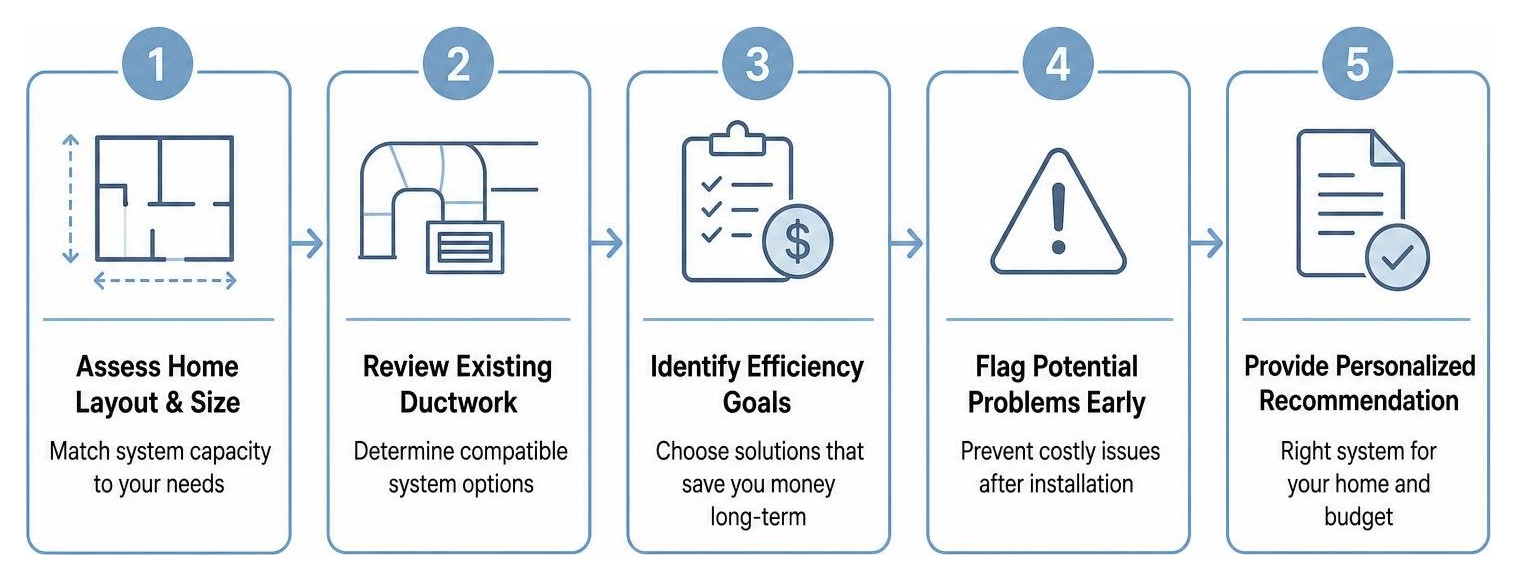
Here is a quick breakdown of what a full consultation does for you:
- Assesses your home’s layout and size to match system capacity to your actual needs
- Reviews your existing ductwork to determine what systems are even compatible
- Identifies efficiency goals so your new system saves you money long-term
- Flags potential problems early before they become expensive mistakes after installation
- Gives you a personalized recommendation instead of a one-size-fits-all quote
Most homeowners in Northern Utah have experienced it — the furnace quits on a cold January night, or the AC struggles through a July heat wave, and suddenly you need answers fast. The temptation is to go with whoever responds first and pick the cheapest option on the table.
That approach carries real risk. Research consistently shows that 65% of enterprise software implementations fail to deliver expected outcomes, and the same pattern holds true in home systems: rushing a selection without proper assessment leads to mismatched equipment, poor performance, and costs that far exceed what a careful upfront consultation would have prevented.
A full consultation is not a sales pitch. It is a structured discovery process — one that puts your home, your comfort needs, and your budget at the center of every recommendation.
Basic how a full consultation helps you choose the right system vocab:
Understanding the Three Primary Models of Consulting
To understand why a comprehensive home system consultation is so valuable, it helps to look at how professional advisors solve problems. In the business world, consultants generally operate under three primary models: the Expert Model, the Doctor-Patient Model, and Process Consultation. Each model has different underlying assumptions, dynamics, and long-term outcomes.
| Consulting Model | Core Assumption | Client’s Role | Long-Term Outcome |
|---|---|---|---|
| Expert Model | “I have the specialized knowledge; I will tell you exactly what you need.” | Passive recipient of a pre-packaged solution. | High dependency on the outsider; low internal learning. |
| Doctor-Patient Model | “You tell me the symptoms, I will diagnose the illness and write a prescription.” | Answers questions but leaves the diagnosis entirely to the advisor. | Moderate alignment; the client may not fully own or understand the cure. |
| Process Consultation | “We will work together to diagnose the situation, build your internal capability, and choose the right path.” | Active partner in discovery, decision-making, and implementation. | High ownership, long-term self-development, and deep understanding of the system. |
The Expert Model
In the Expert Model, a client hires an advisor to perform a specific, highly technical task. The client assumes they know what the problem is, and the consultant simply provides the technical answer. In home services, this is like calling a company and saying, “I need a 3-ton AC unit,” and having them deliver it without asking questions. If the underlying issue was actually poor insulation or leaky ducts, the “expert” solution fails because the problem was misdiagnosed from the start.
The Doctor-Patient Model
In the Doctor-Patient Model, the client knows something is wrong but doesn’t know how to fix it. They ask the advisor to examine the situation, diagnose the issue, and prescribe a solution. While this is more collaborative, it still places the bulk of the accountability on the outsider. If the “patient” doesn’t fully understand why the prescription was written, they may struggle to maintain the system over time.
Process Consultation: The Gold Standard for Long-Term Success
For organizations and homeowners who want to build long-term internal capability, ownership, and self-development, Process Consultation is by far the best model.
Instead of swooping in with a generic recommendation, a process consultant works alongside you to map out your unique situation. This model assumes that you know your home or business better than anyone else, while the consultant knows the technical systems. By combining these two areas of expertise, you co-create a solution.
When applied to home comfort, a process-driven consultation leaves you more capable of managing your energy use, highly aware of how your home’s thermal envelope operates, and oriented toward true ownership of your comfort. You aren’t just buying a metal box; you are understanding how that box interacts with your lifestyle.
How Structured Frameworks and Firm Structures Guide Complex Decisions
Whether a consulting firm is helping a corporation restructure or a local family-owned business is helping a homeowner design a heating and cooling system, structured thinking is what separates guessing from engineering.
Professional advisors rely on proven frameworks to break down messy, complicated problems into actionable solutions:
- MECE (Mutually Exclusive, Collectively Exhaustive): This principle ensures that when we evaluate a problem, we break it down into distinct categories that do not overlap, leaving no stone unturned. In home comfort, this means separating your system needs into distinct buckets: heating capacity, cooling capacity, ventilation, and air filtration.
- McKinsey 7-S Framework: This tool looks at how strategy, structure, systems, shared values, style, staff, and skills align. If one element is out of sync, the whole organization suffers. Similarly, in a home, if your new high-efficiency AC (system) is paired with clogged, undersized ductwork (structure), the system cannot perform.
- Porter’s Five Forces: Used to analyze industry dynamics and competitive pressures, this framework helps businesses understand external forces. For a homeowner, your “external forces” are local weather extremes, rising utility costs, and home insulation levels.
- BCG Growth-Share Matrix & Ansoff Matrix: These strategic tools help balance product portfolios and chart growth strategies. They teach us to balance immediate needs (like fixing an active breakdown) with long-term investments (like transitioning to a modern heat pump).
How these solutions are delivered also depends on the organizational structure of the firm you hire:
- The Solo Expert: A single specialist who offers highly personalized service but has limited bandwidth and resources.
- The Boutique Partnership: A close-knit group of experienced professionals who focus on high-quality, customized delivery, low overhead, and deep client relationships.
- The Leveraged Pyramid: Large national firms built around senior partners who sell the work, while junior, less-experienced technicians or associates actually deliver the service.
As a family-owned business with over 40 years of local experience in Northern Utah, we operate much like a boutique partnership. We don’t send high-pressure sales reps who belong to a corporate pyramid. Instead, our senior, highly trained technicians handle your consultation directly, ensuring that the team designing your system is the same team installing it.
To explore how these structured decisions impact your cooling options, take a look at The Ultimate Guide to Choosing the Right AC for Your Home.
How a Full Consultation Helps You Choose the Right System
When you invest in a new home comfort system, you are making a decision that will affect your daily comfort, indoor air quality, and utility bills for the next 15 to 20 years. This is why how a full consultation helps you choose the right system is so critical. It moves you away from guesswork and toward data-driven certainty.
A professional consultation begins with a comprehensive home analysis. We don’t just look at your old equipment and copy the model number. We evaluate:
- The total square footage and volume of your home
- The orientation of your house relative to the Utah sun
- The quality and depth of your attic and wall insulation
- The age, type, and sealing of your windows
Your existing ductwork is another massive factor. If your ducts are leaky, uninsulated, or poorly routed, installing a new, high-efficiency system will not deliver the comfort or savings you expect. To learn more about this, check out An Essential Guide to How Your Existing Ductwork Affects Your AC Choices.
Additionally, minor home improvements can drastically reduce the workload on your heating and cooling equipment. A thorough consultation will identify these opportunities, helping you understand how simple adjustments like shading, insulation, and sealing can lower your overall equipment sizing needs. For a practical look at this, read the Beginners Guide to How Shade Insulation Sealing Reduce AC Workload.
Why a full consultation helps you choose the right system for your home layout
Every home layout presents unique thermodynamic challenges. A split-level home in Layton has very different airflow requirements than a historic, high-ceiling property in Ogden or a sprawling ranch-style home in West Haven.
During a consultation, we analyze your home’s layout to determine how air moves through the space. This analysis helps us recommend the right configuration:
- Ducted Central Systems: Ideal for homes with existing, well-designed ductwork that need uniform heating and cooling across all rooms.
- Ductless Mini-Splits: Perfect for older homes without ductwork, home additions, or resolving stubborn hot and cold spots in specific rooms.
Understanding these structural differences is key to making a smart investment. You can dive deeper into these choices with The Complete Guide to Mini Split vs Central AC and explore the practical trade-offs in The Cold Hard Truth About Ductless vs Ducted Cooling Pros and Cons.
How a full consultation helps you choose the right system based on efficiency goals
Everyone wants a lower utility bill, but the highest-efficiency system on the market isn’t always the most practical choice for every budget or home type.
A full consultation helps you calculate the real-world return on investment for different efficiency tiers (measured in SEER2 for cooling and AFUE for heating). We look at your usage patterns, how long you plan to stay in your home, and your local climate conditions in Northern Utah to find the sweet spot where equipment efficiency aligns with your financial goals.
For a detailed breakdown of how these choices affect your wallet, see our Beginners Guide to Mini Split vs Central AC Cost Comparison.
Navigating Service Levels: Consultation vs. Full-Service Design
When embarking on a home improvement project, you often have to choose between different levels of professional assistance. A helpful comparison can be found in home design, where clients choose between an interior design consultation and full-service design.
- Design Consultation: This is a short-term, highly focused engagement. The professional assesses your space, answers your questions, and provides a clear, actionable roadmap or design plan. However, the client remains the “project manager” who coordinates contractors and executes the plan.
- Full-Service Design: This is an end-to-end, turnkey solution. The designer handles everything from initial concept and sourcing to contractor management and final installation. The client’s day-to-day involvement is minimal.
In the HVAC industry, we offer a similar spectrum of care. Some homeowners simply need a professional consultation to diagnose a comfort issue or verify which system type is compatible with their home, planning to manage the project steps over time. Others want a complete, full-service design and installation where our team handles every detail from heat load calculations to final permitting and duct sealing.
Determining which level is right for you depends on your project’s complexity, your budget, and how much time you want to spend managing the details. To help you weigh these options and evaluate proposals, refer to A Practical Guide to Comparing AC Quotes Effectively.
Avoiding System Selection Pitfalls and Integrator Red Flags
Rushing into a major system installation without an independent, thorough consultation often leads to disaster. In the enterprise world, software and system integration failures are incredibly common:
- 65% of enterprise software implementations fail to deliver expected business outcomes.
- Only 31% of IT projects complete successfully on time and on budget.
- 72% of organizations report that the vendor they selected did not meet expectations.
- The average final cost of a failed system implementation is 3 to 5 times that of a successful one.
These statistics highlight a universal truth: when you buy a complex system based on a polished sales pitch rather than a rigorous requirements analysis, you risk major failure.
In the home services industry, these same pitfalls present themselves as “red flags” when choosing an installation partner:
- The “One-Size-Fits-All” Proposal: The technician recommends a system size based solely on your home’s square footage, without performing a proper Manual J heat load calculation.
- The Bait-and-Switch: The senior specialist who sold you the system is nowhere to be found on installation day, leaving the work to unsupervised, inexperienced apprentices.
- Vague Scope of Work (SOW): The contract does not clearly define what “done” means, leaving out critical details like duct sealing, electrical upgrades, or warranty registration.
- The Unusually Low Bid: A price that is significantly lower than other estimates usually indicates that the provider is cutting corners, skipping permits, or using sub-standard materials.
Protecting yourself from these risks requires working with a certified, experienced provider who backs their work with clear, written guarantees. For a step-by-step guide on what to look for, read our A-Z Guide to Choosing an HVAC Provider with Warranty.
Frequently Asked Questions About Home System Consultations
What is the difference between a quick quote and a full system consultation?
A quick quote is typically a rough estimate based on minimal information, such as your home’s square footage or the size of your existing unit. It does not account for your home’s unique layout, ductwork condition, insulation levels, or personal comfort goals.
A full system consultation is a comprehensive, on-site assessment. We perform detailed load calculations, inspect your existing infrastructure, and discuss your daily habits and efficiency goals to design a custom solution tailored specifically to your home.
How does existing ductwork impact the type of heating or cooling system I can install?
Your ductwork is the circulatory system of your home. If your ducts are too small, poorly routed, or severely leaking, they cannot handle the airflow required by a modern, high-efficiency central air conditioner or furnace.
During a consultation, we inspect your ductwork to ensure it can support your new system. If your ducts are compromised, we can discuss duct repair, sealing, or transitioning to a ductless mini-split system.
Why do so many large-scale system implementations fail without independent advice?
Most system failures occur because of a misalignment between the sales team and the delivery team. Sales representatives are motivated to close the deal and often present idealized solutions that ignore real-world complexities.
An independent, consultative approach focuses on objective requirements, identifying potential integration bottlenecks, structural limitations, and usage goals before any equipment is purchased or installed.
Conclusion
Choosing a new heating and cooling system is one of the most significant investments you will make for your home. Rushing the process or relying on a generic, over-the-phone quote often leads to mismatched equipment, high energy bills, and chronic comfort issues.
At Anderson HVAC, we believe in doing things right the first time. As a family-owned business with over 40 years of experience serving North Ogden and the surrounding Northern Utah communities, we treat your home comfort as our top priority. We don’t use high-pressure sales tactics or send inexperienced technicians to your door. Our process-driven consultations are designed to help you understand your options, maximize your energy efficiency, and choose a system that fits your lifestyle perfectly.
Whether you live in Brigham City, Layton, Kaysville, or right here in North Ogden, we are ready to help you achieve lasting home comfort.
Schedule your professional home comfort consultation with Anderson HVAC today and experience the difference that personalized, expert service can make for your home.

