


Which Is Cheaper: Mini Split or Central AC?
When it comes to the mini split vs central AC cost comparison, the answer depends on one key factor: whether your home already has ductwork in good condition.
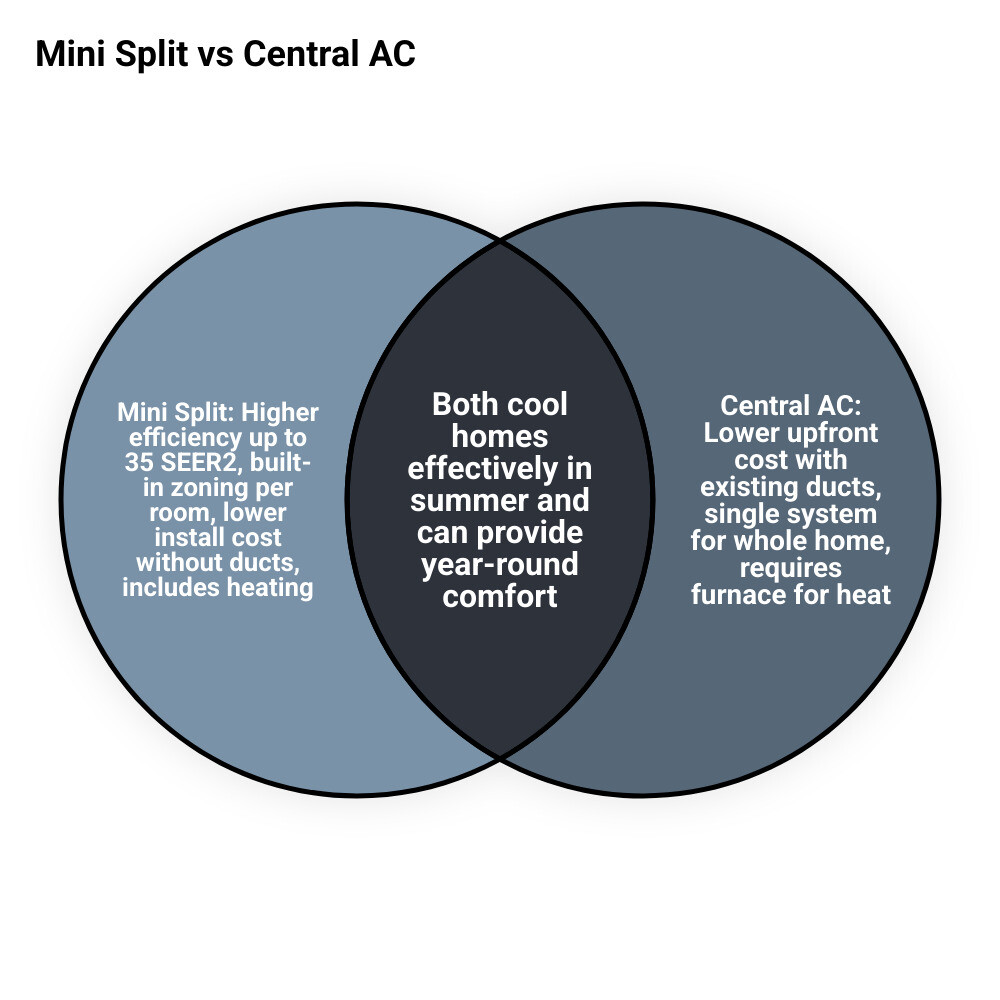
Here is a quick breakdown to help you decide:
| Factor | Mini Split | Central AC |
|---|---|---|
| Home has good existing ducts | Higher upfront cost | Lower upfront cost |
| Home has no ductwork | Much cheaper overall | Very expensive (duct installation adds thousands) |
| Energy efficiency | Higher (up to 35 SEER2) | Lower (typically 14–21 SEER2) |
| Zoning control | Built-in, room by room | Limited without add-ons |
| Heating included | Yes (most models) | Requires separate furnace |
| Best for | Additions, older homes, no ducts | Homes with solid existing ductwork |
If your home in North Ogden or anywhere across Northern Utah already has ducts in solid shape, central AC is usually the more affordable option upfront. If your ducts are old, leaky, or nonexistent, a ductless mini split can save you a significant amount of money — both at installation and on your monthly energy bill.
The U.S. Department of Energy estimates that duct systems lose 20 to 30 percent of conditioned air through leaks and poor insulation. That means even a high-efficiency central AC unit can underperform a mid-range mini split in real-world conditions.
This guide walks you through every side of that comparison — from upfront installation costs to long-term efficiency, maintenance, heating capability, and resale value — so you can make a confident decision for your home and budget.
The Core Differences: How Ductless and Central Systems Work
To truly understand how the financial side of this decision shakes out, it helps to look under the hood of both systems. While both are designed to keep your home cool and comfortable during our hot Northern Utah summers, they go about it in very different ways.
Traditional central air conditioning relies on a forced-air system. This setup consists of a single, large outdoor condenser unit paired with an indoor air handler (often integrated with your furnace). The system cools the air in one central location and then uses a powerful blower fan to push that conditioned air through a network of metal or flexible ducts hidden behind your walls, ceilings, or floorboards.
Because a central AC system relies on a single thermostat, it usually operates on an “all-or-nothing” basis. When the temperature in your living room rises, the entire system kicks on, cooling every single room in the house—regardless of whether anyone is currently using them.
Ductless mini splits, on the other hand, completely bypass the need for ductwork. Instead of one massive indoor unit, a mini split system features small, individual indoor air handlers mounted directly on the walls or ceilings of specific rooms or “zones.” These indoor heads are connected to a single outdoor condenser via thin copper refrigerant lines, electrical wiring, and a condensate drain line. These lines require only a small, three-inch hole through your exterior wall to connect.
The secret weapon of the mini split is its inverter technology. While traditional central AC systems use single-stage compressors that repeatedly turn on at 100% capacity and shut off entirely (similar to driving a car in stop-and-go traffic), mini splits use variable-speed compressors. This technology acts like cruise control, constantly adjusting the compressor speed to maintain a perfectly steady temperature.
This difference in operation has a major impact on wear and tear. If you want to dive deeper into how these mechanical differences affect your regular upkeep, check out our guide on The Great Debate of Heat Pump vs AC Maintenance.
Analyzing the Mini Split vs Central AC Cost Comparison
When comparing the upfront financial investment of these two systems, looking at the equipment price tags alone will not give you the full picture. The true cost of installation depends heavily on labor requirements, the layout of your home, and how much structural renovation is needed to complete the project.
A central air conditioning unit is a highly centralized system. If your home is already set up for it, installing a replacement unit is a relatively straightforward job for a professional team. However, if you are starting from scratch or need to make major changes to your home’s layout, the complexity of the installation can quickly escalate. For those navigating these decisions in Davis County, you can find helpful tips on keeping your investment manageable in our article on Don’t Sweat the Price: Finding Affordable AC Replacement in Clearfield.
With mini splits, the upfront equipment cost scale is different. Because you are purchasing individual air handling units for different rooms, the complexity scales with the number of “zones” you want to create. A single-zone system for a home office is a quick, minimally invasive installation. A multi-zone system for a larger home requires careful planning of refrigerant line runs, condensate drainage, and electrical connections for each head, which increases the labor hours required.
How Existing Ductwork Impacts Your Mini Split vs Central AC Cost Comparison
The presence, absence, or physical condition of ductwork is the single most important factor in the mini split vs central AC cost comparison.
If your home does not have existing ductwork—which is common in historic homes throughout Northern Utah, older homes built before central heating was standard, or homes relying on radiant baseboard heat—retrofitting ducts is a massive undertaking. Installing a brand-new network of metal ductwork requires cutting open plaster walls, dropping ceilings, sacrificing closet space, and rebuilding drywall afterward. This structural remodeling can easily double or triple the total cost of your HVAC project. In this scenario, a ductless mini split is almost always the more affordable and sensible option, as it completely avoids invasive construction.
Even if you do have existing ductwork, it is vital to have it inspected before assuming central AC is the automatic winner. Over time, ducts sag, seals break, and insulation degrades. If your ductwork is older or poorly designed, it can suffer from significant air leaks and energy waste. Replacing or extensively repairing damaged ductwork adds a substantial hidden cost to a central AC installation.
If you are trying to weigh these structural factors for your home, you can find a comprehensive breakdown of the installation process in our guide on Everything You Need to Know About New AC Installation in Kaysville UT.
Zoning and Home Layout Factors in Your Mini Split vs Central AC Cost Comparison
Your home’s layout and how you actually use your living space should also guide your financial decision. Traditional central AC systems treat your entire house as one single zone. This can lead to significant energy waste when you are cooling empty guest rooms, formal dining areas, or basement storage spaces just to keep your master bedroom comfortable at night.
Mini splits offer built-in, room-by-room zoning control. Each indoor wall unit has its own thermostat, allowing you to turn off the cooling in unoccupied rooms or set different temperatures throughout the house. For example, if you work from home, you can cool only your home office during the day rather than running a massive central system to cool all two thousand square feet of your house. This targeted cooling can reduce your monthly energy usage by 30 to 40 percent compared to a ducted system.
This zoning flexibility makes mini splits the undisputed champion for specific home layouts, such as:
- Room additions: Extending ductwork to a new sunroom or master suite can throw your existing central system out of balance.
- Finished basements or attics: These spaces naturally have different heating and cooling needs than the main floor.
- Older multi-story homes: Where the upper floor always stays uncomfortably warm while the main floor is freezing.
To explore how system sizing and home layouts interact during planning, take a look at The Homeowner’s Roadmap to AC Installation in Brigham City UT.
Long-Term Financial Factors: Efficiency, Lifespan, and Maintenance
To find the true value of your HVAC investment, you have to look past the day of installation and calculate the total cost of ownership over the next fifteen to twenty years. This includes looking at monthly utility bills, expected system longevity, and the cost of routine maintenance.
Energy efficiency is measured by the Seasonal Energy Efficiency Ratio 2 (SEER2) rating. The higher the SEER2 rating, the less electricity the system uses to cool your home. Thanks to inverter-driven compressors and the complete elimination of duct-related energy losses, modern mini split systems achieve exceptional efficiency ratings, with premium models reaching up to 35 SEER2. Traditional central AC units, while much more efficient than they were a decade ago, typically top out around 26 SEER2, with most standard models falling between 14 and 21 SEER2.
When you factor in that central systems lose up to 30% of their cooling power through duct leaks, the real-world efficiency gap becomes even wider. Over a decade of hot Utah summers, these monthly utility savings can help offset the initial installation premium of a high-efficiency system. For more insights on balancing upfront replacement choices with long-term operating costs, read about The Secret to Finding Affordable Heating Replacement in Clearfield UT.
Here is a side-by-side comparison of the long-term performance metrics for both systems:
| Performance Metric | Ductless Mini Split | Central AC |
|---|---|---|
| Typical SEER2 Ratings | 18 to 30+ (Premium up to 35) | 14 to 21 (Premium up to 26) |
| Duct Energy Losses | 0% (Ductless design) | 20% to 30% (Leaky/uninsulated ducts) |
| Average Lifespan | 15 to 20+ years | 12 to 15 years |
| Routine Maintenance | Filter cleaning every 2-4 weeks; annual coil cleaning | Filter replacement every 1-3 months; annual professional tune-up |
| Zoning Savings Potential | High (Independent room control) | Low (Requires expensive motorized dampers) |
Heating Capabilities and Year-Round Value
Another major factor in the mini split vs central AC cost comparison is year-round utility. Traditional central air conditioners are strictly one-way systems—they only provide cooling. To keep your home warm during our freezing Northern Utah winters, you must pair your central AC with a separate heating system, typically a gas-fired or electric furnace.
Most modern mini splits, however, are heat pumps. By using a reversing valve, they can run in reverse during the winter, absorbing ambient heat from the outdoor air and pumping it indoors to heat your home. High-performance, cold-climate mini splits can operate efficiently even when outdoor temperatures drop well below freezing.
By choosing a mini split heat pump, you are essentially purchasing a two-in-one heating and cooling system. This can completely eliminate the need to buy or maintain a separate furnace, which reshapes the financial math of your home comfort investment. If you are planning a full system overhaul, you can find valuable advice on heating options in The Ultimate Guide to the Best Heating Installation in Brigham City UT.
Tax Credits, Rebates, and Resale Value
As of June 2026, federal and state incentives make upgrading to energy-efficient HVAC equipment more financially attractive than ever. Under the federal Inflation Reduction Act’s Section 25C tax credit, homeowners can claim up to 30 percent of the cost of qualifying heat pump installations, capped at a maximum credit of $2,000 per year. Because most mini splits qualify as high-efficiency heat pumps, they are highly eligible for these substantial tax savings. Traditional cooling-only central AC units generally qualify for lower credit tiers, typically capped around $600.
When it comes to home resale value, both systems offer clear benefits, but they appeal to buyers in different ways:
- Central AC: This is a universally expected feature for many home buyers. Having a reliable, whole-home ducted system can add up to 10% to a home’s resale value and makes a property much more competitive on the real estate market.
- Mini Splits: While some traditional buyers are still getting used to the look of wall-mounted indoor units, modern buyers increasingly prioritize energy efficiency, low utility bills, and personalized room-by-room climate control. In older or historic homes where adding ducts would ruin architectural charm, a multi-zone mini split is viewed as a premium, high-tech upgrade.
Frequently Asked Questions About Home Cooling Options
Deciding on a new HVAC system is a major decision for any homeowner. Here are some of the most common questions we hear from families across Northern Utah as they weigh their options.
Is a mini split more efficient than central AC?
Yes, in almost all residential applications, a ductless mini split is significantly more efficient than a traditional central AC system. This efficiency advantage comes down to two main engineering benefits. First, mini splits have zero duct loss. Traditional ducted systems lose an average of 20 to 30 percent of their conditioned air through tiny cracks, loose joints, and uninsulated duct runs in hot attics or crawlspaces. Mini splits deliver cooled air directly into the room, completely eliminating this waste.
Second, mini splits utilize advanced inverter-driven compressors. Instead of constantly cycling fully on and off like a traditional central system, the mini split’s compressor runs continuously at a very low, highly efficient speed to maintain your desired temperature. This eliminates the massive energy spikes associated with starting up a single-stage compressor. If your current ductless system is underperforming or needs a professional look, you can read about why timely care matters in Why Your Kaysville Home Needs Professional Ductless AC Repair Right Now.
Can a mini split replace a traditional furnace?
Yes, a multi-zone mini split heat pump system can serve as your primary, year-round heating and cooling source, potentially replacing a traditional furnace entirely. Modern cold-climate heat pumps are designed to extract heat from the outdoor air even in freezing temperatures.
However, because Northern Utah winters can be exceptionally cold, some homeowners choose a hybrid approach. They keep their existing furnace as a backup heating source for the coldest days of the year and use their highly efficient mini split heat pump for moderate winter days and summer cooling. If you want to explore how to keep a ductless system running efficiently year-round, check out Your Harrisville Ductless Air Conditioning Repair Roadmap.
Which system is quieter to operate?
Mini splits are the clear winner when it comes to whisper-quiet operation. Traditional central AC systems rely on a large indoor blower fan to push air through yards of ductwork, which often creates a noticeable rushing wind sound or a deep hum when the system kicks on.
With a mini split, the loudest components—the compressor and condenser fan—are located outside your home. The indoor wall-mounted air handlers use small, highly optimized tangential fans that operate at decibel levels as low as 19 dB (which is quieter than a soft whisper or rustling leaves). Even the outdoor units of a mini split are engineered to run much quieter than a traditional central AC condenser. For those living in close-knit communities, keeping things quiet is a major plus. You can find more tips on keeping your system running smoothly and quietly in West Point’s Best Kept Secrets for Reliable Ductless AC Repair.
Conclusion
Choosing between a ductless mini split and a traditional central AC system is not about finding the “perfect” system—it is about finding the right fit for your home’s unique layout, your family’s comfort goals, and your long-term budget.
At Anderson HVAC, we have been helping our neighbors across Northern Utah navigate these comfort decisions for over 40 years. As a family-owned business based in North Ogden, we take pride in delivering personalized, honest advice and high-quality craftsmanship. Whether you are looking to preserve the historic charm of a home in Brigham City, add targeted comfort to an addition in Kaysville, or upgrade your existing system in Clearfield, we are here to help you design a custom comfort solution that exceeds your expectations.
If you are dealing with a system that needs immediate attention, you can find localized guidance in Your Local Guide to Ductless Mini Split Repair Services in Morgan.
Ready to discover the perfect cooling solution for your home? Schedule a consultation for professional ductless HVAC services in North Ogden, UT with our experienced team today, and let our family take care of yours!

