


Why Choosing the Right AC for Your Home Matters More Than You Think
Knowing how to choose the right AC for your home can be the difference between staying cool all summer and dealing with sky-high energy bills, constant breakdowns, and rooms that never quite reach the right temperature. Whether you’re replacing an aging system or cooling a home for the first time, the choices you make upfront — system type, size, efficiency rating — will affect your comfort and your wallet for the next decade or more.
Here in Northern Utah, summers in communities like North Ogden, Layton, and Farmington can push temperatures well into the 90s. Getting this decision wrong is a costly mistake. Nearly half of all residential AC systems are the wrong size, and most are too big — which means millions of homeowners are paying more than they should, every single month.
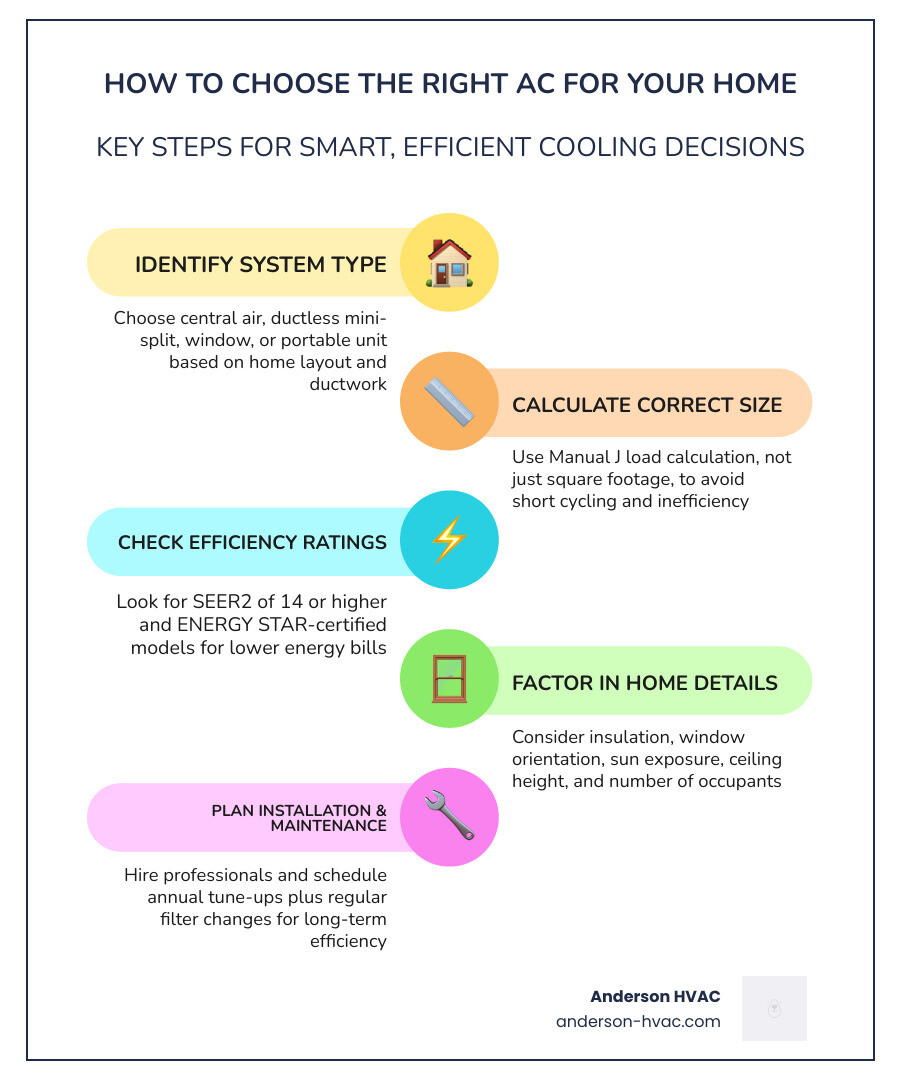
Here’s a quick overview of the key steps to choosing the right AC:
- Identify the right system type — central air, ductless mini-split, window unit, or portable unit — based on your home’s layout and existing ductwork.
- Calculate the correct size using a Manual J load calculation, not just square footage alone.
- Check efficiency ratings — look for SEER2 of 14 or higher, and consider ENERGY STAR-certified models.
- Factor in your home’s details — insulation quality, window orientation, sun exposure, ceiling height, and number of occupants all affect how much cooling you actually need.
- Plan for professional installation — improper installation can undercut even the best equipment.
- Set up a maintenance routine — clean filters, sealed ducts, and annual tune-ups keep your system running efficiently for years.
This guide walks you through every one of these steps in plain language, so you can make a confident, informed decision — and avoid the most common and expensive mistakes homeowners make.
Understanding Different Types of Air Conditioners
The very first decision in system selection is determining which type of air conditioner fits your home’s physical layout and your family’s lifestyle. Not every home is built to accommodate a massive ducted system, and conversely, a series of small window units might not be the most practical choice for a sprawling multi-story house.
When you begin looking into Everything You Need to Know About New AC Installation in Kaysville UT, you will quickly find that residential cooling solutions generally fall into three primary categories: ducted central air, ductless mini-splits, and localized single-room units.

To help you visualize how these options compare, here is a breakdown of the most common air conditioning systems:
| AC System Type | Best Suited For | Installation Complexity | Key Advantage | Major Drawback |
|---|---|---|---|---|
| Central Air Conditioning | Whole-house cooling with existing ductwork | High (Requires professional design) | Consistent, even temperatures throughout | Requires ductwork; energy lost in ducts |
| Ductless Mini-Split | Zoned cooling, renovations, homes without ducts | Medium (Requires professional outdoor/indoor link) | Incredible energy efficiency and precise zoning | Higher upfront equipment cost per zone |
| Window AC Units | Single rooms, apartments, supplemental cooling | Low (DIY-friendly with care) | Affordable and straightforward to replace | Noisy; blocks window views; less secure |
| Portable AC Units | Temporary spaces, rented rooms, window restrictions | Low (Plugs in, vents via window hose) | Extremely mobile; no permanent alterations | Least efficient; takes up valuable floor space |
Central Air Conditioning Systems
Central air conditioning systems are the most popular whole-house cooling method in Northern Utah. These ducted systems operate as split systems, meaning they have an outdoor condenser unit and an indoor evaporator coil (typically sitting on top of your furnace). The system draws warm indoor air through return ducts, cools it by passing it over the cold evaporator coil, and distributes the chilled air back through supply registers.
If your home already has a duct network in place for heating, upgrading or installing a central air unit is often the most logical path. However, if your existing ducts are leaking or poorly designed, you could be wasting 20 to 30 percent of your cooling energy before the air ever reaches your living spaces. If you are looking to replace an old, failing central system, reading up on Everything You Need to Know About AC Unit Replacement in Clinton can help you understand how ductwork evaluations play a pivotal role in your new system’s overall performance.
Ductless Mini-Splits and Zoned Cooling
If your home does not have existing ductwork — or if you have built a new home addition, finished a basement, or converted a garage — a ductless mini-split system is an outstanding choice. These systems utilize an outdoor compressor connected to one or more compact indoor air-handling units mounted directly on your walls or ceilings.
Because they do not rely on ductwork, mini-splits completely eliminate the duct-related energy losses that plague central systems. Furthermore, they allow for highly customized zoned cooling. You can adjust the temperature of individual zones independently, meaning you do not have to waste money cooling empty guest rooms or basement spaces. Their flexible installation and whisper-quiet operation make them a premium comfort solution for modern homes.
Window and Portable Units for Single Rooms
For temporary spaces, apartments, or supplemental cooling in a single room that always stays too hot (like an upstairs home office), window and portable units offer a localized solution.
- Window units are self-contained systems designed to fit into standard double-hung windows. They are relatively simple to install, though they must be sealed tightly with weatherstripping and foam panels to prevent warm air from leaking back inside.
- Portable units sit entirely on your floor and use a flexible plastic hose to vent hot exhaust air through a window. While convenient because they can be rolled from room to room, they are generally the least efficient AC type. Because the entire mechanical system sits inside your living space, they are also significantly noisier and can struggle to cool larger rooms effectively.
How to Choose the Right AC for Your Home: Sizing and Capacity
Once you have selected the type of system that aligns with your layout, the next critical step is determining the correct size. In the HVAC world, “size” does not refer to the physical dimensions of the equipment, but rather its cooling capacity, which is measured in British Thermal Units (BTUs) and tonnage.
Getting the size right is absolutely paramount. As you plan your project, reviewing The Homeowners Roadmap to AC Installation in Brigham City UT will highlight why professional sizing calculations are the foundation of any successful home comfort upgrade.
Calculating BTUs and Tonnage for Your Space
An air conditioner’s cooling capacity is rated in BTUs per hour, representing the amount of heat the unit can remove from your home in a single hour. In larger residential systems, this capacity is often expressed in “tons.” One ton of cooling capacity is equal to 12,000 BTUs per hour. Residential central air conditioners typically range from 1.5 to 5 tons, stepping up in half-ton increments.
As a very basic, rough rule of thumb, an air conditioner requires about 20 BTUs of capacity for every square foot of living space. Below is a general capacity guideline for single-room cooling:
- 150 to 350 sq. ft.: 5,000 to 8,000 BTUs
- 350 to 550 sq. ft.: 8,000 to 12,000 BTUs
- 550 to 1,050 sq. ft.: 12,000 to 18,500 BTUs
- 1,050 to 1,600 sq. ft.: 18,500 to 25,000 BTUs
For whole-house central systems, a simple square footage formula is never enough. A 2,000-square-foot home built in the 1970s with drafty windows will require a vastly different cooling capacity than a highly insulated, modern 2,000-square-foot home built in 2026.
Why Proper Sizing Matters for Humidity and Efficiency
Installing an improperly sized air conditioner can lead to severe comfort and mechanical issues:
- An oversized system will cool your home incredibly fast, causing it to cycle on and off frequently (a phenomenon known as short cycling). Because air conditioners also act as dehumidifiers, they need to run for extended periods to pull moisture out of the air. An oversized unit shuts off before it can lower the humidity, leaving your home feeling cold, damp, and clammy. This constant cycling also wastes energy and causes premature wear and tear on your compressor.
- An undersized system will run constantly without ever reaching your desired indoor temperature. This overworked equipment will spike your monthly utility bills and burn out its components years ahead of its expected lifespan.
If you notice your current system running non-stop but failing to cool, or if you are dealing with other comfort issues, you might need to investigate How to Stop Your AC from Blowing Hot Air to determine if the issue is a mechanical failure or a fundamental sizing problem.
Key Factors Beyond Square Footage
To truly understand how to choose the right AC for your home, you must look beyond simple floor plans. A home is a complex thermal system, and several environmental and structural variables dictate how much heat enters your living spaces daily.
When planning an upgrade, taking the time to read Don’t Sweat the New AC Installation in Farmington UT can help you prepare for a comprehensive home evaluation that looks at the big picture.
How to Choose the Right AC for Your Home Based on Sun Exposure
Solar heat gain is one of the most powerful forces acting against your air conditioner. If your home features large, south- or west-facing windows that receive direct afternoon sunlight, those rooms will absorb a tremendous amount of heat.
When calculating your cooling load, you must adjust your BTU requirements based on sun exposure. For instance, if you are installing a window unit in a highly shaded room, you can reduce the required capacity by 10 percent. Conversely, if the room is exceptionally sunny, you should increase the capacity by 10 percent. Kitchens also require an extra 4,000 BTUs of cooling capacity to offset the heat generated by ovens, ranges, and refrigerators.
The Impact of Insulation and Home Layout
The physical construction of your home plays an enormous role in retaining cool air and keeping heat out:
- Insulation Quality: Homes insulated with modern spray foam or dense fiberglass batts hold conditioned air far better than older homes with settling insulation. Upgrading to double-pane, low-emissivity (Low-E) windows also dramatically reduces heat transfer.
- Home Layout: Open floor plans allow air to circulate freely, which can make them easier to cool with centralized systems but harder to manage with single-room units.
- Multi-Level Homes: Because heat naturally rises, two-story or three-story homes often experience dramatic temperature imbalances. The upper floors can remain uncomfortably hot while the basement feels like an icebox. In these layouts, split-system zoning or supplemental ductless mini-splits are often required to maintain even comfort.
Decoding Energy Efficiency Ratings
Once you know the type and size of the AC you need, you will want to look closely at efficiency ratings. Investing in a high-efficiency system can drastically cut your summer electricity bills, making it well worth the initial investment over the lifespan of the equipment.
If you want a smooth, stress-free upgrade, exploring how to Chill Out with a Seamless AC Install in Harrisville can show you how proper equipment matching maximizes these efficiency metrics.
Understanding SEER vs SEER2
The efficiency of central air conditioners is measured by the Seasonal Energy Efficiency Ratio (SEER). SEER calculates the total cooling output of the system over a typical cooling season divided by the total electrical energy it consumes.
In recent years, the HVAC industry transitioned to a more rigorous testing standard known as SEER2. The SEER2 testing protocol utilizes higher external static pressure to mimic the real-world conditions of home ductwork more accurately.
- The minimum SEER2 allowed for a new split-system central air conditioner in northern regions today is 13.4 (which roughly corresponds to the old 14 SEER standard). This is at least 20 percent more efficient than minimum-efficiency models manufactured a decade ago.
- Standard systems typically fall between 14 and 16 SEER2.
- High-efficiency systems can reach ratings as high as 22 to 26 SEER2. Systems that meet strict ENERGY STAR guidelines must have a minimum SEER2 rating of 15.2.
How to Choose the Right AC for Your Home with High-Efficiency Features
If you want to maximize your energy savings, look for systems that incorporate advanced, modern features:
- Inverter-Driven / Variable-Speed Compressors: Traditional air conditioners are either 100% “on” or completely “off.” They turn on, blast cold air at full capacity, and shut off once the thermostat is satisfied. Variable-speed compressors, powered by inverter technology, can adjust their operating speeds incrementally (anywhere from 25% to 100% capacity). They run continuously at lower, whisper-quiet speeds to maintain a perfectly steady indoor temperature, saving massive amounts of electricity.
- Smart Thermostat Integration: Upgrading to a smart or programmable thermostat can reduce your cooling costs by approximately 10 percent. These devices allow you to set schedules, utilize geofencing to turn down the AC when you leave the house, and track your energy usage. You will save about 3 percent on your utility bill for every single degree you raise your thermostat’s set temperature in the summer!
Preparing for Professional Installation and Maintenance
No matter how advanced or expensive your new air conditioner is, its performance, reliability, and lifespan will ultimately depend on how well it is installed and maintained.
Taking the time to review How to Handle an AC System Replacement in North Ogden Without Losing Your Cool and learning How to Prepare Your Home for AC Replacement will ensure you are fully prepared when the installation team arrives at your door.
What is a Manual J Load Calculation?
A Manual J calculation is the official industry-standard protocol developed by the Air Conditioning Contractors of America (ACCA) to determine the exact heating and cooling load of a home. Rather than relying on simple, lazy “rules of thumb” like square footage, a proper Manual J calculation takes into account:
- The local climate zone and average summer temperatures
- The orientation of your home relative to the sun
- The R-value of your wall, ceiling, and floor insulation
- The total square footage of all windows and their framing materials
- The number of occupants living in the home
- Heat-generating appliances and lighting systems
A major red flag when hiring an HVAC contractor is a technician who glances at your old unit and simply recommends installing the exact same size, or one who calculates your system size based solely on your home’s square footage. Insist on a comprehensive load calculation to protect your investment. If you want to make sure your project starts on the right foot, reviewing Don’t Lose Your Cool During AC Replacement in Huntsville UT will help you understand the technical steps involved in a professional system design.
Essential Maintenance for Long-Term Efficiency
An air conditioner is a major mechanical investment. According to industry data, about 19 percent of central AC systems purchased between 2009 and 2024 encountered at least one significant operational problem, and 24 percent of those units stopped working properly or altogether.
To keep your system running beautifully and avoid costly emergency repairs, follow these simple maintenance best practices:
- Change Your Filters Regularly: Check your air filters monthly and replace them every 1 to 3 months. A clogged, dusty filter restricts airflow, forcing your system to work twice as hard and potentially causing the evaporator coil to freeze over.
- Clear the Outdoor Condenser: Keep the area around your outdoor unit free of debris. Maintain at least 2 to 3 feet of clearance from plants, shrubs, and structures, and clear away falling leaves or grass clippings.
- Use Fans Wisely: Run a ceiling fan (spinning counterclockwise) in the room you are currently occupying. While fans do not actually cool the air, the wind-chill effect can make you feel 3°F to 4°F cooler, allowing you to raise your thermostat setting without sacrificing comfort.
- Schedule Annual Professional Tune-Ups: Have a certified technician inspect your system every spring. They will check refrigerant levels, clean the condenser and evaporator coils, inspect electrical connections, and make sure your system is operating at peak efficiency before the summer heat arrives.
Frequently Asked Questions about Choosing a Home AC
What happens if my air conditioner is too large?
An oversized air conditioner will cool your home very quickly, causing it to cycle on and off frequently (short cycling). This prevents the system from running long enough to dehumidify the air, leaving your home feeling cold and clammy. Short cycling also increases your energy bills, subjects the compressor to excessive wear and tear, and shortens the overall lifespan of the unit.
How much energy can be lost through leaky ducts?
On average, a home can lose 20 to 30 percent of the conditioned air traveling through its duct system due to leaks, loose connections, and poor insulation. Sealing and insulating your ducts keeps you cooler in the summer and warmer in the winter, preventing massive energy waste and reducing the workload on your heating and cooling equipment.
What is the difference between SEER and SEER2?
SEER2 is an updated, more rigorous efficiency testing standard introduced to reflect real-world operating conditions more accurately. While the old SEER test measured system efficiency under perfect laboratory conditions, SEER2 testing accounts for the physical static pressure created by a home’s ductwork. A SEER2 rating is slightly lower numerically than an equivalent SEER rating, but it represents a much more realistic measurement of actual energy efficiency.
Conclusion
Choosing the right air conditioner for your home is a major decision that directly impacts your daily comfort, your monthly utility bills, and your peace of mind for years to come. By taking the time to understand the different types of systems, insisting on a professional Manual J load calculation, and selecting a unit with high-efficiency features, you can ensure your home remains a cool, relaxing sanctuary even during the hottest Northern Utah summer days.
At Anderson HVAC, we have been proudly serving our neighbors in North Ogden, Clinton, Layton, and throughout Northern Utah for over 40 years. As a family-owned and operated business, we are committed to providing personalized, honest service and expert craftsmanship that exceeds your expectations.
When you are ready to upgrade your home’s comfort, let our family take care of yours. Contact us today to learn more about our professional AC installation services in North Ogden and let us help you find the perfect cooling system for your home.

