


Why Knowing What Brand and Efficiency Level Is Right for Your Budget Can Save You Thousands
Figuring out what brand and efficiency level is right for your budget is one of the most important decisions you’ll make as a homeowner — especially in Northern Utah, where summer temperatures can push your AC to its limits for months at a time.
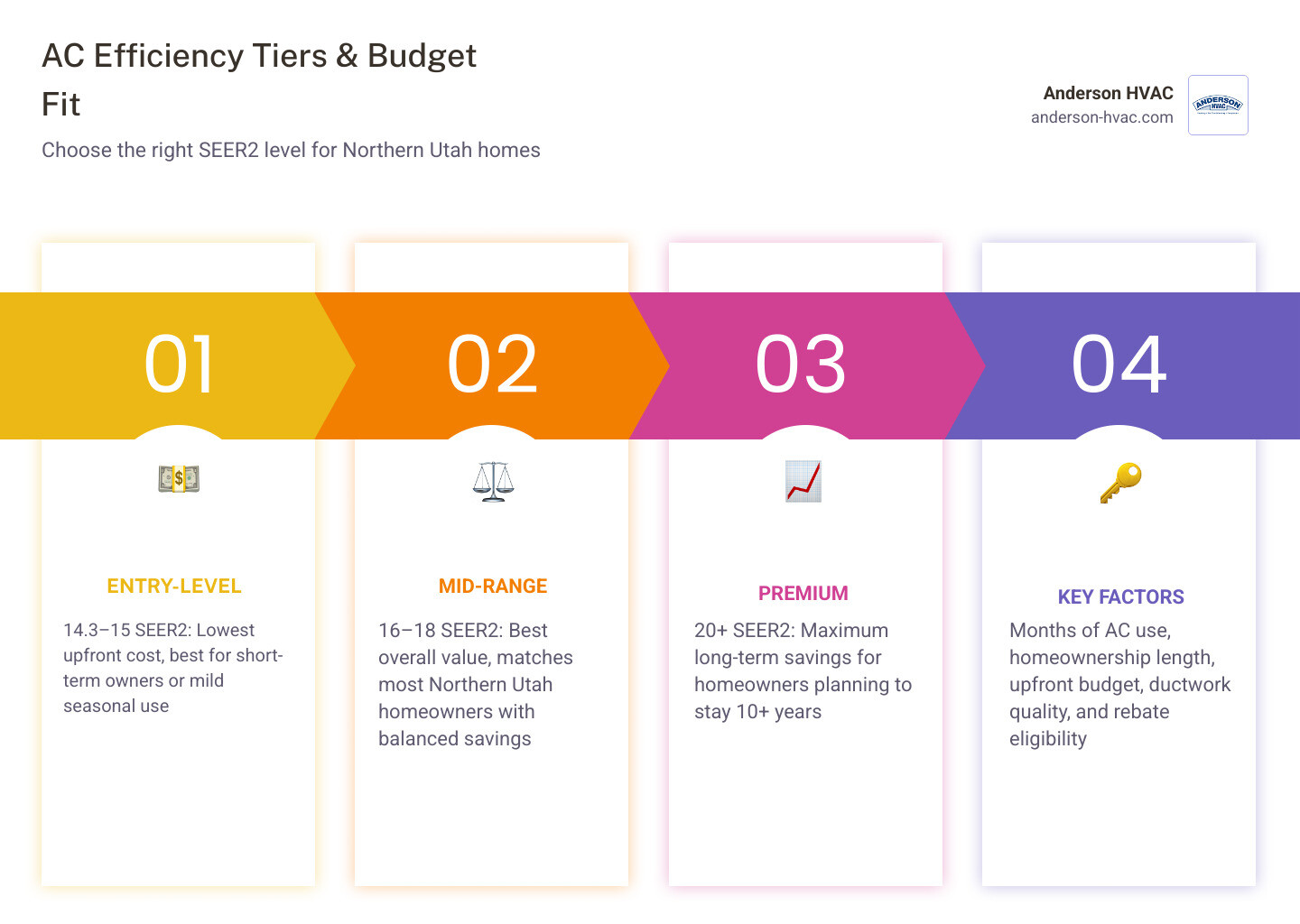
Here’s a quick breakdown to help you decide fast:
| Budget Priority | Efficiency Tier | SEER2 Range | Best For |
|---|---|---|---|
| Lowest upfront cost | Entry-Level | 14.3–15 SEER2 | Short-term owners, mild use |
| Best overall value | Mid-Range | 16–18 SEER2 | Most Northern Utah homeowners |
| Maximum long-term savings | Premium | 20+ SEER2 | Long-term owners, high AC use |
Key factors to consider:
- How many months per year do you run your AC?
- How long do you plan to stay in your home?
- What is your upfront budget vs. your appetite for long-term savings?
- Does your home have well-sealed, properly sized ductwork?
- Are you eligible for federal tax credits or utility rebates?
If you’ve ever stood in your living room in July with the fans running and blinds shut tight, wondering why your energy bill keeps climbing, you’re asking exactly the right question. The honest answer is that the best AC system isn’t always the most expensive one — and it isn’t always the cheapest one either. It’s the one that matches your climate, your home, and how long you plan to live there.
In Northern Utah’s semi-arid climate, where summer heat can stretch across several months, choosing the right efficiency level isn’t just a comfort decision — it’s a financial one that plays out over the 15–20 year lifespan of your system.
What brand and efficiency level is right for your budget vocab to learn:
- how to choose the right ac for your home
- how to compare ac quotes from different companies
- how your existing ductwork affects your ac choices
Determining What Brand and Efficiency Level Is Right for Your Budget
When it comes to budget planning for a new air conditioner, many homeowners focus entirely on the initial purchase price. However, a complete financial strategy balances this upfront investment against your long-term operating costs. A lower-priced, less-efficient system might save you money on installation day, but it will cost you more every month on your utility bills. Conversely, a highly efficient system will reduce your monthly energy consumption but requires a larger initial investment.
To make an informed decision, it helps to read The Ultimate Guide to Choosing the Right AC for Your Home, which breaks down how these factors intersect. To help you visualize the differences between your options, we have outlined the three main efficiency tiers below:
| Efficiency Tier | Typical SEER2 Rating | Compressor Technology | Average Energy Savings | Ideal Homeowner Profile |
|---|---|---|---|---|
| Entry-Level | 14.3 – 15 SEER2 | Single-Stage | Baseline | Budget-conscious buyers, rental properties, or those planning to move soon. |
| Mid-Range | 16 – 18 SEER2 | Two-Stage | 15% – 25% over baseline | Homeowners seeking the best balance of upfront value and ongoing energy savings. |
| Premium | 20+ SEER2 | Variable-Speed (Inverter) | 30% – 50% over baseline | Long-term homeowners who prioritize maximum comfort, quiet operation, and the lowest utility bills. |
When evaluating these tiers, keep this list of key factors in mind to guide your selection:
- Your Climate: Regions with prolonged, intense summer heat benefit far more from higher-efficiency tiers.
- Length of Homeownership: If you plan to stay in your home for many years, you have a much longer window to recoup your investment through lower utility bills.
- The Condition of Your Ductwork: High-efficiency systems require properly sized and sealed ducts to deliver their promised energy savings.
- Available Incentives: Federal tax credits and local utility rebates can significantly lower the net cost of upgrading to a higher tier.
How Climate Affects What Brand and Efficiency Level Is Right for Your Budget
Our local climate along the Wasatch Front features a distinct semi-arid environment. We experience cold, snowy winters followed by hot, dry summers where temperatures frequently soar into the 90s and sometimes exceed triple digits in July and August. This means our cooling systems face a significant workload during the peak summer months, resulting in a high number of cooling degree days.
Because our summers are hot and dry, an air conditioner in cities like Layton, Kaysville, or South Ogden runs consistently for several months. In this type of environment, upgrading from an entry-level system to a mid-range or premium system can yield noticeable differences on your monthly power bills. To learn more about managing your cooling bills during our hottest months, check out The Ogden Homeowner Guide to Slashing AC Costs This Summer.
How Home Tenure Influences What Brand and Efficiency Level Is Right for Your Budget
How long you plan to live in your current home is a major factor in calculating your payback period. The payback period is the amount of time it takes for your monthly energy savings to equal the extra upfront cost of a higher-efficiency system.
If you plan to live in your home in Clearfield, Syracuse, or West Point for only two to five years, you likely won’t be there long enough to fully recover the extra cost of a premium 20+ SEER2 system. In this scenario, an entry-level or standard mid-range system is often the most sensible financial choice. However, if you are in your “forever home” in Huntsville, Morgan, or Mountain Green, a high-efficiency system is a highly rewarding investment. Over its 15-to-20-year lifespan, the cumulative energy savings will easily cover the initial premium and continue to put money back in your pocket. For a deeper dive into how efficiency ratings impact your home’s value and utility costs over time, read our Anderson HVAC Energy Efficient Review 101.
Understanding SEER2 Ratings and Efficiency Tiers
You have likely seen the terms SEER and SEER2 used when shopping for air conditioners. SEER stands for Seasonal Energy Efficiency Ratio. As of 2023, the Department of Energy transitioned to a new testing standard called SEER2.
The main difference is how the systems are tested. The old SEER testing did not accurately account for the air resistance created by a home’s ductwork. SEER2 testing uses five times higher external static pressure to better simulate real-world conditions. This means SEER2 ratings are a much more accurate reflection of how an air conditioning unit will actually perform in your home.
Understanding these ratings helps you make smarter choices about how you run your system. To maximize your savings once your system is installed, you can pair your efficient unit with the advice found in The Definitive Guide to Best Thermostat Strategies for Summer AC Savings.
Recommended Equipment Brands for Every Efficiency Level
Choosing the right brand involves more than just looking at the nameplate. You want to select a brand known for outstanding reliability, excellent warranty coverage, and strong local parts availability. In Northern Utah, having a brand with a robust local distributor network is essential; if a component ever needs replacement during a July heatwave, you do not want to wait days for a part to ship from across the country.
Additionally, you will want to consider whether a traditional split system or a ductless system is best for your home’s layout. For a comprehensive comparison of these two system styles, refer to The Complete Guide to Mini Split vs Central AC.
Reliable Entry-Level and Mid-Range Brands
For homeowners seeking dependable performance without a premium price tag, brands like Goodman and standard-tier Carrier or Daikin models are excellent choices. Goodman, for example, is widely recognized for offering solid, reliable single-stage and two-stage systems that come with exceptional parts warranties when registered properly.
These brands provide straightforward, time-tested technology that is easy to service and maintain. They are ideal for budget-conscious projects, rental properties, or homes with moderate cooling needs. If you are trying to decide between central air and a ductless option on a budget, you can find helpful financial comparisons in our Beginners Guide to Mini Split vs Central AC Cost Comparison.
High-Performance and Variable-Speed Brands
If your goals are maximum energy savings, whisper-quiet operation, and precise temperature control, premium brands like Carrier (especially their Infinity series with Greenspeed intelligence), Daikin (such as the Daikin Fit), and Mitsubishi Electric lead the industry.
These manufacturers specialize in variable-speed inverter technology. Instead of turning completely on and off like a traditional system, a variable-speed compressor can adjust its speed in tiny increments to match the exact cooling needs of your home. This eliminates temperature swings, removes more humidity from the air, and runs so quietly you will barely know it is on. These advanced systems also tend to have longer lifespans when properly cared for. To learn more about maximizing the life of advanced compressor technology, read The Secret to a Long Living Heat Pump.
Maximizing Value Through Proper Installation and Maintenance
It is a well-known industry fact that the most expensive, high-efficiency air conditioner will perform like a budget model if it is installed poorly. Quality installation determines a significant portion of your system’s real-world efficiency and longevity.
A proper installation begins with an accurate Manual J load calculation to ensure the system is perfectly sized for your home. If a system is oversized, it will short-cycle (turn on and off rapidly), which wastes energy and places unnecessary wear on the compressor. If it is undersized, it will run continuously without ever keeping your home comfortable.
Furthermore, sealing leaky ductwork and ensuring proper airflow are critical steps. To keep your newly installed system running at peak efficiency, you must also pay attention to routine maintenance, starting with your air filters. You can discover how filters impact your system’s performance in The Efficiency Secret Choosing the Perfect Filter for Your HVAC.
The Role of Federal Tax Credits and Incentives
One of the best ways to make a high-efficiency system fit your budget is to take advantage of federal tax credits and local utility incentives. Under the Inflation Reduction Act, the Energy Efficient Home Improvement Credit (Section 25C) allows homeowners to claim a tax credit for qualifying high-efficiency central air conditioners and heat pumps.
Additionally, local utilities like Rocky Mountain Power frequently offer cash-back rebates for installing qualifying high-efficiency cooling equipment. When you stack these federal tax credits with local utility rebates, the net cost of upgrading from a standard system to a highly efficient mid-range or premium system becomes much smaller, making the higher-tier options far more accessible.
Common Pitfalls to Avoid When Selecting a System
To get the most value out of your investment, avoid these common home-cooling pitfalls:
- Buying Based on Upfront Price Alone: A cheap system that costs a fortune to run and breaks down frequently is no bargain.
- Skipping the Load Calculation: Never let a contractor guess what size system you need based on square footage alone. Insist on a professional calculation.
- Neglecting the Ductwork: Installing a high-efficiency AC on old, leaky, or undersized ducts will restrict airflow and destroy your energy savings.
- Forgetting About Maintenance: Failing to schedule annual professional tune-ups can void your manufacturer warranty and cause your system’s efficiency to degrade quickly over time.
Frequently Asked Questions about AC Efficiency
What is the difference between SEER and SEER2?
SEER2 is the modern testing standard developed by the Department of Energy to replace the older SEER rating. SEER2 testing uses five times higher external static pressure to better simulate the actual resistance of residential ductwork. This provides a much more accurate representation of how an air conditioner will perform in a real home rather than a laboratory setting.
Which efficiency level qualifies for federal tax credits?
To qualify for federal tax credits under Section 25C, split-system central air conditioners typically must meet specific SEER2 and EER2 requirements (often 16 SEER2 or higher, depending on the region and equipment type). Heat pumps that meet ENERGY STAR criteria also qualify for substantial tax credits. We can help you verify which specific models qualify for these incentives before you make your purchase.
Is a higher SEER2 rating always worth the extra cost?
Not always. A higher SEER2 rating is highly beneficial if you plan to stay in your home for a long time, live in a hot climate, and experience high utility rates. However, if you plan to move in a few years, or if you are installing a system in a home with very low annual cooling usage, a standard-efficiency system may offer a better overall return on your investment.
Conclusion
Finding the perfect balance between your upfront budget and your long-term energy savings does not have to be a stressful process. By evaluating your climate, your home tenure, and taking advantage of available tax credits and rebates, you can select a system that keeps your family perfectly comfortable without breaking the bank.
At Anderson HVAC, we are proud to be a family-owned business serving our Northern Utah neighbors for over 40 years. We specialize in providing personalized, honest guidance to help you find the ideal comfort solutions for your home. Whether you live in North Ogden, Layton, Brigham City, or any of our surrounding communities, we are here to deliver service you can trust.
If you are ready to explore your options and find the perfect cooling system for your home, reach out to us today to schedule your professional AC Installation Services in North Ogden.

