


How Often Should Northern Utah Homes Schedule HVAC Maintenance?
Understanding hvac maintenance frequency for northern utah homes starts with one simple rule: most homes need professional service twice a year — once in spring before cooling season and once in fall before heating season.
Quick Answer: Recommended HVAC Maintenance Frequency for Northern Utah
| System Type | Minimum Service Frequency | Filter Replacement |
|---|---|---|
| Central AC | Once per year (spring) | Every 30–90 days |
| Gas furnace | Once per year (fall) | Every 30–90 days |
| Heat pump | Twice per year (spring & fall) | Every 30–90 days |
| Systems 10+ years old | Twice per year | Monthly checks |
Northern Utah is not a forgiving place for HVAC equipment. Temperatures on the Wasatch Front can swing from below zero in January to over 100°F by July. That kind of extreme range puts continuous stress on your heating and cooling systems — stress that builds up fast when maintenance gets skipped.
The stakes are real. A well-maintained system can last 15 to 20 years. A neglected one often fails in 10 years or less. And regular service is estimated to prevent 70 to 80 percent of HVAC breakdowns before they ever happen.
This guide covers exactly what Northern Utah homeowners need to know — when to schedule service, what gets done each season, what you can handle yourself, and what requires a licensed professional.
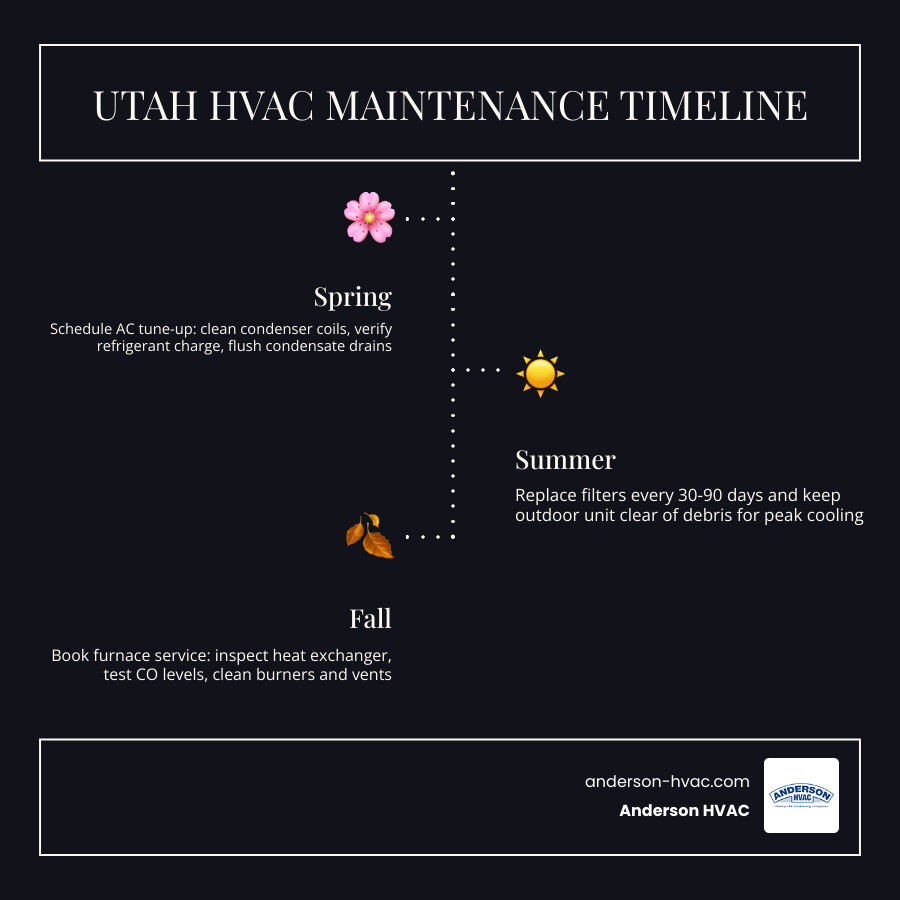
Easy hvac maintenance frequency for northern utah homes word list:
- annual hvac maintenance is it worth it
- how often should you service your hvac
- what does an hvac maintenance visit include
Why Utah’s Climate Demands a Strict Maintenance Schedule
Living along the Wasatch Front — whether you are in Layton, Kaysville, or up in North Ogden — means experiencing some of the most dramatic weather swings in the country. Our unique geographic features directly dictate our heating and cooling needs.
First, consider our high altitude and thin mountain air. At elevations of 4,300 to over 4,800 feet, the air is less dense. This thin air reduces the natural heat transfer efficiency of your heating and cooling equipment. Your system must work harder and move more air to achieve the same temperature control as a system at sea level.
Second, Northern Utah has a dry desert climate characterized by heavy dust loads. In the spring and fall, strong canyon winds whip up fine particulate matter from the West Desert and surrounding agricultural areas. In the winter, we face unique atmospheric inversions that trap PM2.5 particulate matter in our valleys. This airborne debris doesn’t just make the air hazy; it settles directly onto your outdoor AC condenser coils and works its way into your indoor air handler.
Additionally, proximity to the Great Salt Lake introduces a unique variable: salty, alkaline dust that can settle on outdoor units, accelerating the corrosion of delicate aluminum fins.
Finally, we have extreme thermal cycling. It is not uncommon to see daily temperature swings of 30 to 40 degrees in cities like Huntsville or Morgan. Your system might transition from running the furnace at night to cycling the air conditioner by mid-afternoon. This rapid thermal expansion and contraction puts immense physical stress on metal components, electrical connections, and system sensors.
Without regular attention, these factors combine to degrade your system’s performance. In fact, an unserviced AC can lose roughly 5 percent of its operating efficiency every single year. To understand how these regional factors compound over time, take a look at our In-Depth Guide to Annual HVAC Maintenance Value.
Determining the Right HVAC Maintenance Frequency for Northern Utah Homes
When discussing hvac maintenance frequency for northern utah homes, we always emphasize the “twice-yearly rule.” Because our seasons are compressed and extreme, your heating and cooling systems operate under entirely different demands depending on the time of year.
Splitting your maintenance into spring and fall transitions ensures that each system is optimized right before it is asked to do its heaviest lifting. A neglected system works harder, running longer cycles and using more electricity. On the flip side, well-maintained systems operate up to 20% more efficiently.
By keeping up with a twice-yearly schedule, you are not just preventing mid-season breakdowns; you are actively keeping your monthly utility bills in check. For a deeper breakdown of these intervals, read our expert advice on How Often Should You Service Your HVAC?.
How System Type Affects HVAC Maintenance Frequency for Northern Utah Homes
The type of comfort system installed in your home is the primary factor in determining your maintenance schedule:
- Central Air Conditioners & Gas Furnaces (Split Systems): This is the most common setup in places like Clearfield, Syracuse, and Farmington. Because you have two distinct systems — a gas furnace for winter and an outdoor condensing unit for summer — you need two distinct service visits. Your AC should be serviced in the spring (March to May) before the summer heat hits, and your furnace should be tuned up in the fall (September to November) before freezing temperatures arrive.
- Heat Pumps: Heat pumps handle both heating and cooling duties, meaning they run almost year-round. Because they do double duty, heat pumps require professional maintenance twice a year. Skipping a season on a heat pump means it is running on worn components for twelve straight months, which drastically shortens its lifespan. You can learn more about how these demands compare in The Great Debate of Heat Pump vs AC Maintenance and find out why Timing Is Everything for Your Heat Pump Service.
- Evaporative Coolers (Swamp Coolers): Popular in drier valleys below 5,500 feet, evaporative coolers have very specific seasonal needs. They require spring commissioning (uncovering, replacing pads, and turning on water lines) and fall winterization (draining water, shutting off valves, and wrapping the unit) to prevent frozen pipes and rust.
Why Age and Usage Impact HVAC Maintenance Frequency for Northern Utah Homes
As HVAC systems age, their maintenance needs become more critical. If your system is over 10 years old, it has already survived years of harsh Utah winters and hot summers. Older systems naturally experience more wear and tear, meaning electrical contacts wear down, motors lose lubrication, and heat exchangers are more prone to micro-cracks. For older systems, having a professional technician inspect the unit twice a year is the best way to catch minor issues before they turn into system-ending failures.
Furthermore, keeping a strict, documented service history is often a legal requirement to protect your manufacturer’s warranty. Most major HVAC manufacturers require annual professional maintenance to keep parts warranties valid. If a major component like a compressor or heat exchanger fails, and you cannot provide proof of regular professional tune-ups, the manufacturer may deny your warranty claim, leaving you with a hefty repair bill. To keep your system running safely into its second decade, explore The Secret to a Long Living Heat Pump.
Seasonal Maintenance Checklists: Spring vs. Fall Tasks
Timing your seasonal maintenance is all about utilizing the “shoulder seasons.” These are the mild spring and fall months when you aren’t heavily relying on either heating or cooling. Scheduling during these windows ensures you avoid the mid-summer or mid-winter emergency rushes when technicians are busiest.
To set your AC up for success, read about The Best Time to Schedule Your Annual AC Tune-Up and learn how to Prevent Costly Summer Breakdowns with a Professional AC Tune-Up.
Spring Cooling Maintenance Tasks
Before you switch your system to cooling mode, a professional technician should perform several vital checks to ensure peak efficiency:
- Condenser Coil Cleaning: Outdoor coils collect dust, cottonwood seeds, and dirt. A dirty condenser coil can cause a 5% to 15% spike in monthly energy bills because it prevents heat from escaping.
- Refrigerant Charge Verification: Technicians check for correct refrigerant levels using specialized gauges. Incorrect charge levels force the compressor to work harder, leading to premature failure.
- Electrical Connection Tightening: Extreme temperature swings can loosen electrical terminals. We inspect and tighten all connections and test capacitors, which are highly prone to failing during hot July afternoons.
- Thermostat Calibration: We verify that your thermostat is reading indoor temperatures accurately and communicating correctly with your system.
- Condensate Drain Flush: Algae and dust can clog your AC’s drain line, leading to water backups that can damage your ceilings or drywall.
Ensure your technician covers all these bases by reviewing Everything Your HVAC Tech Should Check During a Tune-Up.
Fall Heating Maintenance Tasks
When preparing your furnace for a freezing Utah winter, safety is just as important as efficiency. Our fall checklist includes:
- Heat Exchanger Inspection: This is the most critical safety check. Technicians inspect the heat exchanger for physical cracks or rust. A cracked heat exchanger can allow deadly carbon monoxide gas to leak directly into your home’s air supply.
- Carbon Monoxide Testing: We run combustion analysis tests to ensure your furnace is burning fuel cleanly and safely.
- Burner and Igniter Cleaning: Over the summer, dust settles on burners, which can cause delayed ignition or uneven heating.
- Venting System Inspection: We check flue pipes and chimney drafts to ensure combustion gases are safely venting outside your home.
For a complete look at what we do during these essential visits, read The Ins and Outs of What an HVAC Maintenance Visit Includes.
Homeowner vs. Professional Maintenance: What You Can Safely Do
While professional maintenance is essential for safety and calibration, there are several tasks that you, as a homeowner, can and should perform to keep your system running smoothly. It is all about teamwork: your monthly efforts combined with our professional seasonal visits keep your system in peak condition.
For a complete guide on preventing system strain, check out Stop Heat Pump Headaches Before They Start.
Here is a quick reference table comparing what you can do yourself versus what requires a licensed professional:
| Task | Homeowner DIY | Licensed Professional | Why It Matters |
|---|---|---|---|
| Filter Replacement | Yes | Yes | Keeps airflow steady; prevents system motor strain. |
| Clearing Outdoor Debris | Yes | No | Maintains 2-foot clearance around condenser for airflow. |
| Rinsing Condenser Fins | Yes | Yes | Gentle garden hose rinse removes surface dust. |
| Electrical Diagnostics | No | Yes | High voltage poses severe safety and fire risks. |
| Refrigerant Handling | No | Yes | Requires EPA certification; illegal for DIYers to handle. |
| Heat Exchanger Inspection | No | Yes | Requires specialized cameras and safety training to spot cracks. |
| Combustion Analysis | No | Yes | Measures carbon monoxide; ensures fuel burns safely. |
Air Filter Maintenance in Utah’s Dusty Conditions
In Northern Utah’s dusty environment, air filter maintenance is your system’s first line of defense. Standard 1-inch filters are designed to capture large dust particles, but they can quickly load up to the point of restriction in as little as 30 days during our windy spring and fall seasons.
If you have pets, live near agricultural areas, or suffer from allergies, upgrading to a 4-inch pleated filter can provide superior filtration without restricting airflow. However, higher MERV-rated filters must be monitored closely; if they clog, they restrict airflow, which can cause your AC coils to freeze or your furnace to overheat and shut down.
Always check your filters monthly and replace them at least every 90 days — or every 30 days during peak heating and cooling seasons.
Frequently Asked Questions About Utah HVAC Maintenance
How often should I change my HVAC filter in Northern Utah?
In Northern Utah, you should check your air filter every 30 days. Under normal conditions, a standard filter lasts between 60 and 90 days. However, during periods of high dust, active wildfire seasons, or if you have multiple pets, you should replace your filter every 30 days. Regular replacement keeps your air clean and prevents a 5% to 15% increase in energy consumption caused by dirty, restrictive filters.
Does skipping annual maintenance void my HVAC warranty?
Yes. Almost all major HVAC manufacturers require documented annual maintenance performed by a licensed HVAC contractor to keep your parts warranty valid. If a component fails and you cannot provide service records showing regular professional care, you may have to pay out-of-pocket for expensive replacement parts.
What are the signs that my HVAC system needs immediate professional attention?
You should call a professional technician immediately if you notice any of the following warning signs:
- Unusual Noises: Squealing, banging, or grinding sounds indicate loose belts, failing motors, or broken parts.
- Short-Cycling: If your system turns on and off rapidly without reaching your thermostat’s set temperature, it is overheating or experiencing sensor failure.
- Weak Airflow: Poor air output from your vents often points to a failing blower motor, leaky ductwork, or a severely clogged filter.
- Uneven Temperatures: Rooms that are suddenly much warmer or colder than the rest of the house indicate system imbalance or duct issues.
- Sudden Utility Spikes: A sudden, unexplained jump in your monthly energy bills means your system is losing efficiency rapidly.
Conclusion
When it comes to maintaining your home’s comfort, consistency is key. Keeping up with the proper hvac maintenance frequency for northern utah homes is the absolute best way to lower your energy bills, prevent unexpected breakdowns, and ensure your family stays safe and comfortable all year long.
At Anderson HVAC, we have been serving our neighbors across North Ogden, Layton, Kaysville, Brigham City, and the surrounding communities for over 40 years. As a family-owned business, we are committed to providing personalized service, honest advice, and custom comfort solutions that exceed your expectations.
Ready to get your heating and cooling systems ready for the upcoming season? Contact us today to schedule your seasonal tune-up or to learn about our comprehensive professional HVAC maintenance services in North Ogden. Let our family take care of yours!

