


What an HVAC Maintenance Visit Includes — and Why It Matters for Northern Utah Homeowners
What an HVAC maintenance visit includes is something every homeowner should understand before the seasons change — because knowing what your technician is actually doing makes it easier to protect your system and avoid surprise breakdowns.
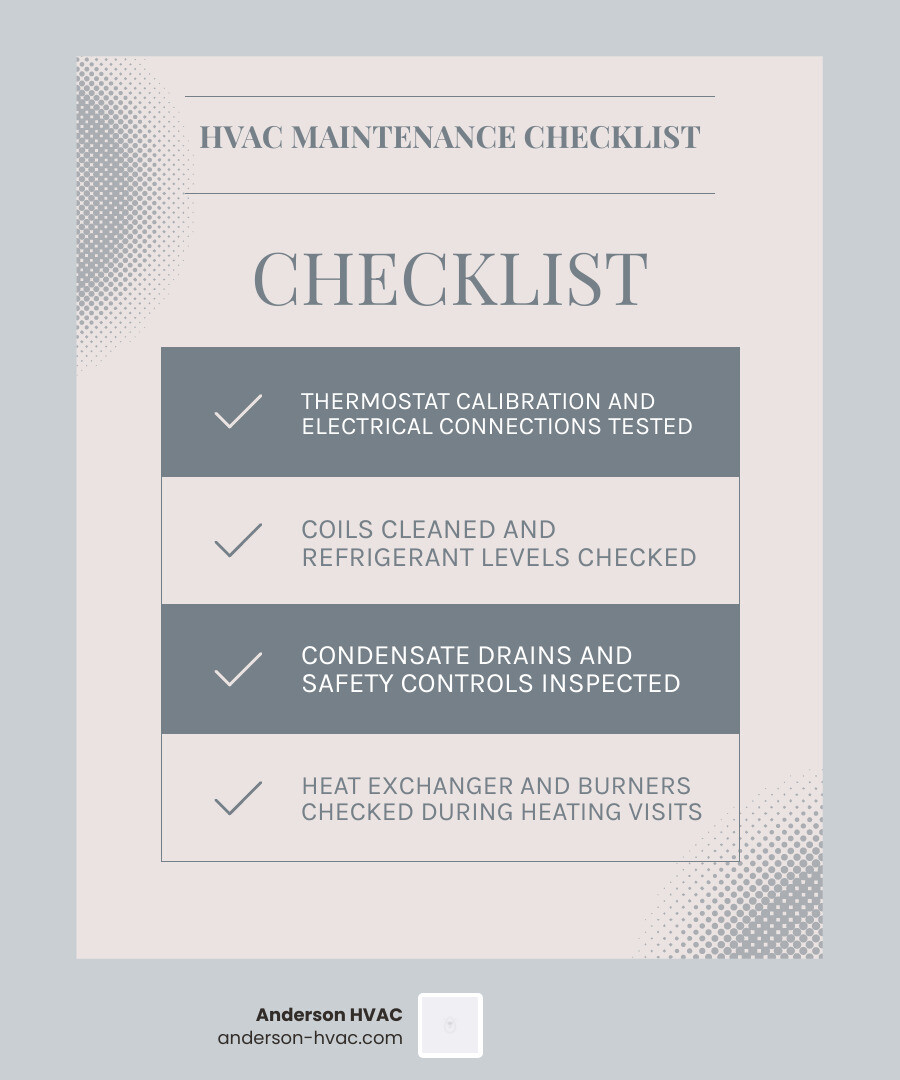
Here is a quick overview of what a standard professional HVAC maintenance visit covers:
- Thermostat calibration — verifying accuracy and proper cycling
- Electrical connections — tightening and testing voltage and amperage
- Coil cleaning — removing buildup from evaporator and condenser coils
- Refrigerant level check — confirming proper charge for peak efficiency
- Condensate drain inspection — clearing clogs that can cause water damage
- Air filter inspection or replacement — restoring airflow and air quality
- Blower motor assessment — checking performance and cleaning components
- Heat exchanger inspection (heating visits) — checking for cracks or corrosion
- Burner and gas connection check (heating visits) — testing combustion and safety
- Safety controls test — verifying all shutoffs and limits work correctly
Most HVAC systems are designed to last 15 to 20 years — but only when they receive regular care. Research shows that preventive maintenance can improve a system’s lifetime by up to 48% and prevent yearly efficiency losses of up to 15%. Skipping visits does not just cost you comfort; it costs you money on energy bills and shortens the life of equipment you have invested thousands of dollars in.
Think of it like a car oil change or a dental cleaning. You do not wait until something breaks. You stay ahead of the problem.
In Northern Utah, where winters can be harsh and summers push your AC hard, that kind of proactive care is not optional — it is essential.
Understanding HVAC Maintenance Plans and Their Benefits
An HVAC maintenance plan is a proactive service agreement designed to keep your heating and cooling systems in peak condition throughout the year. Rather than waiting for a complete system failure on a freezing January night in Layton or a scorching July afternoon in Syracuse, a structured plan ensures that your equipment receives professional care on a regular schedule.
For over 40 years, we at Anderson HVAC have watched how regular maintenance fundamentally changes the health of a home’s comfort systems. When you sign up for a preventive plan, you are not just buying a seasonal checkup; you are investing in long-term reliability.
Extending Your System’s Lifespan
A central air conditioner or furnace is one of the most significant investments you will make in your home. While a standard system typically lasts between 15 and 20 years, neglect can cut that time in half. Dirt, friction, and electrical wear act as silent killers. When dust coats your blower motor or coils, the system must work twice as hard to move air. This extra strain leads to premature compressor failure or a cracked heat exchanger. By scheduling regular visits, you can improve your system’s lifetime by up to 48%, ensuring you get every single year of service out of your investment. To understand how this applies to year-round systems, check out our guide on The Secret to a Long Living Heat Pump.
Maximizing Energy Efficiency
When a system is dirty, its efficiency plummets. In fact, skipping regular maintenance can lead to a 15% loss in cooling efficiency every year. A dirty condenser coil cannot release heat effectively, forcing the compressor to draw more electricity. Similarly, airflow problems can reduce your system’s overall efficiency by up to 15%. When you consider that heating and cooling drive more than half of your home’s total energy bills, keeping your equipment clean translates directly into lower monthly utility costs. If you want to keep your energy bills from skyrocketing during the warmest months, learn how to Prevent Costly Summer Breakdowns with a Professional AC Tune-Up.
Validating Your Manufacturer Warranty
Many homeowners do not realize that their new HVAC system’s manufacturer warranty comes with strings attached. Major brands require proof of regular, professional maintenance to keep parts warranties valid. If your compressor fails five years down the road, and you cannot provide documented service reports proving the system was maintained annually, the manufacturer may deny your claim. A professional maintenance plan acts as your insurance policy, keeping your warranty intact and protecting you from paying out of pocket for major parts.
Improving Indoor Air Quality (IAQ)
The air inside your home can contain significantly more pollutants than the air outside. As your HVAC system circulates air, it collects dust, pollen, pet dander, and mold spores. During a professional visit, cleaning the coils, clearing the condensate lines, and managing the filters prevents these contaminants from recirculating through your living spaces. This is especially vital in Northern Utah, where seasonal inversions can make indoor air quality a top priority for families in Brigham City, Kaysville, and beyond.
How Often Should You Schedule Professional Maintenance?
To keep your system running safely and efficiently, we recommend scheduling professional maintenance twice a year: once in the spring for your cooling system and once in the fall for your heating system.
Timing is everything when it comes to scheduling these visits. Ideally, you want your system serviced before you turn it on for the season.
- Spring Cooling Tune-Ups: The best time to schedule this is in early spring, before the peak summer heat hits Northern Utah. This ensures that any worn-out capacitors or low refrigerant levels are resolved before they cause your system to fail on a hot afternoon. For more details on timing your air conditioning service, read about The Best Time to Schedule Your Annual AC Tune-Up.
- Fall Heating Tune-Ups: This should be scheduled in the early autumn before the first major cold snap. During this visit, technicians focus on safety checks, ensuring that your furnace or heat pump is ready to handle freezing temperatures without leaking carbon monoxide or failing when you need it most.
- Heat Pump Considerations: If you use a heat pump for both heating and cooling, it operates year-round. Because it works double duty, it requires professional service twice a year to check the reversing valve, defrost cycles, and electrical components. You can learn more about this by reading Timing Is Everything for Your Heat Pump Service.
What Does an HVAC Maintenance Visit Include?

When our experienced technicians arrive at your home in North Ogden or West Haven, they perform a comprehensive series of checks. A proper maintenance visit is not a quick visual scan; it is an in-depth, hands-on process that typically takes between 60 and 90 minutes per system.
To help you understand exactly what to expect, let’s break down the core tasks performed during a professional visit. For a deeper dive into this process, read our comprehensive guide on Everything Your HVAC Tech Should Check During a Tune-Up.
1. Thermostat Calibration
Your thermostat is the brain of your HVAC system. If it is out of calibration, your system may run too long, short-cycle, or fail to keep your home at the desired temperature. We test the temperature sensor against a calibrated digital thermometer, verify the programming, check the batteries, and ensure that the thermostat communicates properly with your heating and cooling units.
2. Electrical System Testing
Loose electrical connections are a leading cause of system failures and can create serious safety hazards. Our technicians inspect all wiring, tighten electrical terminals, and measure the voltage and current on motors. We also test the capacitors — which store energy to start your system’s motors. Capacitors are often the first components to degrade under high summer temperatures, and catching a weak capacitor early prevents a sudden motor failure.
3. Condensate Drain Inspection and Flushing
As your air conditioner or heat pump cools your home, it pulls moisture out of the air. This moisture collects in a condensate pan and flows out through a drain line. Over time, algae, dust, and rust can clog this line. A clogged drain line can back up, causing severe water damage to your ceilings, drywall, and floors. We thoroughly flush the drain line, inspect the safety float switch (which shuts the system down if a backup occurs), and ensure that water flows freely to the outside.
4. Safety Controls Verification
Your heating and cooling systems are equipped with multiple safety switches designed to prevent fires, gas leaks, and electrical overloads. We test these controls — including limit switches, pressure switches, and flame sensors — to ensure they will shut down the system immediately if an unsafe condition arises.
What Does an HVAC Maintenance Visit Include for Cooling Systems?
During a spring cooling visit, the focus shifts to the components that keep your home cool and dry during our dry Northern Utah summers.
- Coil Cleaning: Both the indoor evaporator coil and the outdoor condenser coil must be clean to transfer heat effectively. Dirt acts as an insulator; if your coils are dirty, your system has to work harder and run longer to cool your home. We gently wash the outdoor condenser coil to remove grass clippings, dirt, and pollen, and we inspect the indoor evaporator coil for blockages.
- Refrigerant Level Verification: Refrigerant is the substance your system uses to absorb and release heat. If the level is too low or too high, your system’s efficiency drops, and the compressor can suffer permanent damage. We measure the refrigerant charge using precise subcooling and superheat calculations to ensure it matches manufacturer specifications.
- Blower Component Assessment: We inspect the blower wheel and motor to ensure they are clean and balanced. A dirty blower wheel reduces airflow, which can cause the indoor coil to freeze up and cut your system’s overall efficiency by up to 15%.
For those wondering how these tasks vary depending on your specific system setup, we explore the differences in The Great Debate of Heat Pump vs AC Maintenance.
What Does an HVAC Maintenance Visit Include for Heating Systems?
When the autumn chill arrives in the Ogden Valley, our focus turns to making sure your heating system is reliable, efficient, and above all, safe to operate.
- Heat Exchanger Inspection: In a gas furnace, the heat exchanger is the metal chamber where fuel is burned to create heat. If a heat exchanger develops even a microscopic crack, it can leak deadly carbon monoxide gas into your home’s air stream. We perform a meticulous visual inspection of the heat exchanger, often using specialized cameras to check for rust, corrosion, or cracks.
- Burner Combustion Analysis: We clean and adjust the burner assembly to ensure proper fuel-to-air ratios. A clean burner ensures complete combustion, which prevents soot buildup, maximizes energy efficiency, and keeps carbon monoxide production to a minimum.
- Gas Connections and Piping Check: We inspect all gas lines and connections within the furnace cabinet for leaks, verifying that the gas valve operates smoothly and that the gas pressure is set to the manufacturer’s exact specifications.
- Heat Pump Heating Checks: If you rely on a heat pump during the winter, we verify the defrost control board and reversing valve to ensure the system transitions smoothly between heating and cooling modes. For helpful winter prep tips, check out our article: Don’t Get Cold Feet with These Heat Pump Maintenance Tips.
Homeowner vs. Professional Tasks: What Can You Do Yourself?
While professional maintenance is essential for the complex electrical, mechanical, and gas components of your system, there are several simple maintenance tasks that homeowners can — and should — perform themselves to keep their systems running smoothly between professional visits.
Safe DIY Tasks for Homeowners
- Air Filter Management: This is the single most important task you can do. A clogged filter restricts airflow, forcing your system to work harder, increasing your energy bills, and potentially causing the system to overheat or freeze. We recommend checking your filter monthly and replacing it every 1 to 3 months, depending on your household (homes with pets or allergies will need more frequent changes).
- Outdoor Unit Clearance: Your outdoor condenser unit needs plenty of space to release heat. Keep shrubs, weeds, and wild grass trimmed back at least two feet from all sides of the unit. Also, clear away leaves, twigs, and grass clippings that may have accumulated on the metal fins.
- Vent Obstruction Check: Walk through your home and ensure that supply registers and return air grilles are not blocked by furniture, heavy drapes, or toys. Blocked vents disrupt the balanced airflow of your home, putting extra pressure on your ductwork and blower motor.
Tasks Best Left to Certified Professionals
Any task that requires opening the sealed electrical cabinets, handling refrigerant, working with gas lines, or inspecting the internal combustion components must be performed by a certified technician. These components operate under high voltage and high pressure, and attempting to service them yourself can result in severe injury, property damage, or voided warranties.
Frequently Asked Questions About HVAC Maintenance
How long does a typical professional maintenance visit take?
A thorough, high-quality HVAC maintenance visit should take between 60 and 90 minutes per system. If a technician is in and out of your home in 15 or 20 minutes, they likely only performed a brief visual inspection rather than a deep, physical cleaning and electrical testing. At Anderson HVAC, we take our time to clean the coils, test every electrical connection, and run the system through its complete operating cycles to ensure everything is working exactly as it should.
Will skipping professional maintenance void my manufacturer warranty?
Yes, in almost all cases. Most major HVAC manufacturers explicitly state in their warranty terms that the equipment must be professionally maintained on an annual basis. If you need to make a warranty claim for a major part — like a compressor or heat exchanger — you may be asked to show documented service reports from a licensed contractor. Keeping your seasonal maintenance records is your proof of care and keeps your parts coverage secure.
What are the signs that my system needs immediate service?
While regular maintenance prevents most breakdowns, you should call for service immediately if you notice any of the following warning signs:
- Unusual Noises: Squealing, grinding, banging, or rattling sounds can indicate a loose belt, failing motor bearings, or a damaged blower wheel.
- Weak Airflow: If you feel very little air coming out of your vents, or if some rooms are freezing while others are warm, your system is struggling to circulate air.
- Frequent Cycling: If your system turns on and off every few minutes without reaching your thermostat’s set temperature, it is short-cycling, which puts extreme wear on the compressor.
- Unusual Odors: Musty smells can point to mold growth in your ductwork or drain pan, while burning odors indicate potential electrical issues or overheating components.
Conclusion
Understanding what an HVAC maintenance visit includes helps you see the real value of preventive care. It is not just a quick inspection; it is a comprehensive safety, efficiency, and performance tune-up that keeps your home comfortable, protects your family, and ensures your system lives a long, healthy life.
At Anderson HVAC, we have spent more than 40 years helping our neighbors across Northern Utah keep their homes comfortable through freezing winters and hot summers. As a family-owned business based in North Ogden, we take pride in delivering personalized, honest service that goes far beyond a simple checklist. Whether you live in Brigham City, Layton, Kaysville, or West Point, we treat your home’s comfort system as if it were our own.
Do not wait for a sudden system breakdown to think about your heating and cooling systems. Protect your home comfort, lower your energy bills, and keep your peace of mind all year long.
Schedule your professional HVAC maintenance plan with Anderson HVAC today and experience the difference that 40+ years of local, family-owned expertise can make for your home.

