


Why Adding Cooling Without Ductwork Options Compared Matters for Northern Utah Homeowners
Adding cooling without ductwork options compared side by side is the fastest way to find the right fit for your home — especially in older Northern Utah properties that were never built with central air in mind.
Here is a quick look at the main options:
| System | Efficiency (SEER2/EER) | Noise Level | Best For |
|---|---|---|---|
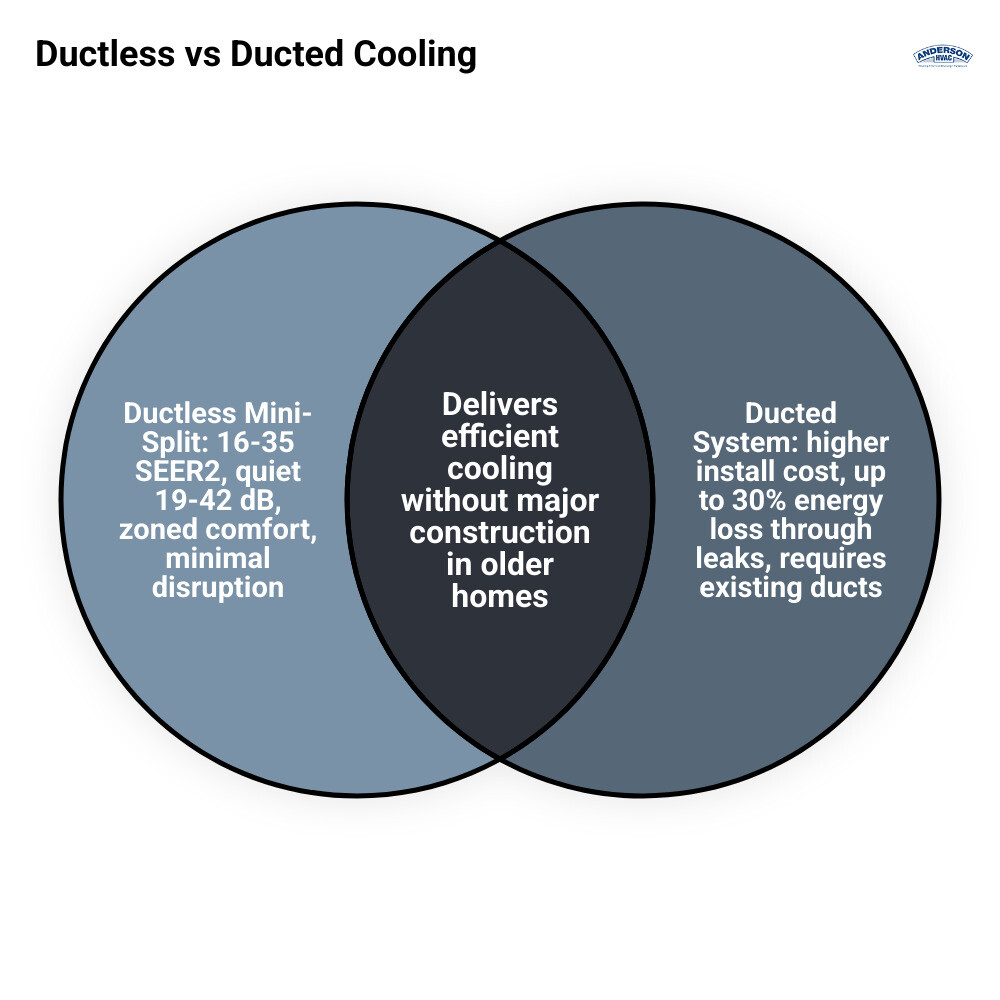
| Ductless Mini-Split | 16–35 SEER2 | 19–42 dB | Whole-home zoned comfort |
| High-Velocity Small-Duct | 14–18 SEER2 | 40–50 dB | Historic homes, tight spaces |
| Window AC | 10–15 EER | 50–65 dB | Single rooms, temporary use |
| Portable AC | 8–12 EER | 52–70 dB | Renters, short-term relief |
Many homes across North Ogden and the rest of Northern Utah were built long before central air conditioning became standard. That means no ducts, no vents, and come July, no real relief from the heat. And retrofitting a full duct system into an existing home is not just expensive — it is disruptive, often requiring walls, ceilings, and crawl spaces to be torn apart. Traditional ducted systems can also lose up to 30% of their cooling energy through leaks and poor insulation, which means you pay more and stay less comfortable.
The good news is that modern ductless technology has come a long way. Whether you own a century-old bungalow in Ogden or a mid-century ranch in Layton, there are smart, non-invasive cooling solutions that can keep your home comfortable without gutting your walls or blowing your budget.
Adding cooling without ductwork options compared vocab to learn:
Adding Cooling Without Ductwork Options Compared

When your home lacks existing vents, you are faced with several paths to summer comfort. Each system has its own set of technical specifications, operational behaviors, and installation requirements. Understanding how these options stack up against one another is essential for choosing a system that provides long-term satisfaction rather than a temporary fix.
To make an informed decision, we must look closely at the engineering behind each option. While some systems are designed to integrate seamlessly into your home for decades, others are merely “band-aid” fixes meant to get you through a single hot weekend.
When analyzing The Cold Hard Truth About Ductless vs. Ducted Cooling Pros and Cons, we find that eliminating the ductwork entirely can actually solve many of the efficiency and indoor air quality issues inherent to traditional central air systems. Let’s break down how these non-ducted options perform in the real world.
Adding Cooling Without Ductwork Options Compared: Mini-Splits vs. Room Units
The most common comparison homeowners make is between permanent ductless mini-splits and temporary room units, such as window air conditioners and portable ACs.
Window units have been the default budget choice for decades, but they come with significant drawbacks. They operate at 50 to 65 decibels, which is roughly equivalent to sleeping next to a running dishwasher. They also block your view, ruin your home’s curb appeal, and present a real security risk by leaving a window partially open.
Portable air conditioners are even less efficient. Most portable units utilize a single hose to vent hot air outside. This design creates negative pressure inside the room, which actually draws hot, humid outdoor air back into your home through cracks under doors and around windows. This negative pressure can reduce a portable AC’s effective cooling capacity by up to 40%. Additionally, portable ACs take up valuable floor space and operate at a noisy 52 to 70 decibels.
In contrast, ductless mini-split systems are permanent, highly engineered solutions. The noisy compressor is located entirely outdoors, allowing the indoor air handlers to operate at a whisper-quiet 19 to 32 decibels—quieter than a human whisper or rustling leaves.
From an efficiency standpoint, the gap is massive. While window units typically top out around 10 to 15 EER and portable units struggle to reach 8 to 12 EER, modern ductless mini-splits can achieve efficiency ratings up to 35 SEER2. This means a mini-split uses roughly 45% less electricity than a window unit of the same cooling capacity, translating directly into lower monthly utility bills. If your current temporary system is struggling, you may find that Why Your Kaysville Home Needs Professional Ductless AC Repair Right Now is a common search topic because older, inefficient portable or window units simply cannot keep up with Northern Utah’s dry, intense summer heat waves.
Adding Cooling Without Ductwork Options Compared: High-Velocity Systems
Another option for homes without traditional ductwork is a high-velocity, small-duct HVAC system. Rather than using large, rectangular metal ducts that require dropped ceilings or wall cavities, high-velocity systems use flexible, insulated mini-ducts that are only about two inches in diameter.
These mini-ducts can be snaked through existing wall cavities, closets, and floor joists with minimal disruption to your home’s structure. High-velocity systems work on the principle of aspiration. Instead of gently dumping cold air into a room like a traditional system, they introduce air at a high speed through small, circular vents. This high-velocity stream creates a gentle vacuum that pulls the room’s existing air into the stream, creating exceptionally even temperatures from floor to ceiling.
One of the major benefits of a high-velocity system is its ability to remove up to 30% more moisture from the air than a standard air conditioner. While Northern Utah is generally dry, during summer storms or in older, damp basements, this extra dehumidification can make a significant difference in comfort.
However, high-velocity systems do operate at slightly higher noise levels (around 40 to 50 decibels) than ductless mini-splits, and they require a centralized indoor blower unit, which must be housed in an attic, closet, or basement. If you are trying to decide between these highly specialized systems, understanding How to Fix Your Clinton Home’s Ductless AC Without Losing Your Cool can help you weigh the long-term maintenance and reliability of ductless setups versus small-duct alternatives.
Why Ductless Mini-Splits Lead the Pack in Efficiency and Comfort
When we look at all the options for adding cooling without ductwork options compared, ductless mini-splits consistently emerge as the gold standard for long-term comfort, efficiency, and reliability.
The secret to the incredible efficiency of modern mini-splits lies in inverter-driven compressor technology. Traditional central air conditioners and window units operate on an “all-or-nothing” cycle. The compressor turns on at 100% capacity to cool the room, shuts off once the thermostat is satisfied, and then turns back on when the temperature rises. This constant cycling creates noticeable temperature swings and consumes massive amounts of electricity during startup.
Inverter compressors, on the other hand, function like a dimmer switch. They run continuously at variable speeds, matching the exact cooling load of the room. By running at lower speeds for longer periods, they maintain a perfectly steady temperature while using up to 40% less energy than conventional ducted systems. When comparing the long-term value, our Beginner’s Guide to Mini Split vs Central AC Cost Comparison highlights how these operational savings quickly offset the initial installation.
Year-Round Heating and Cooling Performance
Many homeowners do not realize that a ductless mini-split is actually a heat pump system. By utilizing a reversing valve, the system can reverse the refrigeration cycle in the winter. Instead of removing heat from your home and dumping it outside, it extracts heat energy from the outdoor air and moves it indoors.
Modern cold-climate mini-split heat pumps are incredibly advanced. They can maintain 100% of their heating capacity even when outdoor temperatures drop to 5°F, and they continue to operate efficiently down to -15°F. This makes them a perfect year-round comfort solution for Northern Utah’s freezing winters and scorching summers.
Because they move heat rather than generating it through electrical resistance, they can be up to 200% to 400% more efficient than standard electric baseboard heaters or old radiators. If you are transitiong to a ductless setup, having a plan like Your Harrisville Ductless Air Conditioning Repair Roadmap ensures your system remains in peak operating condition through both the freezing winters and hot summers of Weber County.
Indoor Air Quality and Humidity Control
Traditional ducted systems can act as a highway for dust, pet dander, pollen, and mold spores. Over time, these contaminants build up inside the dark, hard-to-reach spaces of your ductwork and are blown into your living spaces every time the system turns on.
Ductless mini-splits eliminate this issue entirely. Because there are no ducts to collect debris, the air is filtered directly at the indoor unit. Each indoor air handler features its own dedicated multi-stage filtration system, which typically includes washable mesh filters, carbon filters to eliminate odors, and specialized enzyme filters to trap allergens and microscopic particles.
Additionally, because each zone operates independently, you don’t have to worry about pet dander from the living room being circulated into your bedrooms. To keep these advanced filtration systems and condensate lines working perfectly, local homeowners should look into West Point’s Best Kept Secrets for Reliable Ductless AC Repair to ensure their indoor air quality remains pristine year-round.
Specialized Systems for Historic and Older Northern Utah Homes
Northern Utah is home to beautiful historic properties, from the historic bungalows of Ogden to the classic mid-century homes in Brigham City and Kaysville. These homes possess incredible architectural character, but they also present unique challenges when it comes to modern climate control.
Many of these older homes were constructed with lath-and-plaster walls, heavy timber framing, or solid brick exteriors. Attempting to install traditional ductwork in these structures is often an architectural nightmare. It requires cutting into original plaster, dropping ceilings, building soffits that ruin the room’s proportions, and sacrificing precious closet space.
Ductless mini-splits and high-velocity systems are designed to solve this exact problem. A ductless installation is remarkably non-invasive. The indoor air handler is mounted on the wall, ceiling, or floor, and is connected to the outdoor condenser via a small conduit containing refrigerant lines, a power cable, and a condensate drain. This conduit only requires a small three-inch hole drilled through an exterior wall, leaving your historic plaster walls, crown moldings, and original woodwork completely untouched.
Financial Incentives and Rebates in 2026
In 2026, making the switch to an energy-efficient ductless system is more financially attractive than ever. Under the federal Inflation Reduction Act, the Section 25C tax credit allows homeowners to claim 30% of the total project cost, capped at $2,000 annually, for qualifying high-efficiency heat pumps and ductless mini-splits.
In addition to federal tax credits, local Northern Utah utility companies like Rocky Mountain Power and Dominion Energy offer substantial rebates for upgrading to energy-efficient ductless systems. These rebates can range from several hundred to over a thousand dollars, depending on the system’s efficiency rating and whether you are replacing outdated, inefficient heating sources like baseboard heaters or electric furnaces.
By combining these incentives, you can significantly reduce the upfront investment required to bring modern, whisper-quiet comfort to your older home.
Frequently Asked Questions About Ductless Cooling
As a local, family-owned business with over 40 years of experience serving Northern Utah, we hear many of the same questions from our neighbors in North Ogden, Layton, and surrounding areas. Here are the answers to the most common questions about ductless systems.
Can a ductless mini-split cool an entire home?
Yes, absolutely. While single-zone mini-splits are perfect for individual “problem rooms” like a finished basement, attic suite, or sunroom, multi-zone systems are designed for whole-home comfort.
A single outdoor condenser can support up to six (and in some cases, eight) indoor air handlers. This allows us to design a custom layout that covers your entire home. Each indoor unit is controlled by its own independent thermostat, meaning you can keep your bedrooms cool at night while turning off the cooling in the living room and kitchen to save energy.
How quiet are ductless mini-split systems?
Ductless mini-splits are incredibly quiet. Because the compressor—the part of an air conditioner that makes the loud humming and vibrating noises—is located outside in the outdoor condenser unit, the only sound inside your home is the gentle whisper of the indoor fan.
Most indoor air handlers operate between 19 and 32 decibels. For comparison:
- A whisper is about 20–25 dB.
- A quiet library is about 40 dB.
- A standard window AC unit operates at 50–65 dB.
You will easily be able to sleep, watch television, or have a normal conversation without ever noticing the system is running.
What maintenance is required for a ductless AC?
Ductless mini-split systems require very simple, but regular, maintenance to ensure they last their full 15- to 20-year lifespan:
- Clean the Filters: Every 2 to 4 weeks during heavy use, you should pop open the front panel of your indoor air handlers, slide out the reusable mesh filters, rinse them in the sink, let them dry, and slide them back in.
- Keep the Outdoor Unit Clear: Ensure that grass, weeds, leaves, and snow do not accumulate around your outdoor condenser. The system needs clear airflow to operate efficiently.
- Schedule Annual Professional Tune-Ups: Once a year, have a professional technician inspect the electrical connections, check refrigerant levels, clean the coils, and ensure the condensate drain lines are clear of any debris or algae.
Conclusion
When it comes to adding cooling without ductwork options compared, the evidence is clear: while window units and portable ACs are acceptable short-term “band-aids,” ductless mini-splits and high-velocity systems represent the absolute best long-term investments for your comfort, your health, and your wallet.
At Anderson HVAC, we have spent more than 40 years helping our neighbors across Northern Utah—from Brigham City down to Farmington—find the perfect comfort solutions for their homes. As a family-owned and operated business, we pride ourselves on providing personalized, neighborly service that exceeds expectations. We understand the unique architectural challenges of our local historic homes and are experts in designing custom, non-invasive ductless layouts that preserve your home’s beauty while delivering modern, energy-efficient comfort.
Ready to reclaim your home from the summer heat and save on your monthly energy bills? Schedule expert ductless HVAC services in North Ogden with Anderson HVAC today, and let our family take care of yours!

