


Why Shade, Insulation, and Sealing Are the Real Keys to AC Efficiency
Understanding how shade insulation and sealing reduce your AC workload can save you real money every summer — especially in Northern Utah, where afternoon temperatures regularly push your system to its limits. If your home bakes in the sun all day, lets heat seep through thin walls, and leaks cool air through gaps around windows and doors, your AC never really catches a break.
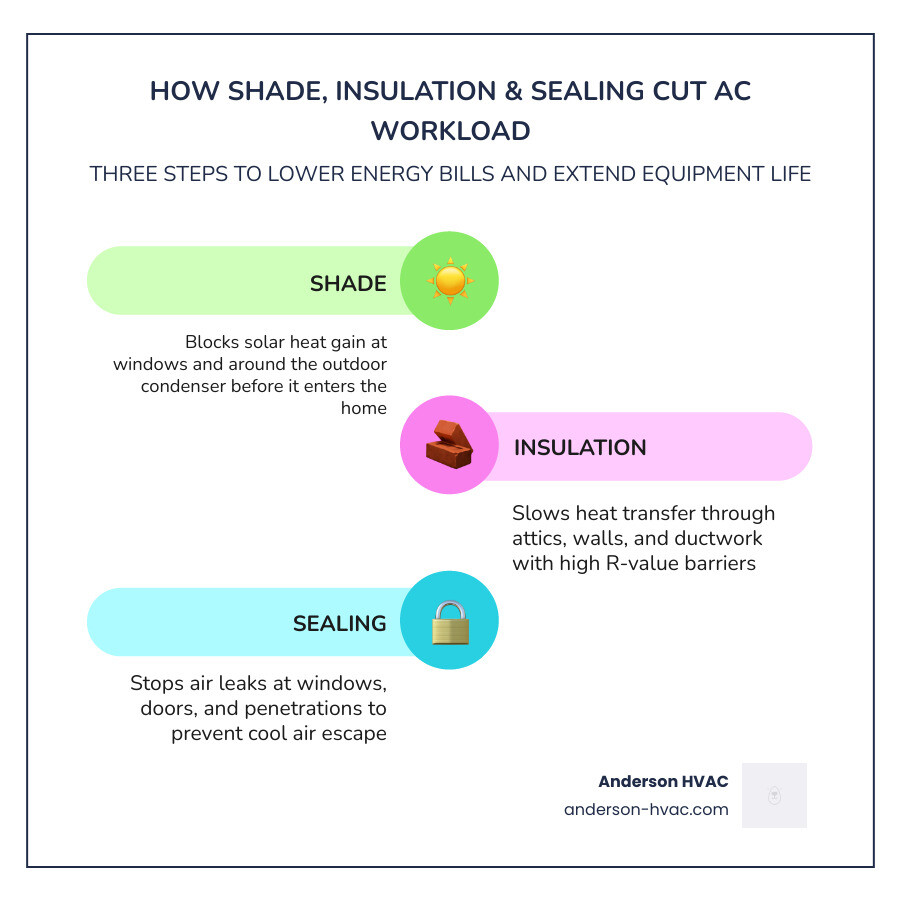
Here’s a quick summary of how each strategy helps:
| Strategy | What It Does | Potential Savings |
|---|---|---|
| Shade | Blocks solar heat before it enters your home or heats your outdoor unit | Up to 10% on cooling energy |
| Insulation | Slows heat moving through walls, attic, and ductwork | 15%+ on annual heating and cooling costs |
| Air Sealing | Stops cool air from escaping and hot air from sneaking in | Addresses up to 40% of home energy loss |
Together, these three strategies work as a team. Shade stops heat at the source. Insulation slows what gets through. Air sealing closes the gaps that let the rest in. The result? Your AC runs less often, lasts longer, and costs less to operate — without you touching the thermostat.
In this guide, we’ll walk through each strategy step by step, so you know exactly where to focus first.
How shade insulation and sealing reduce your ac workload word guide:
How Shade Insulation and Sealing Reduce Your AC Workload

Before we look at how to protect your home, we have to look at the enemy: heat. Heat is like that one neighbor who never takes a hint—it is always trying to get inside where it is cool. In physics, heat moves from warmer spaces to cooler spaces using three primary pathways:
- Radiation: This is electromagnetic heat traveling through space. The prime culprit here is direct sunlight beaming through your windows or baking your roof.
- Conduction: This is heat moving through solid objects. When the Utah sun beats down on your stucco or roof shingles, that heat travels directly through those solid materials and radiates into your living space.
- Convection: This is heat circulating through air currents. When hot outdoor air sneaks in through cracks around your doors or windows, it physically brings the outdoor heat inside.
Your home’s “thermal envelope” is the physical barrier—including the walls, roof, windows, and foundation—that keeps the outdoor elements separate from your indoor climate. When this envelope is weak, your home experiences massive heat gain.
This forces your air conditioner into a state of perpetual struggle. Instead of running short, efficient cooling cycles, your system has to run constantly to keep up. This constant cycling is what causes the most wear and tear on your compressor and fan motor. By understanding Is Your AC Working Overtime? Understanding Utah’s Summer Bill Spikes, you can see how a weak thermal envelope directly translates to higher utility costs and a shorter equipment lifespan.
| Feature | Unshaded, Uninsulated & Leaky Home | Shaded, Insulated & Sealed Home |
|---|---|---|
| AC Cycle Frequency | Frequent, long cycles (system struggles to satisfy thermostat) | Short, balanced cycles |
| Indoor Temperature Comfort | Hot spots near windows; drafty areas | Even, consistent cooling throughout |
| Energy Waste | High (up to 40% loss through air leaks alone) | Low (retains conditioned air efficiently) |
| Equipment Wear & Tear | High risk of premature compressor failure | Extended equipment lifespan |
Strategic Shading: Protecting Your Windows and Outdoor Unit
The most effective way to handle solar heat gain is external interception—stopping the sun’s rays before they ever touch your home’s outer surfaces. Once sunlight passes through your window glass, the heat is already inside, and your AC has to work to remove it. Shading strategies act as your home’s first line of defense.
Shading Windows to Block Solar Heat Gain
Windows are the primary entry points for solar heat. In fact, roughly 76% of the sunlight that hits a standard double-pane window enters your home as heat. Furthermore, up to 30% of unwanted summer heat in your home comes directly through your windows, with south- and west-facing glass being the worst offenders.
To combat this, consider these highly effective window treatments and landscaping upgrades:
- Awnings: Installing exterior awnings can block up to 65% of solar heat gain on south-facing windows and an impressive 77% on west-facing windows. Retractable designs are excellent because they let you block the high summer sun while allowing warm light in during our cold Northern Utah winters.
- Cellular Shades: If you want an interior option, cellular (honeycomb) shades can cut unwanted solar heat through windows by up to 60% by trapping air inside their built-in pockets.
- Deciduous Trees: Planting deciduous trees on the south and west sides of your property provides natural, leafy shade during the hottest months of the year. Once winter arrives and the leaves drop, the bare branches allow the winter sun to naturally warm your home.
- Solar Screens: Exterior solar screens look like heavy-duty window screens but are designed to block a high percentage of incoming solar radiation before it hits the glass, maintaining your view while significantly lowering the Solar Heat Gain Coefficient (SHGC).
How Shade Insulation and Sealing Reduce Your AC Workload via Condenser Protection
Your outdoor AC unit—specifically the condenser—is responsible for releasing the heat collected from inside your home. If that metal unit is sitting in the direct afternoon sun, its job becomes significantly harder. Direct sun alone can add between 1,500 and 2,500 BTUs per hour of extra heat to the condenser, forcing it to run hotter and consume more power.
Providing shade for your outdoor unit can create a cooler microclimate, allowing it to use up to 10% less electricity. However, when shading your condenser with lattice panels, fences, or shrubs, you must follow the “golden rule” of AC maintenance: never restrict airflow.
Your condenser needs plenty of open space to draw in cool air and exhaust hot air out of the top. Always maintain a minimum of 2 to 3 feet of clear space on all sides of the unit, and leave at least 5 feet of clear space above it. If you block the airflow, you will trap hot air around the unit, causing it to overheat and run even less efficiently than it would in the direct sun.
Architectural Shading: Eaves and Overhangs
Architectural features like properly sized roof eaves and horizontal overhangs are brilliant passive cooling designs. Because the sun sits high in the sky during the summer and low in the sky during the winter, you can use basic solar geometry to your advantage.
A well-designed overhang will completely block the high-angle, intense summer sun from shining directly into your south-facing windows. Yet, when winter comes, that same overhang will allow the low-angle winter sun to pass beneath it, naturally warming your home when you need it most.
Prioritizing Insulation and Air Sealing for Maximum Efficiency
While shade takes care of radiant heat from the sun, proper insulation and air sealing handle conductive and convective heat transfer. Together, they form a complete thermal barrier that keeps your cool air inside and the summer heat out.
How Shade Insulation and Sealing Reduce Your AC Workload through Thermal Barriers
Insulation acts as a heavy blanket for your home. It is measured in R-values; the higher the R-value, the better the material is at resisting heat flow. Because heat naturally rises and the sun bakes your roof, attic temperatures can easily climb to 140°F or higher on a hot summer afternoon. Without adequate insulation, that intense heat will migrate straight through your ceiling and into your living areas.
To maximize your home’s efficiency, focus on these key areas:
- Attics: Ensure your attic has an appropriate R-value (typically R-38 to R-49 for our region). If you can easily see your attic floor joists, you likely need an insulation upgrade.
- Radiant Barriers: Installing a radiant barrier (a reflective foil sheet) in your attic can bounce solar heat back out through your roof vents before it ever reaches your attic floor insulation.
- Duct Sealing: If your ductwork runs through an unconditioned attic or crawlspace, any leaks can decrease your cooling efficiency by as much as 20%. Sealing and insulating your ducts ensures that the cold air you pay for actually reaches your rooms.
- Thermal Bridges: Wall studs conduct heat much faster than the surrounding insulation. Adding continuous exterior foam board insulation can break these thermal bridges and keep your home’s envelope tight.
Don’t forget that keeping your system clean is just as important as keeping your home insulated. Check out The Efficiency Secret: Choosing the Perfect Filter for Your HVAC to learn how maintaining proper airflow through your system works hand-in-hand with home efficiency.
Air Sealing: The Forgotten Partner of Insulation
If insulation is the warm sweater your home wears, air sealing is the windbreaker. You can have feet of insulation in your attic, but if you have open gaps and cracks, hot air will draft right through it. Air leaks can account for up to 40% of a home’s total energy loss.
During the summer, a process called the “stack effect” occurs. Warm air rises and escapes through leaks in your attic, which creates a vacuum that pulls hot, humid outdoor air in through lower cracks around your crawlspace, windows, and doors.
By systematically applying weatherstripping to doors, caulking around window frames, and installing foam gaskets behind electrical outlets on exterior walls, you block these pathways. This simple weekend project can save you 15% or more on your annual heating and cooling costs. For more tips on managing your indoor climate efficiently, read The Definitive Guide to Best Thermostat Strategies for Summer AC Savings.
Identifying Air Leaks and Regional Climate Considerations
Finding air leaks doesn’t have to be complicated. You can perform a simple DIY check on a windy day by holding a lit incense stick or a damp hand near window frames, door jambs, and electrical outlets. If the smoke wafts horizontally or you feel a cool draft, you’ve found a leak. Another giveaway is looking at your attic insulation—if you see dark, dirty spots in the fiberglass, it means air is filtering up through a gap in the drywall below, leaving dust behind like a filter.
For a comprehensive look at your home’s performance, a professional energy audit is the gold standard. Utilizing specialized tools like blower doors and thermal imaging cameras, professionals can pinpoint every hidden draft in your home.
In Northern Utah, our climate features hot, dry summers and freezing, snowy winters. This dramatic temperature swing makes a tight thermal envelope absolutely essential year-round. To see where your home stands, check out the Anderson HVAC Energy Efficient Review 101 for a detailed breakdown of local efficiency priorities.
Frequently Asked Questions about Home Cooling Efficiency
Does shading my AC unit really save 10% on energy?
Yes, but only if it is done correctly. Shading the outdoor condenser can lower the temperature of the air it pulls in by several degrees, boosting its operating efficiency. However, if your shading structure (like a tight fence or thick bushes) blocks the free flow of air around the unit, it will trap heat and actually increase your energy bills. Always maintain a 2-to-3-foot clearance around the sides.
What are the most common air leak locations in homes?
The largest leaks are typically hidden from view. They are most commonly found in the attic around plumbing vents, chimney chases, recessed lighting fixtures, and attic pull-down stairs. In the main living areas, leaks are common around window and door frames, electrical outlets on exterior walls, and where the fireplace damper meets the chimney.
Can I over-insulate my home and cause moisture issues?
While it is incredibly difficult to “over-insulate,” it is possible to under-ventilate. A home needs to breathe to expel moisture from cooking, showering, and breathing. If you seal your home tightly without ensuring proper, balanced ventilation, indoor humidity can rise, leading to stale air or condensation issues. That is why we recommend a balanced approach that focuses on sealing energy-wasting leaks while maintaining healthy indoor air circulation.
Conclusion
Taking a proactive approach to your home’s thermal envelope is the single best way to support your air conditioner. By combining strategic outdoor shade, proper attic and duct insulation, and thorough air sealing, you stop heat before it ever gets inside. This keeps your living spaces naturally cooler, reduces system wear and tear, and ensures your family stays comfortable all summer long.
For over 40 years, our family-owned team at Anderson HVAC has been helping Northern Utah families stay comfortable. Whether you live in North Ogden, Layton, Kaysville, or Brigham City, we are here to help you maximize your home’s cooling efficiency.
Ready to make sure your air conditioner is running at peak performance? Contact us today to schedule our professional air conditioning services in North Ogden, UT and let our experienced team keep your home cool and efficient.

