


Why Your AC Loses Its Cool: What Every Northern Utah Homeowner Should Know
Understanding how refrigerant leaks happen and how they are repaired could save you from a sweltering summer and an expensive system breakdown. Here’s a quick overview:
How refrigerant leaks happen:
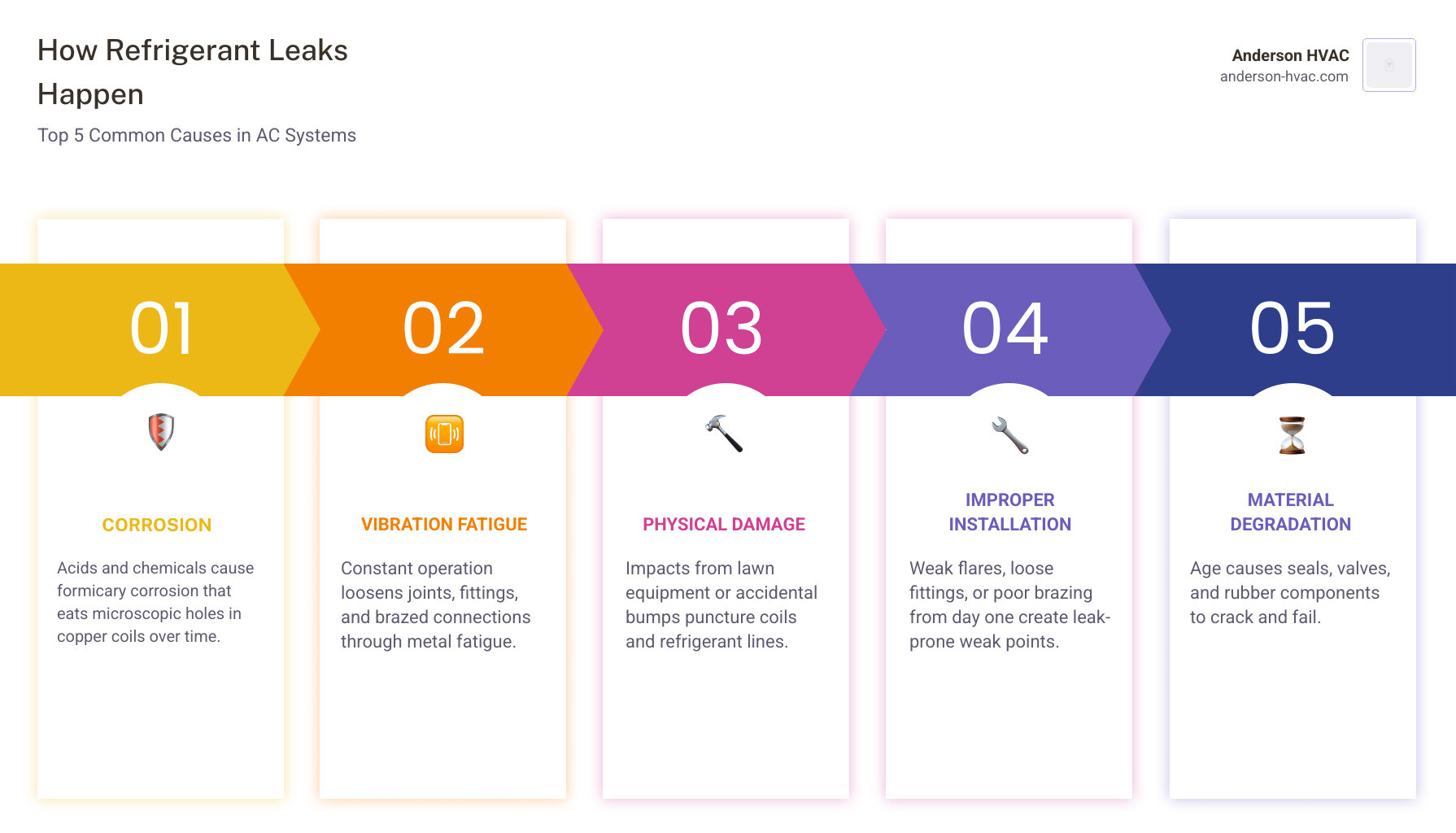
- Corrosion eats through copper coils over time
- Vibration from normal operation loosens joints and fittings
- Physical damage from lawn equipment or accidental impact
- Poor installation leaves weak connections from day one
- Age causes seals, valves, and tubing to degrade
How refrigerant leaks are repaired:
- A certified technician locates the leak using electronic detectors, UV dye, or nitrogen pressure testing
- Remaining refrigerant is safely recovered
- The damaged component is brazed, replaced, or resealed
- The system is evacuated to remove moisture
- Refrigerant is recharged to the manufacturer’s exact specification
Your home’s air conditioner runs on a closed loop of refrigerant — a substance that absorbs heat from inside your home and releases it outside. It never gets “used up.” So if your system is low on refrigerant, that’s not normal wear. It means there’s a breach somewhere in the circuit that needs to be found and fixed.
In Northern Utah, where summer temperatures push AC systems hard, even a small leak can quickly turn into weak cooling, frozen coils, or a full system failure. The good news? Refrigerant leaks are diagnosable and fixable — when caught early.
This guide walks you through exactly what causes leaks, how to spot them, and what a proper professional repair looks like from start to finish.
Common how refrigerant leaks happen and how they are repaired vocab:
- Capacitor failure: Why it is the most common AC repair
- How condenser coil damage leads to costly AC repair
- Most common AC repairs and what causes them
Common Causes: How Refrigerant Leaks Happen and How They Are Repaired

When we talk about how refrigerant leaks happen and how they are repaired, we have to start with the “why.” Your HVAC system is a pressurized, sealed environment. In a perfect world, that refrigerant would stay inside for the entire 15-to-20-year lifespan of the unit. However, several mechanical and environmental factors can breach that seal.
Formicary Corrosion
One of the most common culprits in Northern Utah homes is formicary corrosion. This occurs when copper tubing reacts with volatile organic compounds (VOCs) found in common household items like cleaning supplies, air fresheners, and even new building materials. This chemical reaction creates microscopic “pinhole” leaks in the evaporator coil. These leaks are often so small—some as shallow as 0.003 inches—that they can be incredibly difficult to find without specialized equipment.
Vibration Fatigue
Think of your AC unit like a car; it has moving parts that create constant vibration. Over time, this mechanical wear and tear can cause copper lines to rub against the metal frame of the unit or against other tubes. Eventually, the friction wears through the metal. Furthermore, the constant cycling on and off can cause “joint friction,” where brazed connections or flare fittings slowly work themselves loose.
Physical Damage and Improper Installation
Sometimes, the cause is much more direct. We’ve seen many cases where a wayward weed whacker or lawnmower clips the outdoor condenser coil. In other instances, a poor initial installation is to blame. If a technician didn’t properly braze the joints or failed to use a nitrogen purge during the process, the connections might be weak from day one. To ensure your system is set up for success, it’s vital to rely on residential HVAC services that prioritize precision.
Recognizing the Signs of a Leak in Your Northern Utah Home
You don’t need to be an HVAC expert to notice when something is wrong. Because refrigerant is essential for the thermodynamic cycle, a leak will manifest in several “telltale” ways. If you notice any of the following, it’s time to look into AC repair services.
- Hissing or Bubbling Noises: If you hear a hissing sound near your indoor or outdoor unit, that’s likely high-pressure gas escaping. A bubbling sound usually indicates a leak in a line where the refrigerant is in a liquid state.
- Frozen Evaporator Coils: This is a classic symptom. When refrigerant levels are low, the pressure inside the system drops. This causes the temperature of the coil to plummet below freezing, turning the condensation on the coil into a block of ice.
- High Indoor Humidity: Your AC doesn’t just cool the air; it dehumidifies it. If your home feels “sticky” or “muggy” despite the AC running, the system isn’t effectively removing moisture because of a low charge.
- Oily Residue: Refrigerant is mixed with a specialized lubricant oil. When the gas leaks out, it often carries a bit of this oil with it, leaving greasy spots on the connections or coils.
- Spiking Utility Bills: An unchecked leak can drive up utility bills by as much as 30%. Because the system is struggling to reach the set temperature, it runs longer and harder, consuming significantly more energy.
The Professional Detection and Restoration Framework
In 2026, the regulations surrounding refrigerant are stricter than ever. Under EPA Section 608, it is illegal to intentionally vent refrigerant into the atmosphere. This means that a “DIY” repair isn’t just dangerous—it’s against the law. When we perform air conditioning services, we follow a rigorous framework to ensure safety and efficiency.
Advanced Detection: How Refrigerant Leaks Happen and How They Are Repaired
Finding a leak is often the hardest part of the job. We use several layers of technology to pinpoint the breach:
- Electronic Sniffers: These highly sensitive devices “smell” the chemical signature of escaping refrigerant.
- Ultrasonic Detectors: These tools listen for the high-frequency sound of a leak that is inaudible to the human ear.
- UV Dye Injection: We can inject a fluorescent dye into the system. After it circulates, we use a UV light to see exactly where the dye is escaping.
- Isolation Testing: If a leak is particularly stubborn, we perform a “Level 2” search. This involves removing the refrigerant, isolating the line set and coils, and pressurizing them with nitrogen for 24 to 48 hours to see which component loses pressure.
The Restoration Phase: How Refrigerant Leaks Happen and How They Are Repaired
Once the leak is found, the real work begins. We first recover any remaining refrigerant into a certified tank. Then, depending on the location, we may use high-heat brazing techniques to seal a copper line or replace the entire component, such as a leaking evaporator coil.
After the repair, we must remove all air and moisture from the lines. We use a vacuum pump to pull the system down to 500 microns. If the system can’t hold that vacuum, it means moisture or a secondary leak is still present. Finally, we recharge the system by weight, using a digital scale to match the manufacturer’s nameplate specifications exactly.
Repairing vs. Replacing Your Cooling System in 2026
As we move through 2026, homeowners in Northern Utah face a shifting landscape regarding refrigerants. Deciding whether to fix a leak or invest in AC replacement often comes down to the type of refrigerant your system uses.
| Refrigerant Type | Status in 2026 | Repair Recommendation |
|---|---|---|
| R-22 (Freon) | Obsolete / Phase-out complete | Replace system; refrigerant is extremely scarce and expensive. |
| R-410A (Puron) | Phase-down in progress | Repair if the system is under 10–12 years old and in good condition. |
| Modern A2L (R-454B/R-32) | Current Standard | Always repair; these are the most eco-friendly and efficient options. |
If your system is approaching the 15-year threshold, a major refrigerant leak is often the “final straw.” The cost of finding the leak, the labor for the repair, and the price of the refrigerant itself can sometimes equal half the cost of a new, high-efficiency unit. Furthermore, older refrigerants like R-410A have a high Global Warming Potential (GWP)—it is 2,088 times more damaging to the climate than carbon dioxide. Upgrading to a modern system isn’t just a financial decision; it’s an environmental one.
Preventing Future Leaks Through Proactive Maintenance
The best way to handle a refrigerant leak is to never have one in the first place. While some factors like age are unavoidable, HVAC maintenance can drastically reduce your risk.
During a seasonal tune-up, we check for the early signs of vibration fatigue and ensure that all service valves are tightened to spec. We also clean the coils; dirty coils can lead to higher pressures and temperatures, which stress the metal and lead to premature failure. Something as simple as changing your filters regularly keeps airflow steady, preventing the pressure imbalances that can contribute to coil degradation. By catching a small “seep” during a maintenance visit, we can often save you from a total system shutdown in the middle of a July heatwave.
Frequently Asked Questions about Refrigerant Leaks
Is it safe to run my AC if I suspect a refrigerant leak?
No, we strongly recommend turning the system off. Running an AC with low refrigerant puts immense strain on the compressor. Since the refrigerant also carries the oil that lubricates the compressor, running it “dry” can cause the compressor to burn out, turning a repairable leak into a total system replacement.
Why does my AC have ice on it if the weather is hot?
It seems counterintuitive, but ice is a primary sign of a leak. Low refrigerant levels cause the pressure in the evaporator coil to drop. When the pressure drops, the temperature of the coil falls below 32°F. The humidity in your home hits that freezing coil and instantly turns to ice, eventually insulating the coil so much that no cooling can take place.
Can I just “top off” my refrigerant every year instead of fixing the leak?
“Topping off” is like putting a bandage on a gaping wound. Because an HVAC system is a closed loop, any loss of refrigerant is a sign of a hole. If you don’t fix the hole, the new refrigerant will just leak out again—sometimes in a few days, sometimes in a few months. It’s a waste of money and harmful to the environment.
Conclusion
At Anderson HVAC, we’ve spent over 40 years helping our neighbors in North Ogden, Layton, and across Northern Utah stay comfortable. We understand that a refrigerant leak is more than just a mechanical failure; it’s a disruption to your family’s comfort and a potential hit to your wallet.
As a family-owned business, we pride ourselves on providing personalized, honest advice. Whether your system needs a complex brazing repair or it’s time to consider a more efficient replacement, we’re here to guide you through the process with the expertise that only four decades of local service can provide. Don’t let a small leak turn into a big headache. Schedule your professional AC repair in North Ogden today and let our family take care of yours.

