Why How the Right Filter Improves Your AC Efficiency Is the Most Overlooked Home Energy Fix
How the right filter improves your AC efficiency is simpler than most homeowners expect — and the payoff is real:
- Choose the right MERV rating (8–13 for most homes) to balance airflow and filtration without straining your system
- Replace your filter every 30–90 days — more often if you have pets, allergies, or run your AC heavily
- Use a pleated filter over basic fiberglass for better particle capture without excessive airflow resistance
- Match filter size exactly to your system’s specifications to prevent air bypass around the edges
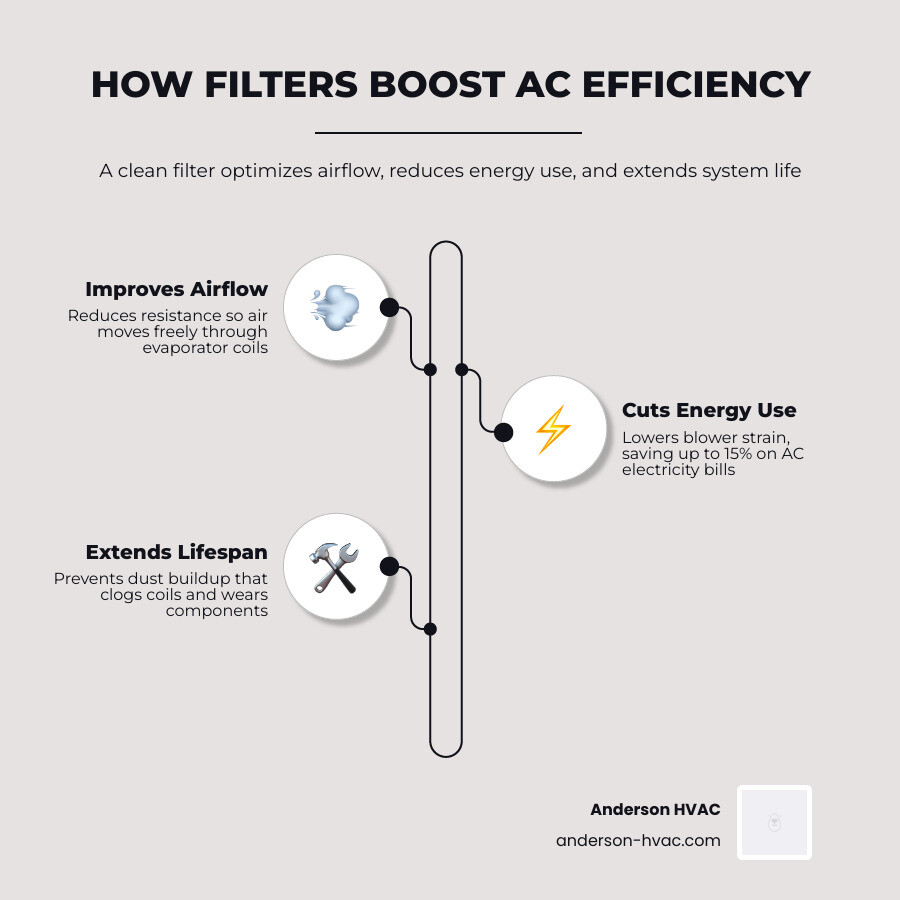
- A clean, well-matched filter can cut AC energy use by up to 15%, according to the U.S. Department of Energy
Most people in Northern Utah adjust their thermostat or call for repairs when their AC struggles — but the real culprit is often sitting right in the filter slot. A clogged or mismatched filter forces your system to work 10–20% harder, drives up your utility bills, and puts unnecessary wear on components like the blower motor and evaporator coil. The good news? Fixing it is one of the easiest and most cost-effective things you can do for your home’s comfort.
In this guide, Anderson HVAC — a family-owned HVAC contractor serving Ogden and Northern Utah for over 40 years — walks you through everything you need to know to choose the right filter and keep your AC running at its best.
How the Right Filter Improves Your AC Efficiency and Lowers Bills
It sounds like a small detail, but the air filter is the “beginning of the circulation path” for your entire HVAC system. When we talk about how the right filter improves your AC efficiency, we are really talking about the physics of airflow. Your air conditioner works by pulling warm air from your home, passing it over cold evaporator coils to remove heat, and then blowing the cooled air back into your rooms.
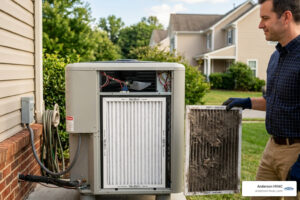
If that filter is clogged with dust, pet hair, or Utah’s high-desert grit, your system has to suck air through a “brick” of debris. This creates massive resistance. To compensate, the blower motor has to run longer and harder just to move the same amount of air. This extra effort doesn’t just feel like a breeze; it shows up on your monthly statement. The U.S. Department of Energy confirms that simply replacing a dirty filter with a clean one can cut your cooling energy consumption by 5% to 15%.
Beyond the immediate energy savings, a clean filter is your best defense against “evaporator coil contamination.” When a filter is too thin or doesn’t fit correctly, dust bypasses it and settles directly onto the wet cooling coils. This creates an insulating layer of grime that prevents the refrigerant from absorbing heat efficiently. When heat transfer is blocked, your AC runs nonstop, yet your home stays warm.
| System Condition | Energy Efficiency Impact | Estimated Annual Savings |
|---|---|---|
| Clean, High-Quality Filter | Optimal Performance | Baseline |
| Slightly Dirty (3-4 months) | 5-10% Efficiency Loss | Potential $50-$100 waste |
| Severely Clogged (6+ months) | 15-20% Efficiency Loss | Potential $150+ waste |
| No Filter Installed | High Risk of System Failure | High Repair Liability |
By maintaining a proper filtration schedule, you ensure that every dollar you spend on electricity actually goes toward cooling your home, not fighting against a dirty piece of mesh. For a deeper dive into maximizing your home’s performance, check out our Anderson HVAC energy efficient review 101.
Understanding MERV Ratings: Balancing Airflow and Filtration
When you walk down the aisle at a hardware store in Ogden or Layton, you’ll see a number on every filter called a MERV rating. MERV stands for Minimum Efficiency Reporting Value. It’s a scale from 1 to 16 that measures how well a filter captures particles.
- MERV 1–4: The most basic filters. They catch large dust bunnies but let most allergens through.
- MERV 5–8: A solid choice for many residential homes, offering a balance between air purity and airflow.
- MERV 9–13: High-efficiency filters that can catch mold spores, fine dust, and even some bacteria.
- MERV 14–16: Hospital-grade filtration, but often too restrictive for standard home AC units.
Here is the secret: how the right filter improves your AC efficiency is all about balance. A filter with a MERV rating that is too high for your specific equipment acts like a wall. It captures every tiny particle, but it also creates “static pressure” that can burn out your blower motor or cause your coils to freeze. We recommend professional air filtration solutions to help you find the “sweet spot” where your air is clean but your system can still breathe freely.
How the right filter improves your AC efficiency for allergy sufferers
For our neighbors in Northern Utah who suffer from seasonal allergies or asthma, the filter choice is even more critical. If you have pets or live in a high-traffic area, a MERV 8 to MERV 11 filter is usually the best bet. These filters are designed to trap pet dander and pollen before they can circulate through your ductwork. When these particles are removed, your air is healthier, and your system doesn’t have to cycle as often to maintain a comfortable, “fresh” feeling. You can significantly improve your indoor air quality by matching your filter to your specific health needs.
How the right filter improves your AC efficiency in dusty climates
Living in North Ogden or the surrounding areas means dealing with high-desert dust and the occasional haze from regional wildfires. In these environments, standard fiberglass filters are almost useless. Pleated filters are the gold standard here because they have more surface area to trap fine Utah dust without immediately clogging. If your home feels dusty even after cleaning, it might be time for expert duct cleaning services to remove the buildup that has already bypassed your old filters.
Choosing the Best Filter Type for Your Northern Utah Home
With so many options on the market, it’s easy to get overwhelmed. Here is a breakdown of the most common types and how they impact your efficiency:
- Fiberglass Filters: These are the flat, blue or white filters you find for a few dollars. While they are cheap, they only catch about 20% of large particles. They provide great airflow, but they offer very little protection for your AC’s internal components.
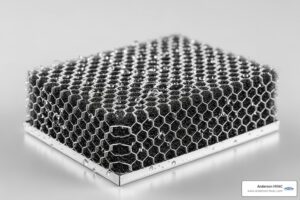
- Pleated Filters: These use a folded media (looking like an accordion) to increase surface area. They are the best choice for improving AC efficiency because they trap more debris without significantly hindering airflow.
- HEPA Filters: High-Efficiency Particulate Air filters are the “heavy lifters.” However, most residential AC systems in Utah aren’t designed to push air through a standard HEPA filter. Using one without a professional modification can actually decrease efficiency by choking the system.
- Washable Filters: These are environmentally friendly, but they require diligent cleaning. If you don’t let them dry completely, you risk blowing mold spores into your vents.
- Electrostatic Filters: These use self-charging fibers to attract particles like a magnet. They are excellent for smoke and fine dust but need to be cleaned or replaced regularly to maintain their “charge.”
If you’re looking for a system that doesn’t rely on traditional ductwork filters, you might want to explore ductless HVAC options, which often feature specialized, easy-to-clean filtration systems.
Maintenance Habits to Protect Your System and Extend Lifespan
The “set it and forget it” mentality is the enemy of AC efficiency. In Northern Utah, we recommend checking your filter once a month, especially during the peak of summer. While a filter might be rated for 90 days, a home with two golden retrievers in Syracuse or a dusty construction site nearby in West Haven might need a change every 30 days.
Regularly changing your filter does more than save energy; it extends the life of your entire system by 2 to 5 years. When airflow is restricted, the blower motor runs hot, and the lack of warm air passing over the coils can cause them to drop below freezing. A “frozen AC” is a common service call that can usually be prevented with a simple filter swap.
To keep your system in peak condition year-round, we highly recommend that you sign up for a maintenance plan. This ensures a professional eye is on your filtration and internal components before the summer heat hits its peak.
Frequently Asked Questions about AC Filters and Efficiency
What are the signs my filter needs immediate replacement?
If you notice weak airflow coming from your registers, or if your vents look unusually dusty, your filter is likely past its prime. Other red flags include a sudden spike in your utility bills, the AC running longer cycles than usual, or a strange whistling sound coming from the return air vent — which is often the sound of your system “gasping” for air through a clog.
Can I run my AC without a filter temporarily?
In a word: No. Running your AC without a filter, even for a day, allows raw dust, hair, and debris to be sucked directly into the sensitive internal mechanics. This can coat the evaporator coils and the blower fan, leading to poor air quality, mechanical failure, and potentially a complete system shutdown that requires professional cleaning to fix.
Do higher MERV ratings always mean better efficiency?
This is a common myth! While a higher MERV rating means cleaner air, it doesn’t always mean a more efficient AC. If the filter is too dense for your system’s blower motor to handle, it creates a pressure imbalance. This forces the motor to work harder and consume more electricity. The goal is “balanced filtration” — the highest MERV rating your specific system can handle without restricting airflow.
Conclusion
At Anderson HVAC, we’ve seen how a simple filter choice can make or break a home’s comfort. For over 40 years, our family-owned team has been dedicated to helping our neighbors in North Ogden, Layton, Kaysville, and across Northern Utah get the most out of their cooling systems. We pride ourselves on personalized service and expert advice that goes beyond just “fixing the machine.”
Understanding how the right filter improves your AC efficiency is the first step toward a more comfortable, affordable summer. If you’re not sure which filter is right for your home, or if your system needs a professional check-up to restore its cooling power, we are here to help.
Schedule your professional AC service in North Ogden today and let our family take care of yours. Whether you are in Brigham City or Syracuse, we are just a phone call away from ensuring your home stays cool and efficient all season long.