


Why Electrical Connection Problems Are One of the Leading Causes of AC Breakdowns
How electrical connection problems cause ac breakdowns is something every Northern Utah homeowner should understand — especially when summer temperatures in North Ogden push your system to its limits. The short answer: failing wires, corroded terminals, worn capacitors, and pitted contactors interrupt the flow of electricity your AC needs to run. When that happens, the system shuts down, struggles to start, or trips your breaker repeatedly.
Here is a quick look at the most common ways electrical connection problems lead to AC failure:
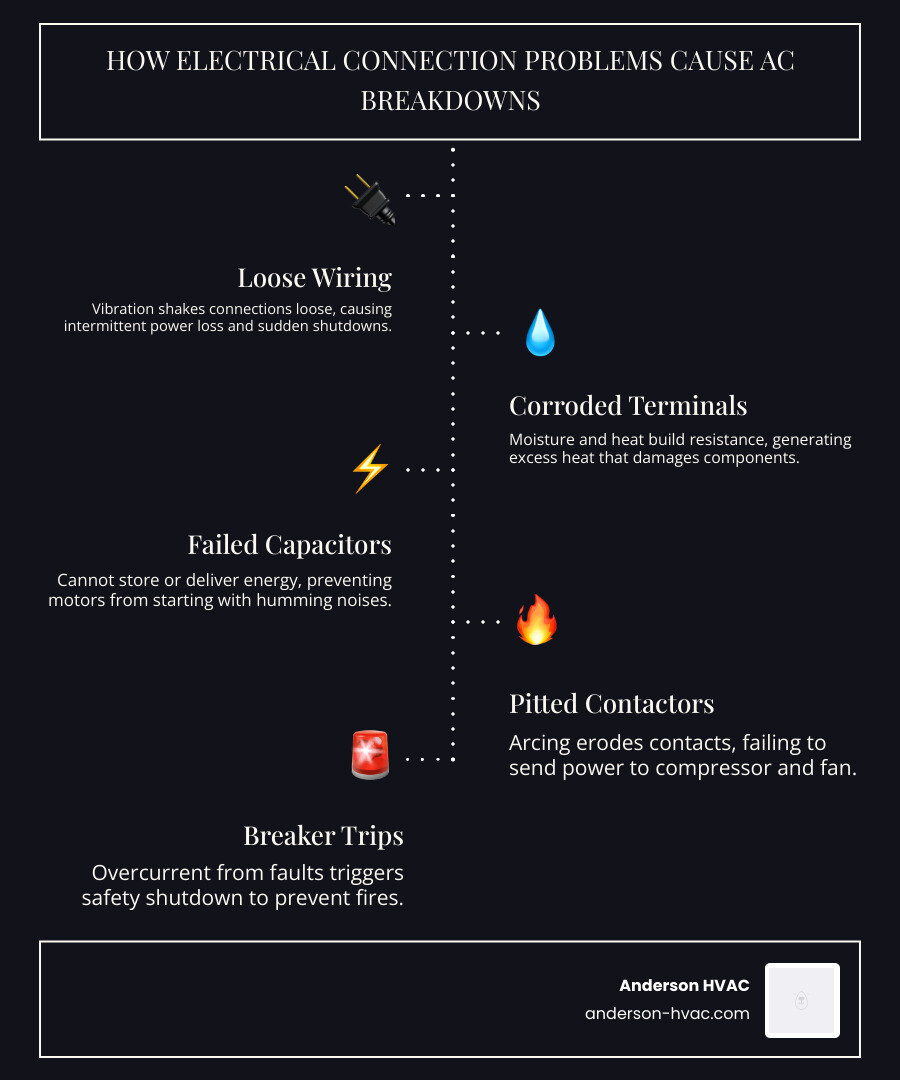
- Loose wiring – Vibration from daily operation shakes wire connections loose over time, causing intermittent power loss and unexpected shutdowns
- Corroded terminals – Moisture and heat corrode the metal contacts that carry current, creating resistance and heat buildup
- Failed capacitors – Weak or dead capacitors cannot deliver the electrical boost the compressor needs to start
- Pitted contactors – The switches that send power to your compressor wear down after thousands of cycles, eventually failing to make contact
- Tripped circuit breakers – An AC drawing more current than its circuit can handle will trip the breaker as a safety response
- Short circuits and ground faults – Damaged wire insulation allows electricity to escape its intended path, causing instant shutdowns or fire risk
- Power surges – Voltage spikes from storms or grid fluctuations can destroy sensitive control boards and capacitors in seconds
Most of these failures do not happen overnight. They build slowly, through normal wear, heat, humidity, and the relentless vibration of a system running thousands of hours each cooling season. The frustrating part? Many homeowners do not notice anything is wrong until the system stops working entirely — often on the hottest day of the year.
At Anderson HVAC, we have seen this pattern play out across Northern Utah homes for over 40 years. A small electrical issue that could have been caught during a spring tune-up turns into a full breakdown in July. Understanding what to look for is the first step toward preventing that from happening to you.
Common Electrical Connection Problems That Cause AC Breakdowns
When we talk about how electrical connection problems cause ac breakdowns, we are usually looking at the “silent killers” of the HVAC world. Unlike a frozen coil or a clogged filter, which have very visible symptoms, electrical issues often hide deep within the control box of your outdoor unit or inside the walls of your home.
One of the most frequent culprits is loose wiring. Believe it or not, your air conditioner is a vibrating machine. Every time the heavy compressor kicks on, it sends a pulse of movement through the entire chassis. Over May 2026 and the years prior, this constant shaking can actually back out terminal screws and loosen wire nuts. When a wire is loose, the electricity has to “jump” the gap, creating an arc. This arcing generates extreme heat, which can melt the plastic insulation around the wire and eventually lead to a total loss of power.
Corroded terminals are another major factor. In our Northern Utah climate, we see a fair share of moisture and temperature swings. If the metal contacts at your contactor or capacitor become oxidized, they develop a layer of “crust” that acts as insulation. This forces the electricity to work harder to pass through, causing the connection to overheat and eventually fail. If you are noticing your system struggling in the heat, you might need Ac Repair In Clearfield Ut A Breath Of Fresh Air For Your Car And Home/ to address these hidden connection points before they burn out completely.
How electrical connection problems cause ac breakdowns via capacitor failure
Think of your AC capacitors as the “batteries” of the system, but much more powerful. There are typically two types: start capacitors and run capacitors. The start capacitor provides the massive “kick” of torque needed to get the heavy compressor motor spinning from a dead stop. The run capacitor provides a steady stream of energy to keep it spinning efficiently.
When electrical connections to these components fail—or when the capacitors themselves wear out due to heat—your system will experience “startup hesitation.” You might hear a loud humming noise coming from the outdoor unit, followed by a click, but the fan or compressor never actually starts. This is a classic sign that the motor isn’t getting the electrical boost it needs. If left unaddressed, the motor will continue to try to start until it eventually overheats and burns out, turning a simple capacitor fix into an expensive compressor replacement.
Identifying how electrical connection problems cause ac breakdowns through pitted contactors
The contactor is the primary electrical switch in your outdoor unit. When your thermostat calls for cooling, it sends a low-voltage signal to the contactor, which then pulls down a metal bridge to send high-voltage power to the compressor and fan.
Over time, every time that bridge closes, a tiny spark occurs. This is called arcing. After thousands of cycles, the smooth metal surfaces of the contactor become “pitted” or covered in black burn marks. These pits prevent a clean electrical connection. In some cases, the contactor can actually weld itself shut, causing the AC to run nonstop, or it may fail to close entirely, leaving you with a silent, warm house.
Early Warning Signs of Failing AC Electrical Connections
You don’t have to be an electrician to spot the early warning signs of how electrical connection problems cause ac breakdowns. Your home will often give you several sensory clues that something is wrong before the system gives up the ghost.
- Flickering Lights: If your indoor lights dim or flicker every time the AC kicks on, it’s a sign of a “hard start.” The system is pulling an excessive amount of amperage to overcome a weak capacitor or a loose connection.
- Buzzing or Clicking Sounds: A persistent buzzing sound usually indicates an electrical arc or a contactor that is struggling to stay closed. Rapid clicking is often a sign of a failing control board or a low-voltage wiring issue.
- Burning Plastic Odors: This is a major red flag. If you smell something acrid or “fishy” near your air handler or outdoor unit, it means wire insulation is melting. This is a fire hazard and requires an immediate shutdown.
- Random Shutdowns: If your AC runs for ten minutes and then shuts off without reaching the set temperature, it may be a safety switch or a loose wire connection being interrupted by the heat of operation.
If you catch these signs early, you can save yourself a lot of stress. For those in the northern part of our service area, Brigham City Ac Repair Keeping Your Home Chilled And Your Wallet Full/ is a great way to ensure these small electrical gremlins don’t turn into a total system meltdown.
Why Circuit Breakers Trip and How Electrical Connection Problems Cause AC Breakdowns
Your circuit breaker is a safety device designed to protect your home from fire. When your AC pulls more electricity than the wires can safely handle, the breaker trips to “kill” the power. While it’s tempting to just flip the switch back on and forget about it, a tripping breaker is a loud cry for help from your HVAC system.
| Feature | Thermal Trip | Magnetic Trip |
|---|---|---|
| Cause | Gradual overheating from mechanical strain | Instant surge from a short circuit |
| Timing | Happens after 5 to 30 minutes of running | Happens the millisecond the unit starts |
| Common Trigger | Dirty filters, clogged coils, low refrigerant | Blown capacitor, grounded compressor, bare wires |
| Risk Level | High (leads to component burnout) | Critical (fire and shock hazard) |
How electrical connection problems cause ac breakdowns through breaker trips usually falls into two categories. A short to ground occurs when the internal copper windings of the compressor break down and touch the metal shell. This creates an instant path for electricity to escape, causing a massive amperage spike.
However, mechanical issues can also trigger electrical failures. For example, a dirty air filter restricts airflow, forcing the blower motor to work twice as hard. This increased workload causes the motor to draw more current, eventually leading to a thermal trip. Similarly, clogged condenser coils (the fins on the outside unit) prevent the system from releasing heat, which causes the compressor to run hotter and pull more power. If you are dealing with a stubborn breaker, Dont lose your cool with Farmington AC repair to get to the bottom of whether the issue is electrical or mechanical.
The Dangers of Ignoring Electrical Issues in Your Cooling System
Ignoring the warning signs of how electrical connection problems cause ac breakdowns isn’t just bad for your comfort—it’s dangerous for your home.
The most significant risk is an electrical fire. Loose connections and frayed wires generate intense heat. In some cases, this heat can even lower the ignition temperature of the wooden studs in your walls over time, a process called pyrophoric carbonization. Eventually, the wood can spontaneously combust.
Beyond the fire risk, there is the issue of compressor burnout. The compressor is the most expensive part of your AC. When electrical connections are poor, the “dirty power” and voltage drops force the compressor to run at higher temperatures. This breaks down the specialized oil inside the compressor, leading to mechanical failure. Once the compressor dies, you are often looking at a full system replacement.
We often hear homeowners describe a “fishy” odor. This is the specific smell of melting Bakelite and plastic insulation used in HVAC components. If you smell this, turn the system off at the breaker immediately. Taking quick action and seeking Farr West Ac Repair Finding The Best And Most Affordable Services/ can prevent a localized electrical failure from becoming a catastrophic loss.
Professional Diagnostics and Prevention Strategies
When our technicians arrive at your home in North Ogden or Layton, we don’t just look for what’s broken; we look for why it broke. We use advanced diagnostic tools like multimeters to perform voltage testing and continuity checks. These tools allow us to see if a capacitor is within its specified microfarad range or if a wire has too much resistance.
Prevention is the best medicine for your AC. An annual spring tune-up is designed specifically to catch these issues. During a professional maintenance visit, we:
- Tighten all terminal screws that may have loosened due to vibration.
- Inspect for rodent damage, as mice and squirrels often chew on low-voltage wires in attics or outdoor conduits.
- Check contactors for pitting and replace them before they weld shut.
- Test capacitor strength to ensure your compressor isn’t straining to start.
- Install surge protection to shield your expensive control boards from Northern Utah’s summer thunderstorms.
For more information on how we keep your system running smoothly, check out our More info about air conditioning services page.
Frequently Asked Questions about AC Electrical Issues
Why does my AC breaker trip immediately after I reset it?
If the breaker trips the very second you flip it back on, you likely have a “hard short” or a “magnetic trip.” This means a hot wire is directly touching a ground wire or the metal chassis of the unit. Do not attempt to reset it again, as this can cause a fire. Call a professional to locate the short circuit.
Can a dirty air filter really cause an electrical breakdown?
Yes! A clogged filter makes the blower motor work much harder to pull air through the house. This increased resistance causes the motor to draw more electricity (amps). Over time, this extra heat degrades the motor’s internal wiring and can eventually trip the breaker or blow a fuse.
What is that burning smell coming from my vents?
If the smell is acrid or like burning plastic, it is likely an electrical component—such as a blower motor or a heater strip—overheating or melting its insulation. Turn the system off at the thermostat and the breaker panel immediately to prevent a fire.
Conclusion
At Anderson HVAC, we understand that your family’s comfort depends on a reliable air conditioner. For over 40 years, our family-owned business has served the Northern Utah community, from the quiet streets of North Ogden to the growing neighborhoods of Syracuse and Kaysville. We know exactly how electrical connection problems cause ac breakdowns in our local climate, and we have the tools and experience to fix them right the first time.
Don’t wait for a total meltdown to occur. Whether you are in Brigham City, Farmington, or anywhere in between, our team is ready to provide the personalized service you deserve. We pride ourselves on exceeding expectations and treating every customer like part of our own family.
Is your AC making strange noises or causing your lights to flicker? Schedule your expert AC repair in North Ogden today and let us ensure your home stays cool and safe all summer long.

