


What Happens When Ductwork Is Evaluated During AC Replacement
How ductwork is evaluated during AC replacement is one of the most important — and most overlooked — parts of getting a new cooling system in Northern Utah. Most homeowners focus on the new unit itself, but the ducts carrying that conditioned air to every room matter just as much as the equipment.
Here is a quick overview of how professionals evaluate ductwork during an AC replacement:
- Visual inspection – Check for sagging, disconnected sections, rust, crushed flex duct, and deteriorating insulation
- Physical integrity check – Look for rodent damage, failed seals, and collapsed sections
- Insulation review – Verify R-values on ducts running through unconditioned spaces like attics or crawlspaces
- Leak detection – Pressurize the system to find leaks at joints, seams, and connections
- Static pressure testing – Measure airflow resistance (should stay under 0.8 inches of water column)
- Sizing and airflow check – Confirm ducts can deliver 400 CFM per ton of cooling capacity
- Design verification – Review load calculations and equipment specs to confirm compatibility
Ducts and AC units often reach the end of their useful life at the same time — ductwork typically lasts 15 to 20 years, right in line with most AC systems. That makes AC replacement the ideal moment to check whether your ducts can actually support the new equipment. Leaky or undersized ducts can waste 20% or more of the conditioned air your new system produces, leaving you with higher utility bills and rooms that never quite reach the right temperature.
Skipping this step is a bit like buying a high-performance engine and leaving it connected to worn-out, cracked hoses — the new equipment can only perform as well as the system around it.
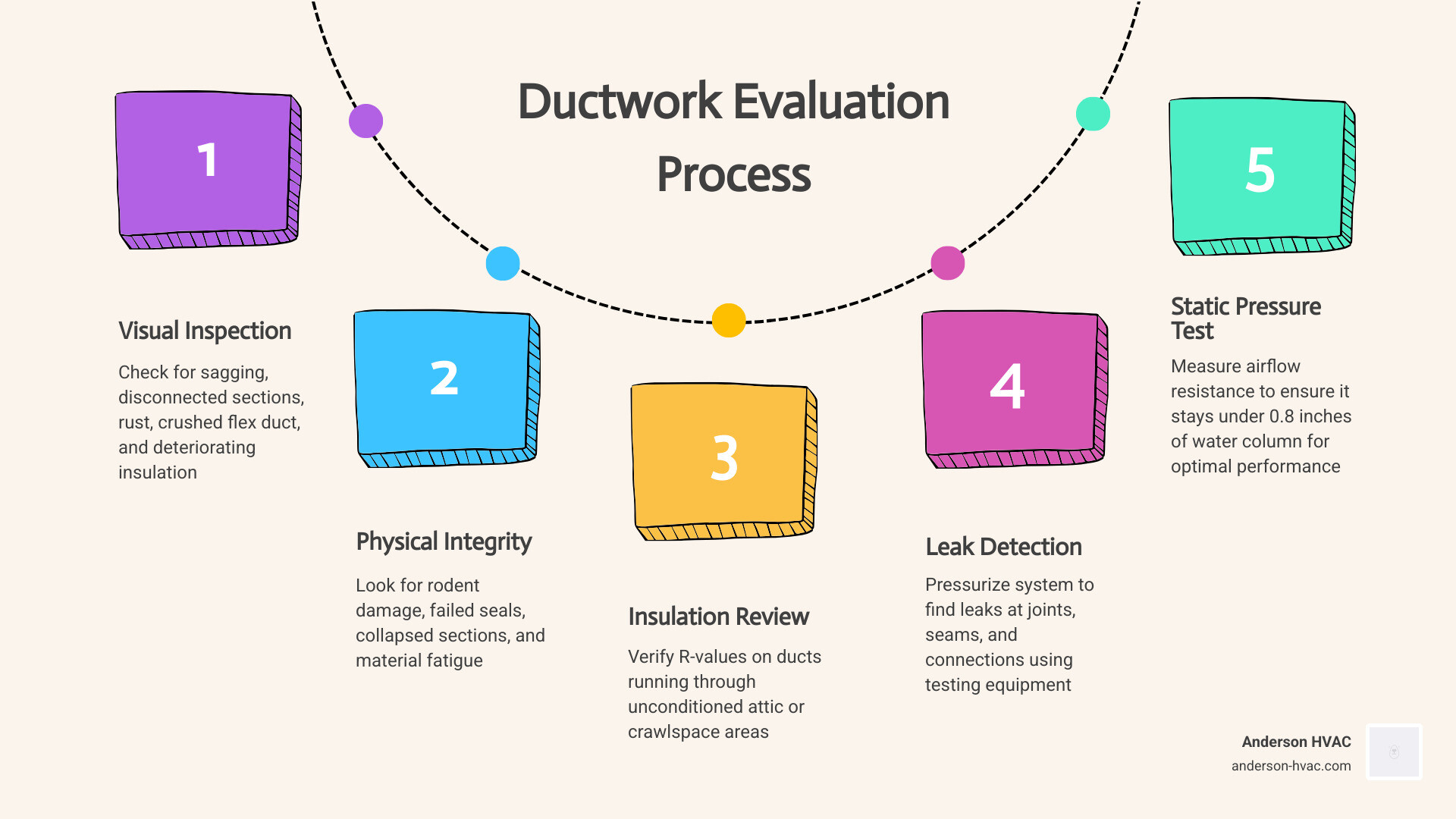
How ductwork is evaluated during ac replacement terms simplified:
Why Evaluating Ductwork Is Critical During AC Replacement
When we replace an air conditioner, our primary goal is to ensure your home remains a comfortable sanctuary during our hot Northern Utah summers. However, simply swapping out an old outdoor condenser and indoor evaporator coil is only half the job.
If we connect a state-of-the-art, high-efficiency AC system to a compromised, decaying, or poorly designed network of ducts, the entire system will struggle. Understanding how ductwork is evaluated during ac replacement helps you realize why this evaluation is so critical to your system’s overall health and your indoor comfort.
The most critical factor in ductwork health is static pressure. Think of static pressure as the “blood pressure” of your heating and cooling system. It measures the resistance the blower motor must overcome to push conditioned air through your home and pull stale air back. When ducts are too narrow, clogged, or poorly routed, the static pressure spikes.
High static pressure forces your blower motor to work significantly harder, leading to premature motor failure and skyrocketing energy bills.
This pressure is particularly problematic for modern variable-speed AC units. These high-efficiency systems are incredibly sensitive to airflow restrictions. While older, single-speed motors might have simply run at their standard speed regardless of the resistance (resulting in weak airflow at the registers), modern Electronically Commutated Motors (ECM) will actively ramp up their speed to overcome high static pressure.
While this keeps your airflow consistent, it causes the motor to consume massive amounts of electricity and can eventually burn out the motor entirely. Furthermore, restricted airflow can cause the temperature of your indoor evaporator coil to drop below freezing, leading to a frozen coil, water leaks, and potential compressor failure.
By thoroughly assessing your home’s air delivery system, we protect your new equipment, optimize your energy savings, and prevent unexpected breakdowns. If you are preparing for an upgrade, checking out The Ultimate Guide to What to Expect During AC Replacement and learning How to Prepare Your Home for AC Replacement can help you get ready for this essential diagnostic process.
The Step-by-Step Process of How Ductwork Is Evaluated During AC Replacement
Evaluating a duct system is a scientific process that combines visual inspection with precise mechanical testing. When our experienced technicians visit your home, they do not just peek into your utility closet and guess. They follow a comprehensive, multi-step diagnostic routine to build a complete profile of your ductwork’s physical and mechanical health.
The evaluation begins with a detailed visual inspection. We examine all accessible portions of your ductwork in your basement, attic, crawlspace, or utility rooms. During this phase, we look for physical integrity issues such as rusted metal, crushed or kinked flexible ducts, disconnected joints, and sagging runs.
We also inspect the quality of the existing seals — looking for brittle, peeling duct tape (which, ironically, is terrible for sealing ducts) or degraded mastic.
Next, we evaluate the insulation R-values on any ducts running through unconditioned spaces. In Northern Utah, attics and crawlspaces experience extreme temperature swings. If your ducts lack adequate insulation (we recommend at least R-8 for attics), the cold air traveling through them during the summer will absorb heat before it ever reaches your living spaces.
This visual and physical inspection ensures we catch obvious structural flaws before moving on to deeper, more technical evaluations.
Whether you are planning an Everything You Need to Know About AC Unit Replacement in Clinton or scheduling an Everything You Need to Know About Air Conditioner Replacement in Brigham City UT, this rigorous diagnostic process is the first step toward a perfect installation.
How Ductwork Is Evaluated During AC Replacement for Sizing and Airflow
The size of your ducts determines how much air they can safely carry. To evaluate this, we perform Manual D calculations, which is the industry standard for residential duct design. We compare the physical diameter of your existing supply and return ducts against the airflow requirements of your new air conditioner.
The gold standard for residential cooling systems is 400 Cubic Feet per Minute (CFM) of airflow per ton of cooling capacity. For example, a 3.5-ton AC system requires exactly 1,400 CFM of total airflow to operate correctly.
To see how easily a system can be bottlenecked, consider standard duct capacities at a typical friction rate:
- A 6-inch branch duct can handle about 100 CFM.
- An 8-inch duct can handle about 200 CFM.
- A 12-inch duct can handle about 500 CFM.
- A 16-inch main trunk duct can handle about 1,050 CFM.
If a contractor installs a 3.5-ton AC system in a home that only has a single 16-inch return air duct, the system will be short by 350 CFM! This undersized return air capacity acts like a choke point, starving the system of air, making the registers whistle loudly, and putting immense strain on the blower motor.
We measure every trunk line and branch run to ensure your ductwork can handle the volume of air your new system needs to move, which is a vital step during a Everything You Need to Know About New AC Installation in Kaysville UT.
Measuring Total Duct Leakage and Grading Performance
Even a perfectly sized duct system will waste energy if it is riddled with leaks. To measure this, we perform specialized duct leakage testing. This test involves sealing all your supply and return registers and using a calibrated fan (often called a duct blaster) to pressurize the duct system. By measuring the airflow required to maintain a specific pressure, we can calculate exactly how much air is escaping through cracks, seams, and disconnected joints.
Under industry standards like RESNET/ACCA/ANSI Standard 310, duct systems are graded based on their total leakage rates:
- Grade I (LPT < 4%): This is the highest quality tier. It means the system is exceptionally tight, losing less than 4 CFM per 100 square feet of conditioned floor area.
- Grade II (LPT 4% to 8%): This represents moderate leakage. While acceptable in some older installations, there is still room for improvement.
- Grade III (LPT > 8%): This represents severe leakage. Systems in this tier are dumping substantial amounts of conditioned air into unconditioned spaces like attics or crawlspaces, leading to high utility bills and poor comfort.
Identifying these leaks is especially important in homes across Pleasant View, where hot attics can quickly ruin your cooling efficiency. To find out more about keeping your home comfortable, read AC Replacement in Pleasant View UT: A Homeowner’s Guide to Staying Chilled.
Evaluating Blower Fan Volumetric Airflow and System Compatibility
A critical phase of the evaluation is verifying how your existing blower fan interacts with your duct system. The blower fan, located inside your furnace or air handler, is the heart of your home’s air circulation. During our evaluation, we measure the actual volumetric airflow moving across your indoor coil.
This step is essential when upgrading to a modern system equipped with a variable-speed ECM blower. Unlike older, single-speed PSC motors, an ECM motor adjusts its power output based on the resistance it senses. If your ducts are restricted, the ECM motor will spin faster and harder to deliver the programmed CFM.
While this ensures you get the cooling you need, it can make the air rushing out of your vents sound incredibly loud and “angry,” while also wearing out the expensive motor prematurely. We verify that your blower fan and ductwork are perfectly matched to prevent these issues, keeping your home quiet and comfortable.
For residents in mountain communities, checking this compatibility is a must. Learn more by reading Don’t Lose Your Cool During AC Replacement in Huntsville UT.
How Ductwork Is Evaluated During AC Replacement for Design Verification
Before we finalize any recommendations, we perform a comprehensive design verification. We review your home’s layout, taking into account architectural plans, square footage, window placement, and insulation levels. This information allows us to perform accurate Manual J load calculations to determine exactly how much cooling each individual room requires.
We then compare these room-by-room load requirements against your existing duct layout. We verify that:
- The main supply trunk lines taper correctly to maintain air velocity.
- The branch lines are balanced so that rooms furthest from the equipment receive their fair share of air.
- The return air grilles are strategically placed to pull stale air back efficiently.
This design verification ensures that your existing duct network is physically capable of distributing air evenly. Without it, you might end up with a brand-new AC that leaves your master bedroom sweltering while your living room is a freezer.
For homeowners in North Ogden, taking the time to verify this design is the key to a stress-free upgrade. Discover more tips in How to Handle an AC System Replacement in North Ogden Without Losing Your Cool.
Deciding Between Duct Sealing, Repair, and Full Replacement
Once we complete our evaluation, we present you with a clear, objective assessment of your ductwork’s condition. The big question then becomes: can we seal and repair your existing ducts, or is it time for a full replacement?
Making this decision requires balancing several factors, including the age of your ducts, the severity of any design flaws, material fatigue, and potential health hazards like mold or asbestos. For example, older homes in Brigham City may have duct joints sealed with old “white tape” that contains asbestos, which requires professional abatement rather than simple repairs.
Similarly, if your home has old, grey-plastic flexible ductwork from the 1980s or 1990s, the inner plastic liner has likely become brittle and started flaking into your airstream, making a replacement the only healthy option.
To help you understand your options, here is a quick comparison of duct sealing versus full replacement:
| Feature / Scenario | Duct Sealing & Repair | Full Duct Replacement |
|---|---|---|
| Best For | Tight budgets, minor leaks, accessible joints, and structurally sound duct systems. | Crushed or collapsed runs, severe mold, undersized trunk lines, and systems older than 20 years. |
| Airflow Impact | Restores lost pressure and ensures air reaches its intended destination. | Corrects fundamental design flaws, increases capacity, and balances airflow room-by-room. |
| Efficiency Gain | Typically improves HVAC efficiency by 10% to 15%. | Can improve overall system efficiency by 20% to 30%. |
| Air Quality Impact | Stops dust and attic insulation from being pulled into the duct system. | Completely eliminates old dust, mold, pet dander, and deteriorated fiberglass liners. |
| When to Choose | If your ducts are sized correctly but leak at the seams. | If your ducts are fundamentally undersized or structurally failing. |
Addressing these issues during an AC upgrade is highly efficient because our team is already working on your system. If you are also planning for the winter months, you can learn how these systems tie together in Everything You Need to Know About Heating Installation in Brigham City UT.
Common Ductwork Problems in Older Homes
Older homes across Northern Utah have incredible character, but their duct systems often leave much to be desired. Some of the most common issues we find include:
- Air Leaks at Joints and Seams: Over decades, temperature swings cause metal ducts to expand and contract, eventually breaking old tape seals and letting conditioned air escape into your crawlspace or attic.
- Poor or Missing Insulation: Many older homes have uninsulated metal ducts running through freezing crawlspaces or scorching attics, leading to massive thermal losses.
- Undersized or Missing Return Air Ducts: Older heating systems often relied on a single return grille on the main floor. Modern air conditioners need dedicated, balanced return paths to keep air moving smoothly.
- Poor Layout Choices: We frequently see the “octopus layout,” where long, tangled runs of flexible duct are draped haphazardly over attic joists, creating major kinks and restricting airflow.
When to Seal and Repair Existing Ducts
If your ductwork is structurally sound, properly sized, and free of major contaminants, targeted sealing and repairs are highly effective. We focus on sealing all accessible joints, seams, and connections using professional-grade paint-on mastic sealant reinforced with fiberglass mesh.
We may also use high-quality UL-181 foil tape for tight spaces. This process stops conditioned air from escaping and prevents dusty, unconditioned attic air from being sucked into your home’s breathing air.
When a Full Replacement Is Necessary
Sometimes, repairs are simply “good money after bad.” A full duct replacement is necessary when:
- Ducts Are Severely Crushed or Damaged: If flexible ducts have been crushed by storage boxes in the attic or chewed through by rodents, they cannot be reliably repaired.
- There Is Active Mold Contamination: If moisture has gotten inside insulated ducts or duct board, mold can grow within the porous lining, posing a serious health risk.
- The System Is Badly Undersized: If your existing duct trunk lines cannot support the CFM requirements of your new, high-efficiency AC, keeping them will choke your new system and cause it to fail prematurely.
Frequently Asked Questions About Ductwork Inspections
How long does a professional ductwork evaluation take?
A thorough, professional ductwork evaluation typically takes between 45 and 90 minutes. This includes a comprehensive visual assessment of all accessible runs, measuring duct diameters, inspecting insulation quality, and performing static pressure tests using a digital manometer.
If we perform a pressurized duct leakage test, it may take a bit longer, but it provides highly accurate data to guide your replacement decisions.
Can I keep my old ducts if I upgrade to a high-efficiency AC?
Yes, you can often keep your existing ducts, but only if they are sized correctly and in good structural condition. Modern high-efficiency AC systems, especially those with variable-speed blowers, require precise airflow to meet their SEER2 efficiency ratings.
If your old ducts are leaky or undersized, your new high-efficiency system will not deliver the energy savings you expect, and the increased static pressure could damage the new equipment.
What are the risks of using undersized or leaky ducts with a new AC?
Using compromised ducts with a new air conditioner carries several serious risks:
- Frozen Evaporator Coils: Restricting airflow causes the indoor coil to drop below freezing, turning condensation into ice and blocking all cooling.
- Premature Compressor Failure: Liquid refrigerant can flood back to the outdoor compressor if the indoor coil cannot absorb enough heat, destroying the most expensive part of your system.
- Excessive System Noise: Forcing high volumes of air through narrow ducts creates loud whistling, rattling, and rushing noises at your vents.
- Skyrocketing Energy Bills: Leaking 20% to 30% of your cooled air into an empty attic means your system has to run much longer to cool your home.
Conclusion
Your home’s ductwork is the hidden highway that delivers comfort, health, and efficiency to every room. When it is time to replace your air conditioner, taking the time to evaluate this critical infrastructure ensures you get the full performance, longevity, and quiet comfort you are paying for.
At Anderson HVAC, we have spent over 40 years helping our neighbors across Northern Utah stay comfortable in their homes. As a family-owned business, we believe in doing the job right the first time — with personalized service, technical expertise, and a commitment to exceeding your expectations.
If you are ready to upgrade your cooling system and want to ensure your home’s air delivery network is up to the task, we are here to help. Schedule your professional AC replacement in North Ogden today and let our family take care of yours.

