


Your Quick Answer: How Often to Change Your AC Filter in High Desert Four-Season Conditions
How often to change your ac filter in high desert four season conditions is one of the most important maintenance questions you can ask as a Northern Utah homeowner — and the answer is very different from the generic advice on the back of a filter box.
In high desert climates like Northern Utah, standard guidelines simply don’t hold up. Extreme heat, dry winds, dust storms, and four distinct seasons put your filter to work far harder than in milder regions. A filter that might last 90 days in a coastal city can be completely clogged in 30 days or less here.
Here’s a fast-reference guide based on your situation:
| Household Condition | Recommended Change Frequency |
|---|---|
| Standard home, low dust, no pets | Every 60 days |
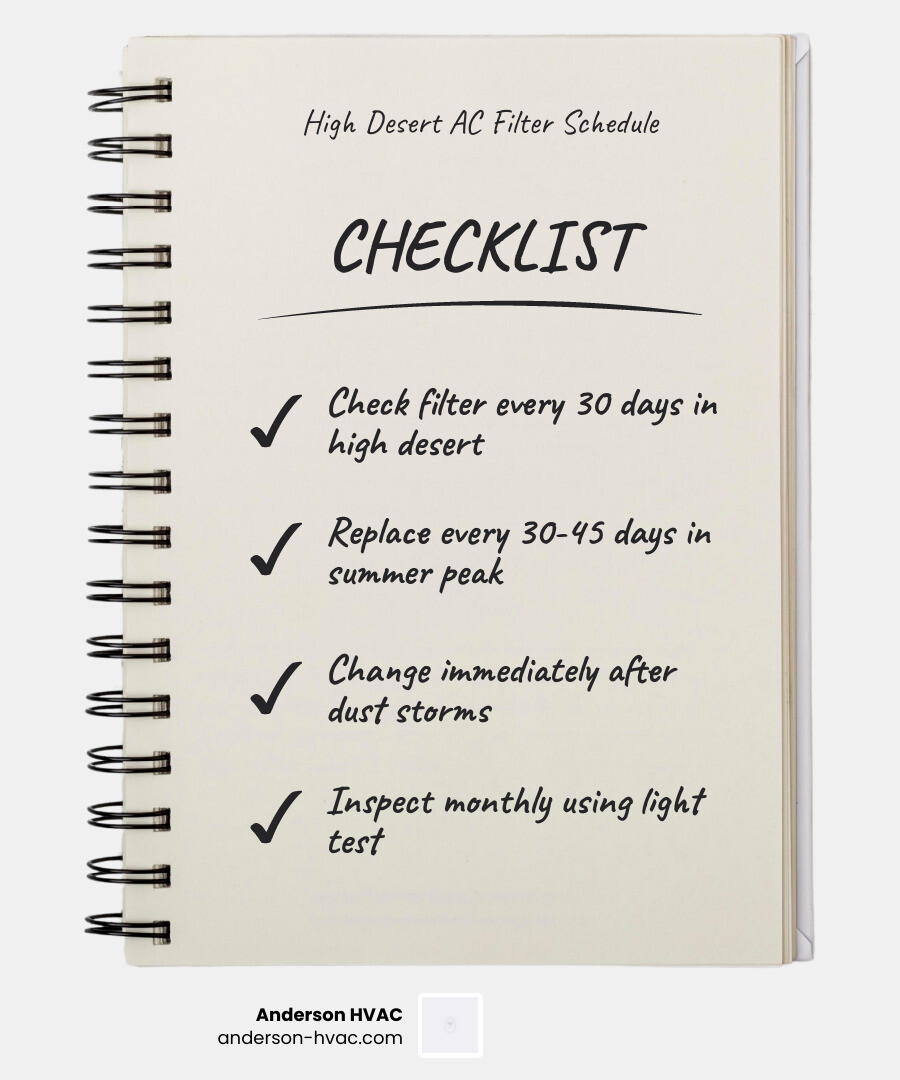
| Summer peak season (June–September) | Every 30–45 days |
| Home with 1 pet | Every 30–45 days |
| Home with multiple pets or allergies | Every 20–30 days |
| After a dust storm or wildfire smoke event | Immediately |
| Winter heating season | Every 45–60 days |
| Spring pollen peak | Every 30–45 days |
| 1-inch fiberglass filter (any season) | Every 30 days or less |
| 4–5 inch media filter | Every 3–6 months |
The bottom line: check your filter every month without fail, and replace it the moment it looks gray, matted, or blocks light when held up to a lamp. In the high desert, your eyes are a better guide than any calendar.
Here in Ogden and across Northern Utah, the combination of dry air, wind-driven silt, seasonal pollen, and months of heavy AC use creates a uniquely tough environment for HVAC filters. When a filter gets overwhelmed, your system works harder, your energy bills climb, and your indoor air quality drops — all problems that are easy to prevent with the right schedule.
Anderson HVAC has spent over 40 years helping Northern Utah homeowners stay ahead of exactly these challenges. This guide will walk you through everything you need to know — season by season, filter type by filter type — so your system runs clean and efficient all year long.
Why High Desert Climates Demand More Frequent Filter Changes
Living in places like North Ogden or Brigham City means dealing with a specific “cocktail” of airborne debris. Unlike humid climates where moisture can help settle dust, our high desert environment keeps particulate matter suspended in the air. When the wind picks up, it carries fine silt, agricultural dust from nearby valleys, and organic debris directly into your home’s intake.
During the peak of May 2026, we’ve seen how quickly a single windstorm can saturate a filter. In desert conditions, dust acts as a thermal blanket on your system’s components. If that dust makes it past a clogged filter, it coats your evaporator coils, reducing heat transfer efficiency by 20% to 30%. This “mechanical fatigue” is why systems in our region often fail in under 10 years if neglected, whereas a well-maintained unit can last 15 to 20 years. For a deeper dive into managing the unique dust levels in our area, check out The Mountain Green Homeowners Guide To Not Living In A Dust Bowl/.
The Impact of Arid Air and Wind
Arid air is inherently lighter and allows fine particulates to travel further. When we experience high-wind events or “haboobs” (large-scale dust storms), the concentration of soil and silt in the air skyrockets. Furthermore, the dry air in Northern Utah contributes to static electricity, which can actually cause dust to “stick” to your filter fibers more aggressively than in other climates.
This wind-driven debris doesn’t just sit on the filter; it can be forced into the ductwork. If you find yourself changing filters every two weeks and still seeing dust on your furniture, you might have larger issues with your air channels. You can learn more about Why Your Home Needs Air Duct Cleaning In Morgan Ut Right Now/ to see how the desert environment impacts your entire ventilation system.
How often to change your ac filter in high desert four season conditions
When determining how often to change your ac filter in high desert four season conditions, the type of filter you use is the primary factor. Not all filters are created equal, especially when facing Utah’s silt and pollen.
| Filter Type | Thickness | Desert Lifespan (Avg) | Peak Season Lifespan |
|---|---|---|---|
| Fiberglass | 1-inch | 30 Days | 20 Days |
| Pleated (Basic) | 1-inch | 60–90 Days | 30–45 Days |
| Pleated (High-MERV) | 1-inch | 30–60 Days | 30 Days |
| Media Filter | 4–5 inch | 6 Months | 3–4 Months |
Fiberglass filters are the “budget” option, but they offer minimal protection. They are designed to catch large “boulders” of dust to protect the motor, but they let fine desert silt pass right through. We generally recommend pleated filters for our customers in Layton and Kaysville because the increased surface area handles our dusty environment much better. However, because they catch more, they clog faster. A clogged filter can restrict airflow by up to 50%, forcing your blower motor to work overtime and spiking your energy bills by 5% to 15%.
Seasonal breakdown for how often to change your ac filter in high desert four season conditions
Our four-season climate means your filter’s workload changes every few months:
- Summer (June–September): This is the “marathon” season. Your AC might run 10 to 14 hours a day. With constant airflow and summer dust storms, check your filter every 20 to 30 days.
- Fall (October–November): As the harvest begins in agricultural areas near West Haven and Plain City, fine dust and dried plant matter fill the air. Even if you aren’t running the AC as much, the furnace cycles begin, and that harvest dust can quickly mat down a filter.
- Winter (December–February): We spend more time indoors with windows shut. This traps indoor pollutants like pet dander and skin flakes. While there is less outdoor dust, the high run-time of your heater means you should still replace the filter every 45 to 60 days. To prepare for the transition between these seasons, read Everything You Need To Know About Duct Cleaning In Kaysville Ut/.
- Spring (March–May): Pollen is the enemy here. Sagebrush, juniper, and local grasses create a “yellow dust” that can saturate a filter. If you suffer from seasonal allergies, a fresh filter every 30 days is a must.
Impact of pets and allergies on how often to change your ac filter in high desert four season conditions
If you have furry family members, your HVAC filter acts as a giant lint trap. In the high desert, pets tend to shed more during the transition into summer and winter. This hair and dander combine with outdoor dust to create a thick, felt-like layer on your filter.
For households in North Ogden with multiple pets or residents suffering from asthma, we recommend checking the filter every 15 to 20 days. A clean filter can reduce allergy and cold symptoms by up to 70% by keeping those triggers out of your breathing air. If your home still feels “stuffy” despite regular changes, it might be time for Air Duct Cleaning In North Ogden Ut For A Fresher Home/ to remove the deep-seated dander that filters can’t reach.
Choosing the Right MERV Rating for Northern Utah Homes
MERV (Minimum Efficiency Reporting Value) ratings range from 1 to 20, but for most Northern Utah homes, the “sweet spot” is between MERV 8 and MERV 11.
- MERV 8: Great for standard homes. It catches dust, pollen, and mold spores without putting too much strain on your blower motor.
- MERV 11: Ideal for homes with pets or mild allergies. It catches finer particles like pet dander and car exhaust.
- MERV 13: These are excellent for capturing microscopic particles, including wildfire smoke and bacteria. However, they are very dense. In older systems common in Huntsville or South Ogden, a MERV 13 filter can actually act like a clog even when it’s clean, causing “static pressure” that can burn out your motor.
Choosing the right rating is a balancing act. You want the cleanest air possible, but you don’t want to choke your system. For residents in more rural areas, understanding local air quality is key. See The Definitive List Of Best Duct Cleaning In Huntsville Ut/ for more on how to manage air quality in different Northern Utah environments.
Balancing Filtration and Airflow
In the high desert, cooling capacity is everything. When temperatures hit triple digits in Syracuse or Clinton, your AC needs maximum airflow to keep the evaporator coils from freezing. If you use a filter that is too restrictive (high MERV) and leave it in too long, the lack of airflow will cause the system to “short cycle” — turning on and off rapidly. This is a leading cause of compressor failure, which is the most expensive repair an AC can face.
During wildfire season, which has unfortunately become a staple of our four-season cycle, you might be tempted to use the highest MERV filter available. While this helps with smoke, you must be prepared to change it much more frequently—sometimes every two weeks—to prevent system damage. For those looking for a balance between high-end filtration and affordability, check out Budget Friendly Duct Cleaning In Kaysville Ut That Actually Works/.
Signs Your Filter is Clogged and Affecting Performance
Waiting for a specific date on the calendar is a mistake in the high desert. Instead, you should look for the physical warning signs that your filter has reached its limit.
- The Light Test: This is the gold standard for DIY inspection. Remove your filter and hold it up to a bright light or the sun. If you cannot see light passing through the fibers, the filter is “loaded” and needs to be replaced immediately.
- Weak Airflow: If the air coming out of your registers feels “lazy” or weak, a clogged filter is the most likely culprit.
- Increased Dust: If you notice a layer of dust on surfaces near your return vents shortly after cleaning, your filter may be so full that air is “blowing by” the edges, carrying dust directly into your home.
- Strange Noises: A whistling or humming sound near the intake often means your system is struggling to “inhale” through a blocked filter.
- Energy Spikes: An unexplained 10% to 20% jump in your utility bill often points to a system working twice as hard to move air through a dirty filter.
Visual Inspection and Testing
We recommend a 15-day visual check for any home in a high-dust area like West Point or Farr West. It only takes a minute to pull the filter and look at the color. A new filter is typically white or light yellow; a desert-saturated filter will be a dull gray or even blackish-brown from tire rubber and soot if you live near a major road like I-15.
If you find that your filters are turning gray very quickly (under 20 days), it’s a sign that your home’s “envelope” might be leaky, pulling in more outdoor dust than it should. This is often linked to dirty ductwork that acts as a reservoir for desert silt. Regular Air Duct Cleaning In North Ogden Ut For A Fresher Home/ can help break this cycle.
Frequently Asked Questions about Desert AC Maintenance
Does wildfire smoke affect my replacement schedule?
Absolutely. Wildfire smoke consists of extremely fine ash and particulates that can clog a high-efficiency filter in a matter of days. During heavy smoke events, we recommend running your HVAC fan in the “ON” or “CIRC” position to continuously scrub the air, but you must check the filter every 48 to 72 hours. Replace it immediately once the smoke clears to ensure your system isn’t strained.
Can a dirty filter really damage my AC system?
Yes, and the damage can be catastrophic. A clogged filter restricts the warm air from reaching the evaporator coils. Without that heat, the refrigerant stays too cold, causing the coils to freeze into a block of ice. This can lead to liquid refrigerant “slugging” back into the compressor, which will destroy it. A $15 filter change can truly prevent a multi-thousand-dollar system replacement.
Why does my filter get dirty faster in the winter?
While there is less “blowing dust” in a Utah winter, we keep our homes sealed tight. This means every bit of skin dander, lint from blankets, and indoor cooking smoke stays inside. Because the furnace runs almost constantly during a cold snap in Morgan or Huntsville, the filter processes a huge volume of this indoor air, often clogging just as fast as it does in the summer.
Conclusion
Mastering how often to change your ac filter in high desert four season conditions is the simplest and most effective way to protect your home’s comfort and your wallet. In Northern Utah, we can’t use a “set it and forget it” mentality. Our environment is beautiful, but it is undeniably dusty and demanding.
At Anderson HVAC, we’ve been the trusted name in Northern Utah comfort for over 40 years. As a family-owned business based right here in Ogden, we understand the unique challenges our climate poses to your heating and cooling systems. Whether you need a professional tune-up to catch those “hidden gremlins” before summer hits or you’re looking to upgrade to a high-capacity media filter that can handle the desert dust better, we are here to help.
Don’t let the dust win. Keep your air clean, your bills low, and your system running strong for years to come. Schedule your professional air conditioning services in North Ogden today and experience the personalized, expert service that our community has relied on since the 1980s.

