


Why the Advantages of Serving Both Residential and Commercial Clients Matter for HVAC Businesses
The advantages of serving both residential and commercial clients are some of the most overlooked growth levers in the HVAC industry — and for businesses in Northern Utah, they can make the difference between a company that survives seasonal swings and one that thrives year-round.
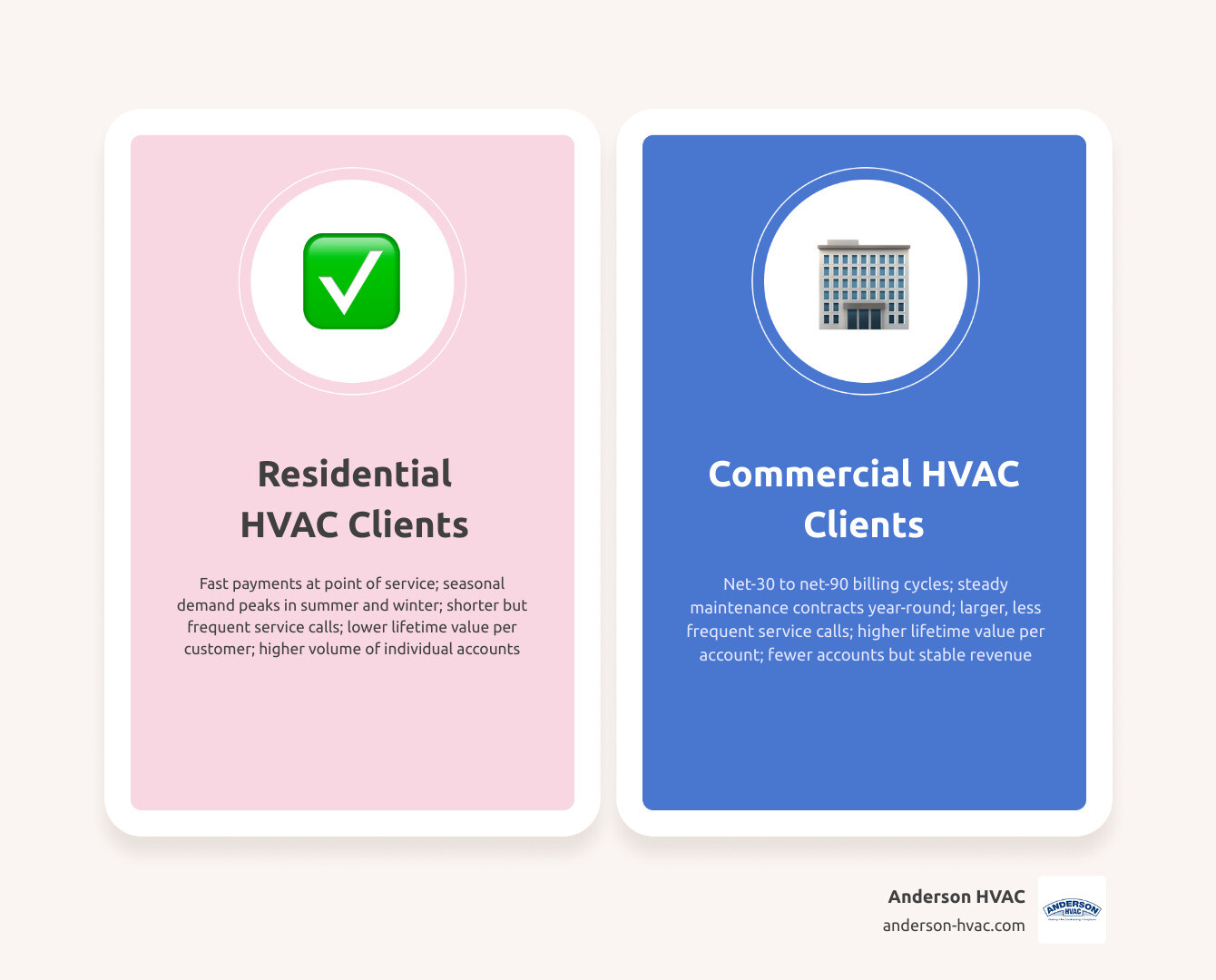
Most HVAC contractors start with one market. Residential work is , relationship-driven, and pays quickly. Commercial work is steady, contract-based, and anchors revenue through slower seasons. But here is what the data consistently shows: businesses averaging $500,000 or more in annual revenue typically have both in their revenue mix.
Here is a quick look at the core advantages:
- Revenue stability — commercial contracts fill gaps when residential demand dips in spring and fall
- Reduced risk — spreading income across dozens of homeowners and several commercial accounts protects against losing any single client
- Higher lifetime value — commercial clients call 1-2 times per month versus 1-2 times per year for residential
- Operational efficiency — cross-trained technicians and shared equipment reduce downtime and travel costs
- Brand credibility — serving both segments builds a broader local reputation and generates cross-referral opportunities
- Cash flow balance — residential payments offset the 30-90 day payment cycles common with commercial accounts
- Seasonal smoothing — commercial maintenance contracts help stabilize revenue during Northern Utah’s winter and summer demand peaks
What makes this especially relevant in 2026 is the growing recognition that neither market alone is enough. Fewer than 20% of service businesses operate profitably in both residential and commercial markets at the same time — but the ones that do are typically the most stable and best-positioned for long-term growth.
For a family-owned HVAC company like Anderson HVAC, with over 40 years of serving Northern Utah homes and businesses, the dual-market approach is not just a strategy. It is a natural extension of what it means to be a trusted community partner.
Balancing Cash Flow and Revenue Stability
In the heating and cooling industry, seasonality is a constant presence. When the mild spring breezes and crisp autumn afternoons roll through the Wasatch Front, phones naturally stop ringing as often. Homeowners simply do not think about their heating or cooling systems when the outdoor temperature is comfortable. This is where the strategic balance of a dual-market model saves the day.
By diversifying our revenue across both residential and commercial sectors, we can smooth out these predictable seasonal dips. Commercial properties, such as offices, retail spaces, and local municipal buildings, require year-round ventilation, air filtration, and planned preventative maintenance. When residential demand cools down, our commercial accounts keep our service schedule full and our technicians busy.
Managing this balance requires a keen understanding of working capital and accounts receivable. While residential calls keep cash moving into the business immediately, commercial contracts provide a predictable baseline of scheduled work that allows us to plan our resources months in advance. If you are curious about how local home services stack up in our primary service area, you can explore Which Businesses Provide the Best Air Conditioning Repair Services in the North Ogden Area? to see how high-quality standards translate to local customer trust.
How the Advantages of Serving Both Residential and Commercial Clients Improve Cash Flow
To understand why a hybrid model is so financially resilient, we have to look at the mechanics of cash flow. In a residential-only business, you are paid almost immediately at the point of service. A technician repairs a furnace in Syracuse or replaces an AC unit in Layton, and the homeowner pays via credit card or check before the technician leaves the driveway. This provides excellent, immediate liquidity.
Commercial work, however, operates on a different financial timeline. Commercial clients—ranging from property management firms in Ogden to local businesses in Kaysville—typically request Net-30, Net-60, or even Net-90 billing terms. This means you might complete a large-scale commercial duct cleaning or rooftop unit repair today, but you won’t see the payment for two or three months.
This delay creates what financial planners call “receivables drag.” If a business only does commercial work, they must maintain massive cash reserves just to cover payroll and overhead while waiting for invoices to clear. But when you combine both models, the immediate cash collected from daily residential service calls directly funds the working capital needed to sustain those larger commercial accounts. The residential side keeps the lights on and the gas tanks full, while the commercial side secures long-term financial stability and larger project milestones.
Mitigating Client Concentration Risk with a Diversified Portfolio
Relying too heavily on a small handful of large commercial accounts is a dangerous gamble. If a commercial HVAC contractor gets 40% of their annual revenue from a single local office park or school district, losing that one contract due to a budget cut or property sale can instantly throw the business into a financial crisis.
This vulnerability is known as client concentration risk. The best way to mitigate this risk is by building a diversified portfolio that blends residential volume with commercial anchors.
- Residential Volume: Spreads your risk across hundreds of individual homeowners. If one homeowner relocates or chooses another provider, it has a negligible impact on your bottom line.
- Commercial Anchors: Provide larger, predictable contract values that allow for bulk purchasing of equipment and stable scheduling.
By serving both markets, we create a business model that is highly resistant to economic downturns. When discretionary residential spending slows down during tough economic times, our commercial maintenance agreements keep our revenue steady. Conversely, if local commercial real estate experiences a temporary lull, the high volume of residential repairs and replacements across Northern Utah keeps our team moving forward.
The Strategic Advantages of Serving Both Residential and Commercial Clients
Operating a hybrid HVAC business is not just about survival; it is about building a highly scalable and resilient brand. When a company successfully manages both residential and commercial systems, it unlocks unique market opportunities that single-focus competitors simply cannot access.
| Metric | Residential HVAC Model | Commercial HVAC Model | Hybrid Advantage |
|---|---|---|---|
| Typical Gross Margin | High (40% – 60%) | Moderate (25% – 40%) | High overall profitability |
| Payment Cycle | Immediate (Point of Sale) | 30 to 90 Days | Balanced, steady cash flow |
| Client Frequency | 1 – 2 times per year | 1 – 2 times per month | Maximum technician utilization |
| Acquisition Method | Local SEO, reviews, referrals | B2B networking, formal bids | Multi-channel brand authority |
| Contract Length | Seasonal / On-demand | Multi-year agreements | Long-term revenue predictability |
This balance of high-margin residential work and high-volume commercial contracts makes a hybrid business highly attractive from a strategic growth perspective. It builds a diverse customer lifetime value that supports steady, sustainable expansion.
Blending Industrial Precision with Personalized Residential Care
One of the most profound advantages of serving both residential and commercial clients is the cross-pollination of technical skills and customer service philosophies.
Commercial HVAC systems are complex, demanding, and governed by strict safety codes and structural regulations. Working on these heavy-duty systems instills a high level of technical discipline, safety protocol adherence, and diagnostic precision in our technicians. When those same technicians bring that commercial-grade discipline into a residential home in West Haven or Pleasant View, the homeowner benefits from an incredibly thorough, precise, and safe installation or repair.
At the same time, residential work is deeply personal. It requires empathy, clear communication, cleanliness, and a respectful attitude toward a family’s personal space. Our technicians learn to listen closely to homeowners’ comfort concerns, explaining complex airflow issues in simple, friendly terms. This emphasis on personalized care makes our team uniquely approachable and communicative when dealing with commercial property managers, who frequently complain about the lack of communication from traditional commercial contractors.
To see how this philosophy of customized, attentive service directly benefits local families, take a look at Individualized Service: How Anderson HVAC Sets the Bar for Home Comfort.
Leveraging the Advantages of Serving Both Residential and Commercial Clients for Brand Growth
In the local service industry, trust is the ultimate currency. Serving both residential and commercial clients supercharges your brand authority by creating a powerful web of cross-referrals and community connections.
Think about the natural overlap between a local business owner and a homeowner:
- The Business Owner’s Home: A business owner who trusts us to maintain the rooftop package units at their retail store in Farmington is highly likely to call us when the air conditioner at their personal home in Kaysville starts blowing warm air.
- The Employee Connection: When we keep a local office building comfortable and healthy, the employees working in that building notice. They see our branded service trucks, recognize our clean uniforms, and ask for our business cards when they need furnace work at their own homes.
- The Property Manager’s Network: Property managers who oversee apartment complexes, HOAs, and strip malls are deeply embedded in the local community. A strong relationship with a commercial manager often leads to dozens of residential referrals across nearby neighborhoods.
This dual-market presence naturally boosts our local SEO and organic search visibility. When residents see our service vehicles parked outside prominent local businesses as well as neighboring homes, it reinforces the message that we are an established, reliable, and versatile team. For instance, our reputation as one of Kaysville’s Top Rated Heating Companies Ranked is built directly on this foundation of community-wide trust and versatile technical expertise.
Operational Efficiency and Resource Optimization
To run a profitable service business, you must keep your resources—namely your vehicles, tools, and technicians—fully utilized. A hybrid service model allows for an incredible level of operational efficiency by ensuring that expensive equipment and specialized labor rarely sit idle.
Instead of maintaining two entirely separate operations, a well-managed hybrid business shares core resources. Our fleet vehicles, heavy-duty diagnostic tools, and administrative staff support both divisions. By using modern field service management software, we can seamlessly dispatch technicians to a residential AC tune-up in Farr West in the morning and a light commercial ventilation inspection in North Ogden in the afternoon. This level of flexibility maximizes our daily productivity and significantly lowers our operational overhead.
Cross-Training Technicians for Maximum Fleet Flexibility
The heart of our operational efficiency lies in our team of “Swiss Army Knife” technicians. By cross-training our technicians to handle both residential systems and light commercial equipment, we unlock unparalleled scheduling flexibility.
If a sudden heatwave strikes Northern Utah, causing a massive surge in residential emergency AC repair calls, we aren’t limited by a rigid staffing structure. We can quickly redeploy our cross-trained commercial maintenance crews to help our residential team handle the emergency volume. Conversely, during slower periods, those same technicians can focus on scheduled commercial system overhauls and duct cleaning projects.
This cross-market versatility also leads to:
- Enhanced Troubleshooting Speed: Technicians who understand complex commercial air handling and zoning systems can diagnose tricky residential airflow problems in a fraction of the time.
- Superior Safety Practices: The rigorous safety standards required for commercial rooftop work—including advanced electrical safety and fall protection—become second nature, raising the safety standards of every residential job we perform.
- Better Career Longevity: Technicians enjoy a varied work environment that keeps them engaged, challenged, and constantly learning new aspects of the trade.
To learn more about the value of routine maintenance and how experienced technicians keep systems running safely, check out Who Are the Top Rated HVAC Companies in North Ogden for Routine Maintenance?.
Streamlining Scheduling and Route Optimization
One of the biggest logistical hurdles in the service industry is coordinating travel times and access windows. Residential clients usually prefer early morning, late afternoon, or weekend appointments to accommodate their work schedules. Commercial clients, however, almost always prefer service during standard business hours (9 a.m. to 5 p.m.) to minimize disruption to their daily operations.
This difference in scheduling preferences is a major advantage for a hybrid business. It allows us to build incredibly efficient daily schedules:
- Early Morning: Technicians can handle residential maintenance or diagnostic calls before homeowners leave for work.
- Mid-Day: Crews can transition to commercial properties, performing scheduled maintenance, filter changes, and system inspections during normal business hours.
- Late Afternoon: Technicians can return to residential areas for end-of-day repair calls and installations.
By blending these two schedules, we dramatically reduce travel times and empty “windshield time” for our technicians. Our service vehicles spend less time stuck in traffic on I-15 and more time actively helping customers in communities like Roy, Syracuse, and South Ogden. This streamlined routing lowers fuel consumption, reduces wear and tear on our fleet, and allows us to offer faster, more reliable response times to everyone we serve.
Frequently Asked Questions about Dual-Market Services
Transitioning to or managing a dual-market service model comes with unique questions. Here are some of the most common inquiries we receive about how these two segments operate side-by-side.
What are the main operational differences between residential and commercial HVAC work?
The primary operational differences lie in system scale, complexity, and administrative requirements. Residential HVAC systems typically consist of split systems or packaged units ranging from 1.5 to 5 tons, designed to heat and cool a single-family home. The work is straightforward, usually completed in a few hours, and requires minimal structural coordination.
Commercial systems, even “light commercial” properties, are much larger and more complex. They often involve rooftop units (RTUs), sophisticated zoning systems, variable air volume (VAV) boxes, and advanced commercial ventilation. Operationally, commercial work requires stricter safety protocols, detailed compliance documentation, and coordination with building managers, tenants, and local code officials.
How do payment terms differ between commercial and residential clients?
Residential clients pay immediately upon completion of the work using credit cards, checks, or pre-arranged financing options. This provides rapid cash flow.
Commercial clients almost always operate on an invoicing system with established credit terms (typically Net-30 or Net-60). They require formal purchase orders, detailed service reports, and lien waivers before processing payments through their accounts payable departments. Managing a hybrid model requires using the steady cash from residential work to cover the temporary cash-flow gap created by commercial billing cycles.
Can a local HVAC company successfully manage both segments simultaneously?
Yes, but it requires the right digital infrastructure and organizational discipline. Attempting to run both residential and commercial services using paper schedules or basic calendars is a recipe for missed appointments and administrative chaos.
To succeed, a local company must invest in robust field service management software that handles real-time dispatching, automated customer notifications, digital invoicing, and detailed equipment tracking. It also requires a commitment to ongoing technician training so that the team remains equally comfortable working on a residential smart thermostat in Clinton or a commercial economizer in South Ogden.
Conclusion
At the end of the day, the advantages of serving both residential and commercial clients come down to one core concept: building a stronger, more resilient business that can better serve the entire community. By balancing the immediate, relationship-driven nature of residential service with the steady, contract-based stability of commercial work, we create a hybrid model that stands the test of time.
For over 40 years, Anderson HVAC has proudly served as Northern Utah’s trusted comfort partner. As a family-owned business, we understand that whether we are repairing a cozy fireplace in Huntsville, installing an energy-efficient ductless system in Clearfield, or maintaining a complex rooftop unit for a local business in North Ogden, our mission remains the same: to deliver honest, dependable craftsmanship and personalized service that exceeds expectations.
If you are a local business owner or property manager looking for a reliable partner to keep your commercial property comfortable, safe, and energy-efficient, we invite you to explore our specialized light commercial HVAC services in North Ogden, UT. From our family to yours, we are here to care for your comfort—every season, every day.

