


When Is a Mini Split Better Than Central AC? Here’s What Northern Utah Homeowners Need to Know
When is a mini split better than central AC comes down to a few key factors about your home — mainly whether you have ductwork, how many rooms you need to cool, and what your comfort goals are.
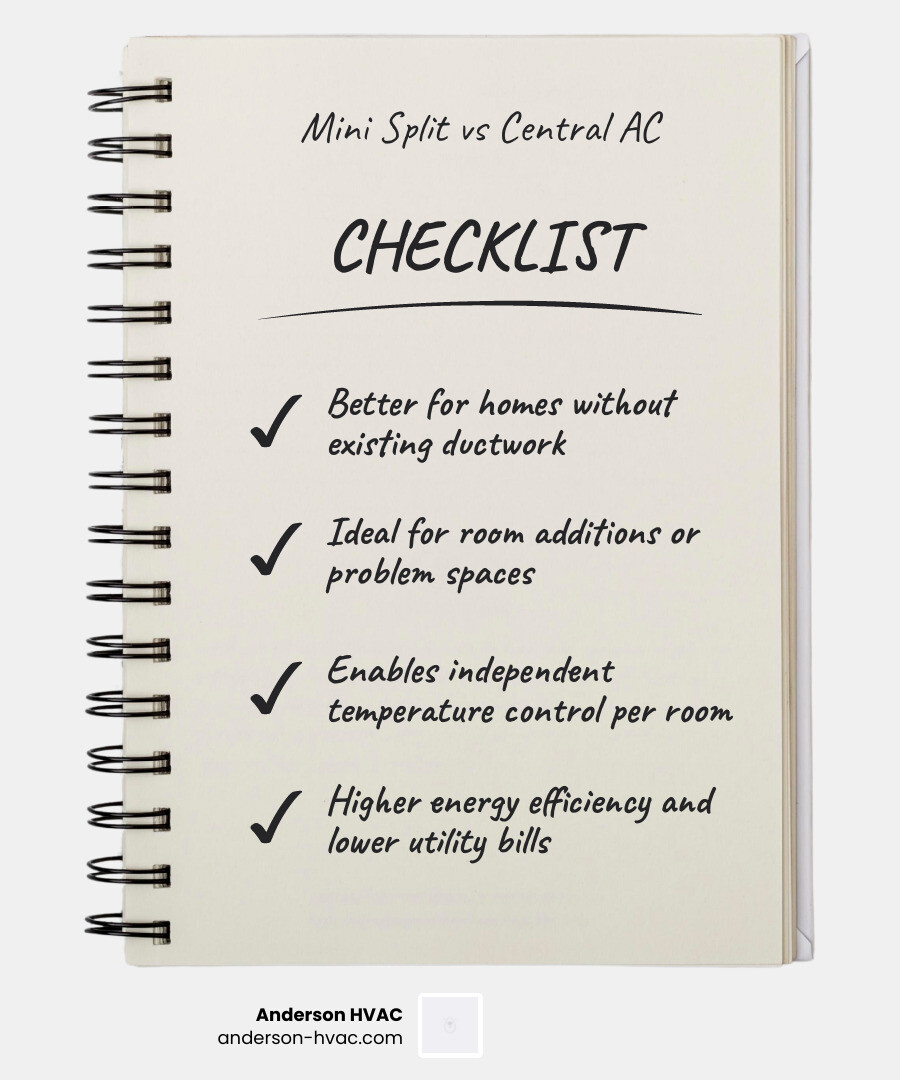
A mini split is better than central AC when:
- Your home has no existing ductwork (common in older Ogden and Northern Utah homes)
- You’re adding a room, finishing a basement, or converting a garage
- You have “problem rooms” that never reach the right temperature
- You want independent temperature control in different rooms
- You’re replacing both an aging AC and furnace at the same time
- You want higher energy efficiency and lower monthly utility bills
Central AC is usually the better fit when:
- Your home already has good, well-sealed ductwork
- You need to cool five or more rooms with similar usage patterns
- You prefer all climate control managed from a single thermostat
If you’re a homeowner in Northern Utah dealing with a system that isn’t keeping up — whether it’s a sweltering upstairs bedroom or a garage conversion that never cools down — understanding this difference can save you real money and frustration.
At Anderson HVAC, we’ve helped Northern Utah families navigate this exact choice for over 40 years. The answer isn’t always one or the other. Sometimes the smartest move is a combination of both.
Understanding the Core Differences: Ductless vs. Ducted Systems
Before deciding which path to take, it helps to understand how these two systems handle air. While both rely on the same basic refrigeration cycle to extract heat from your home and release it outside, their delivery methods are entirely different.
Choosing between them often impacts your long-term energy bills, your home’s indoor air quality, and how comfortable you feel during our hot Northern Utah summers. To get a foundational look at this comparison, you can read about The Cold Hard Truth About Ductless vs Ducted Cooling Pros and Cons.

How Central Air Conditioning Works
Central air conditioning is a ducted system. It relies on a single, centralized indoor air handler (often connected to your furnace) and an outdoor condenser unit.
The system cools air in one central location and then uses a powerful blower fan to push that air through a network of sheet metal or flexible ducts hidden behind your walls, ceilings, or floors. The air enters your living spaces through registers and returns to the system through centralized return grilles.
This process is governed by a single thermostat. When the temperature near that thermostat rises above your set point, the entire system turns on, cooling every room connected to the ductwork simultaneously, regardless of whether anyone is using those rooms.
How Ductless Mini Splits Works
A ductless mini split system completely eliminates the need for ductwork. Instead of one massive central unit, a mini split uses an outdoor compressor connected directly to one or more individual indoor air handlers mounted on your walls, ceilings, or floors.
These indoor units are connected to the outdoor compressor by a small bundle of lines containing refrigerant tubing, a suction line, power cables, and a condensate drain line. This bundle passes through a small, non-invasive three-inch hole drilled through your exterior wall.
What makes mini splits incredibly efficient is their use of inverter technology. While traditional central AC compressors operate on an “all-on or all-off” cycle—blasting cold air at full capacity and then shutting down—inverter-driven variable-speed compressors constantly adjust their speed to match the exact cooling demands of the room. They run continuously at lower, whisper-quiet speeds, maintaining a perfectly steady temperature while using a fraction of the electricity.
When Is a Mini Split Better Than Central AC for Your Home?
To help you visualize the core differences, here is a quick overview of how these two systems stack up across key categories:
| Feature | Ductless Mini Split | Central Air Conditioning |
|---|---|---|
| Ductwork Required | No | Yes |
| Zoning Capability | Built-in (independent control per head) | Requires complex, expensive damper systems |
| Energy Efficiency | Ultra-high (often 25 to 30+ SEER2) | Standard to high (typically 15 to 22 SEER2) |
| Aesthetics | Visible indoor wall or ceiling units | Hidden vents and registers |
| Air Filtration | Individual washable filters per room | Centralized high-MERV or HEPA filters |
| Lifespan | 15 to 20+ years (with proper care) | 12 to 15 years |
| Heating Capability | Yes (acts as a highly efficient heat pump) | Requires a separate furnace or ducted heat pump |
Every home in Northern Utah has a unique architectural footprint. The layout of your house, its age, and how you use your space will ultimately dictate whether a mini split or central AC is the superior choice.
When Is a Mini Split Better Than Central AC for Older Homes Without Ductwork?
Many historic properties in older neighborhoods of Ogden, Morgan, and Brigham City were built long before central air conditioning was invented. These beautiful homes often rely on radiant boiler heat or electric baseboards, meaning they completely lack existing ductwork.
If you want to install central air in a home without ducts, the installation process can be highly invasive. Technicians have to cut into plaster walls, build drop-ceilings, or sacrifice valuable closet space to route bulky metal ducts throughout the house. This structural disruption can compromise the architectural integrity and historic charm of your home.
This is when is a mini split better than central ac in the most obvious way. Installing a ductless mini split preserves your home’s plaster walls and original woodwork. The only physical modification required is a small hole through the exterior wall to run the refrigerant lines.
If you live in Morgan or the surrounding mountain valleys and have an older home that needs a non-invasive comfort upgrade, check out Your Local Guide to Ductless Mini Split Repair Services in Morgan to learn more about keeping these systems running perfectly.
When Is a Mini Split Better Than Central AC for Home Additions and Problem Rooms?
Perhaps your home already has a central AC system, but you’ve recently added a sunroom, finished a basement, or converted the garage into a home office. Extending your existing central ductwork to cover these new spaces is often incredibly complex.
Your current central air conditioner was sized specifically for your home’s original square footage. Forcing it to cool an extra room can overload the compressor, leading to premature system failure and uneven temperatures throughout the rest of your house.
Additionally, many homes have notorious “problem rooms”—like a bonus room over the garage or an attic guest suite—that always feel like a sauna in July, even when the downstairs is freezing.
A single-zone ductless mini split is the perfect, targeted solution for these spaces. It handles the local heat load independently, allowing you to keep your home office or guest space perfectly chilled without putting extra strain on your main central system.
If you are noticing comfort imbalances in your Kaysville home, you can read more about how local experts can help at Your Kaysville Home Needs Professional Ductless AC Repair Right Now.
Efficiency, Zoning, and Comfort Performance
When evaluating the long-term value of your HVAC investment, operational efficiency and daily comfort are the two most important factors. Mini splits offer unique engineering advantages in both areas.
Eliminating Energy Waste from Leaky Ductwork
Did you know that ducted systems lose a massive amount of their cooling capacity before the air ever reaches your living spaces? According to the U.S. Department of Energy and ENERGY STAR, the average ducted system loses 20% to 30% of its conditioned air through duct leaks, poorly sealed connections, and thermal transfer in unconditioned spaces like hot attics or crawlspaces.
This means if your monthly cooling bill is high, a significant portion of that money is literally escaping into your attic or floor joists.
Because mini splits deliver conditioned air directly from the indoor air handler straight into the room, they experience zero duct loss. Every bit of energy you pay for goes directly toward keeping your family comfortable.
If you are looking to maximize your home’s efficiency in Clinton or nearby areas, you can explore detailed maintenance tips at How to Fix Your Clinton Homes Ductless AC Without Losing Your Cool.
Achieving Precision Comfort with Zoned Cooling
With a traditional central air system, your entire home is treated as a single zone controlled by one thermostat. If you want to cool down your upstairs master bedroom at night, you have to cool the empty downstairs kitchen, living room, and dining room as well. This leads to massive energy waste.
Ductless mini splits feature built-in zone control by design. Each indoor unit operates on its own independent thermostat. This allows you to practice occupancy-based cooling:
- Keep the bedrooms cool at night while turning down the units in the living areas.
- Turn off the cooling entirely in guest rooms or home offices when they aren’t in use.
- Allow family members to customize the temperature in their own bedrooms to their exact preferences.
By only cooling the rooms you are actively using, you can significantly reduce your monthly utility bills while keeping everyone in the house perfectly comfortable.
For homeowners in West Point looking for reliable comfort solutions and specialized care, find out more at West Point’s Best Kept Secrets for Reliable Ductless AC Repair.
Aesthetic, Maintenance, and Heating Trade-offs
While mini splits excel in efficiency and flexibility, they do come with a different set of visual and maintenance considerations compared to central air systems.
Visual Impact and Maintenance Requirements
The most common objection to mini splits is their aesthetic footprint. While central air vents are flush with your walls or ceilings and virtually invisible, standard mini split indoor units are mounted directly on the wall.
Fortunately, modern manufacturers have made wall units incredibly sleek, quiet, and low-profile. For homeowners who still prefer a hidden look, we can install ceiling cassettes that sit flush with the drywall, or slim-duct units hidden behind a decorative grille. On the outside of your home, the refrigerant lines are neatly enclosed in paintable “line hides” that blend seamlessly into your home’s exterior siding or brick.
In terms of maintenance, both systems require regular attention to operate at peak efficiency:
- Central AC: Requires replacing the central air filter every 1 to 3 months. It also benefits from professional duct cleaning every few years to remove dust, pet dander, and allergens.
- Mini Splits: Feature individual washable mesh filters inside each indoor unit. Because these units recirculate air locally, these filters should be popped out and rinsed under a tap every 2 to 4 weeks during heavy use. They also require an annual or bi-annual professional deep cleaning to keep the indoor blowers and coils free of dust build-up.
Year-Round Comfort with Heat Pump Technology
Most modern mini splits are not just air conditioners—they are fully functional heat pumps. By reversing the refrigeration cycle, a mini split can extract heat from the outdoor air (even in freezing winter temperatures) and pump it indoors to heat your home.
This dual-functionality can change the financial math of your home comfort system. If you have an older home in Northern Utah with an aging central AC and a separate, inefficient gas furnace, replacing both with a multi-zone mini split heat pump system can provide highly efficient heating and cooling in one unified system.
Modern cold-climate heat pumps are designed to perform exceptionally well during our chilly Northern Utah winters, providing reliable, even heat without the dry, drafty airflow typical of older forced-air furnaces.
Frequently Asked Questions About Mini Splits vs. Central AC
Can a mini split system replace my entire central AC?
Yes, absolutely. Many homeowners choose to retire their old, leaky ductwork entirely and transition their entire home to a multi-zone mini split system. This is an excellent option when you are remodeling an older home, converting to an all-electric heating and cooling setup, or looking to maximize your home’s energy efficiency. A multi-zone outdoor compressor can typically power up to five or more indoor units, allowing you to create a customized comfort layout for your entire household.
How do noise levels compare between ductless and central systems?
Mini splits are the undisputed champions of quiet operation. Traditional central AC systems feature large, powerful blowers that create a noticeable “whoosh” of air rushing through the vents when the system kicks on.
In contrast, mini split indoor units use small, segmented tangential fan wheels that slice through the air quietly. On their lowest settings, indoor mini split heads operate at whisper-quiet levels—typically between 19 and 26 decibels (dB), which is quieter than a library or a soft whisper. The outdoor condenser units are also engineered to run much quieter than traditional, noisy central AC compressors.
What federal tax credits and incentives are available in 2026?
Because mini split heat pumps are highly energy-efficient, they qualify for substantial federal tax credits and local utility rebates. Under the federal Energy Efficient Home Improvement Credit (Section 25C), homeowners can claim a tax credit of up to 30% of the total project cost (up to a specific annual cap) for installing qualifying high-efficiency heat pump systems.
Additionally, local Utah utility companies often offer cash-back rebates for upgrading to energy-efficient ductless systems. Our team at Anderson HVAC stays up to date on all 2026 guidelines to help you maximize these savings.
Conclusion
Choosing between a mini split and central AC isn’t about finding which system is universally “better”—it’s about determining which system is the perfect match for your home’s unique layout, age, and comfort needs.
If your Northern Utah home has existing, well-maintained ductwork and you want simple, whole-house cooling, central AC is a highly reliable and practical option. However, if you are dealing with a home without ducts, an addition, persistent hot spots, or you want the absolute highest level of energy efficiency and zone control, a ductless mini split is the superior choice.
At Anderson HVAC, we bring over 40 years of local, family-owned experience to every home we visit. We don’t believe in one-size-fits-all solutions. Our skilled technicians will thoroughly evaluate your home’s layout, listen to your comfort goals, and design a custom heating and cooling system that fits your lifestyle perfectly.
Ready to explore your options? Discover our specialized Ductless HVAC Services in North Ogden, UT and across Northern Utah, or contact our friendly team today to schedule your personalized in-home consultation!

