


Why How Your Existing Ductwork Affects Your AC Choices Matters More Than You Think
How your existing ductwork affects your AC choices comes down to a few key factors — and getting them wrong can cost you comfort and money for years.
Here’s a quick summary:
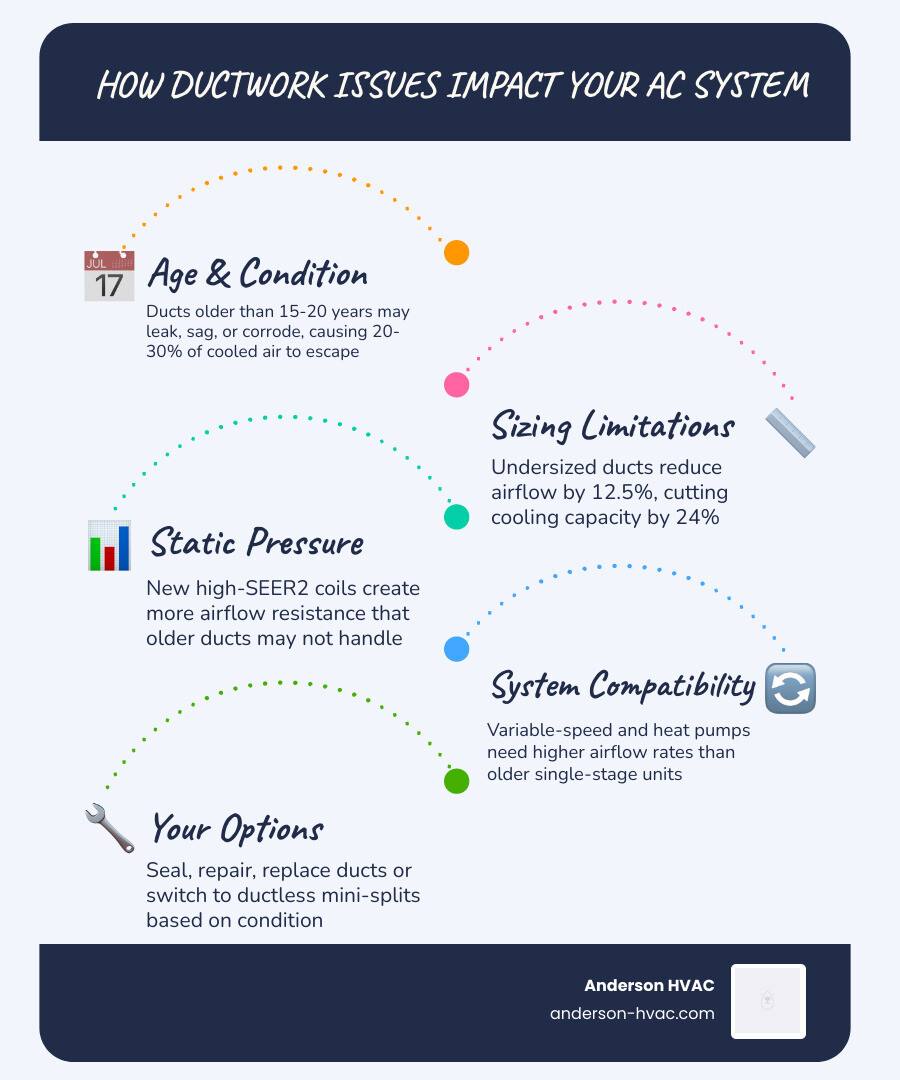
- Age and condition — Ducts older than 15-20 years may leak, sag, or corrode, causing 20-30% of cooled air to escape before it reaches your rooms.
- Sizing — Undersized ducts can’t move enough air for modern high-efficiency units. Reducing airflow by just 12.5% can cut cooling capacity by 24%.
- Static pressure — Newer high-SEER2 coils have denser fins that create more airflow resistance, which can overwhelm older duct systems.
- System compatibility — Variable-speed and heat pump systems need higher airflow rates than older single-stage units. Your ducts may not be built for that.
- Your best options — Depending on duct condition, you may need to seal, repair, replace, or skip ducts entirely with a ductless mini-split system.
Most homeowners replacing an AC unit focus entirely on the new equipment — the brand, the efficiency rating, the price. The ductwork stays out of sight and out of mind. But here in Northern Utah, where summers push AC systems hard and winters demand reliable airflow from heating systems too, that hidden network of ducts can quietly undermine even the most efficient new unit you install.
Think of it this way: putting a high-performance engine into a car with clogged, worn-out fuel lines won’t get you very far. The same logic applies to your HVAC system. If your ducts can’t support the airflow a modern AC needs, the unit will never perform the way it was designed to — no matter how high the SEER2 rating on the box.
How Your Existing Ductwork Affects Your AC Choices for High-Efficiency Systems
When we look at upgrading to a modern, high-efficiency cooling system, the physical differences between old and new equipment become incredibly important. Under current 2026 SEER2 standards, air conditioners are tested under more realistic, higher static pressure conditions than they were in the past. To achieve these higher efficiency ratings, manufacturers design modern indoor evaporator coils with tightly packed, dense fins.
While these dense fins are excellent at transferring heat out of your indoor air, they also create significantly more airflow resistance. If your existing ductwork is restrictive, choked with dust, or poorly designed, your new system’s blower motor will have to work twice as hard to push air through the indoor coil. This resistance is known as static pressure. High static pressure forces the system to consume more electricity, completely canceling out the energy-saving benefits of your high-SEER2 investment.
To make matters more complex, modern variable-speed air conditioners are highly sensitive to ductwork restrictions. Traditional single-stage air conditioners run at 100% capacity and then shut off. Variable-speed systems, however, are designed to run almost continuously at lower, whisper-quiet speeds to maintain a perfectly consistent indoor climate.
If the ductwork is leaky or improperly sized, a variable-speed system cannot accurately calculate the static pressure in the home. The system may continuously ramp up its fan speed to compensate for the restriction, leading to noisy vents, higher energy bills, and accelerated wear and tear on the blower motor. To maximize your comfort and ensure your system runs at peak efficiency, we always recommend pairing a high-efficiency system with a properly sealed and insulated duct network. You can learn more about how reducing the overall thermal load on your home makes your system’s job easier in our Beginners Guide to How Shade Insulation Sealing Reduce AC Workload.
How Your Existing Ductwork Affects Your AC Choices for Variable-Speed Heat Pumps
As more homeowners in Northern Utah transition from traditional gas furnaces to highly efficient electric heat pumps, ductwork compatibility has become a primary topic of discussion. While both systems distribute air through the same vents, they do so using very different temperature profiles and airflow rates.
A traditional gas furnace produces incredibly hot air—often between 120°F and 140°F. Because this air is so hot, a furnace can successfully heat a home even with relatively low airflow rates (measured in Cubic Feet per Minute, or CFM). Electric heat pumps, on the other hand, provide a more gradual, consistent warmth, delivering air that typically ranges between 95°F and 105°F.
To deliver the same amount of heating capacity throughout your home, a heat pump must move a larger volume of air. This means a heat pump requires higher CFM airflow rates than a furnace. If your existing ductwork was sized strictly for a furnace, it may be too narrow to handle the higher airflow volume required by a heat pump. Attempting to force this higher volume of air through undersized ducts will lead to loud, rushing wind noises at your registers, increased static pressure, and drafty, uneven temperatures.
Before converting to a heat pump, it is critical to have your ductwork evaluated to ensure it can support these higher airflow demands. If your current ducts cannot handle the volume, you may want to explore ductless alternatives. We break down the differences, benefits, and drawbacks of both approaches in The Cold Hard Truth About Ductless vs Ducted Cooling Pros and Cons.
How Your Existing Ductwork Affects Your AC Choices for Traditional Central AC Upgrades
Even if you choose to stick with a traditional central air conditioner upgrade rather than a heat pump, your legacy duct system can still dictate what equipment is actually viable for your home. Many older homes in communities like Kaysville, Layton, and North Ogden have duct systems that were installed 20, 30, or even 40 years ago. These legacy systems were designed for older, low-efficiency AC units that typically operated at 8 to 10 SEER.
Older systems used smaller, thinner evaporator coils that offered very little resistance to airflow. Because modern minimum efficiency standards require much larger coils to achieve better heat transfer, a straight swap of the outdoor condenser and indoor coil can create a major system mismatch. If we connect a new, high-efficiency evaporator coil to a legacy duct system without checking the physical dimensions and airflow capacity, the sudden increase in coil resistance can choke the system.
This is why we never guess when it comes to system sizing. A professional HVAC contractor must perform a Manual J load calculation to determine the exact cooling and heating needs of your home. This calculation takes into account your home’s square footage, insulation levels, window orientations, and local climate.
Once the load is calculated, we must verify that your existing ductwork can actually deliver the required CFM. If the ducts are too small for the calculated tonnage, we must either modify the ductwork or select a system capacity that matches the maximum safe airflow of your existing ducts. For a deeper dive into what to expect during a professional installation in our region, check out Everything You Need to Know About New AC Installation in Kaysville UT.
Signs Your Current Ducts Are Incompatible with Modern AC Units
Because ductwork is hidden behind drywall, under floors, and in attics, it can be difficult to know when it is failing or incompatible with modern equipment. However, your home will usually drop several hints that your ducts are struggling to keep up.
- Whistling or noisy vents — If you hear a high-pitched whistling, rattling, or loud rushing wind sound when your AC turns on, your ducts are likely undersized. The system is trying to force a large volume of air through a space that is simply too narrow.
- Uneven temperatures — If your living room feels like an icebox while your upstairs bedrooms remain sweltering, your ductwork layout may be failing to distribute air evenly, or massive leaks in the attic are letting cold air escape.
- Excessive indoor dust — If you find yourself dusting your furniture constantly, your return ducts may have cracks or disconnected joints in unconditioned spaces like attics, crawlspaces, or unfinished basements. This vacuum effect pulls insulation fibers, dust, and outdoor allergens directly into your breathing air.
- Frequent system short-cycling — If your new air conditioner turns on and off rapidly, restricted airflow may be causing the indoor coil to drop below freezing, triggering safety switches to shut the system down before it damages the compressor.
Low airflow is one of the leading causes of frozen indoor coils and premature compressor failure. When air cannot move freely across the cold evaporator coil, the refrigerant inside doesn’t absorb enough heat. The coil’s temperature drops below 32°F, causing condensation to freeze solid on the metal fins. To understand the physics behind this common and frustrating issue, take a look at The Science Behind Dirty Filters and Frozen Coils.
Sizing and Static Pressure Limitations
To understand why these symptoms occur, we have to look at the relationship between system capacity, CFM requirements, and duct design. As a general industry standard, a central air conditioning system requires approximately 400 CFM of airflow per ton of cooling capacity.
- A 2-ton system requires 800 CFM of total airflow.
- A 3-ton system requires 1,200 CFM of total airflow.
- A 4-ton system requires 1,600 CFM of total airflow.
If we install a 4-ton AC system because a home has a high cooling load, but the existing ductwork was only designed to handle 1,000 CFM, the system will experience extreme static pressure. Think of static pressure like blood pressure in a human body—when it is too high, it puts immense strain on the heart (or in this case, the blower motor).
Most residential duct designs are based on a specific “friction rate” calculated using an air duct slide rule or calculator. A common mistake in older homes is having an undersized return air system. While a home might have plenty of supply registers pushing air into the rooms, it may only have one or two small return vents pulling air back to the system.
If the return air system is choked, the blower motor is starved of air. This starvation forces the blower motor to run at maximum speed, consuming excessive electricity, generating heat, and ultimately leading to a premature motor failure within the first few years of installation.
Choosing Between Duct Sealing, Replacement, and Ductless Mini-Splits
When face-to-face with ductwork limitations, homeowners generally have three paths forward. The right choice depends on the age of your home, your budget, and the current physical condition of your ductwork.
| Feature / Criteria | Duct Sealing & Insulation | Full Ductwork Replacement | Ductless Mini-Split System |
|---|---|---|---|
| Best For | Ducts under 15 years old with minor leaks and good structural integrity. | Ducts over 20 years old, crushed flex ducts, or major layout changes. | Historic homes, homes with no attics, or adding room-by-room zoning. |
| Airflow Impact | Restores lost airflow and improves static pressure consistency. | Maximizes airflow and perfectly matches modern system CFM demands. | Eliminates airflow restrictions completely by bypassing ducts. |
| Energy Efficiency | Stops 20-30% of conditioned air from escaping into attics or crawlspaces. | Modern R-8 insulation and tight seals maximize high-SEER2 performance. | Extremely high efficiency; no duct loss and localized zoning control. |
| Indoor Air Quality | Prevents dust, mold spores, and attic insulation from entering the air stream. | Removes decades of accumulated dust, dander, and biological growth. | Features built-in, multi-stage filtration for individual rooms. |
When to Seal and Insulate Existing Ducts
If your existing ductwork is structurally sound, properly sized, and free of major rust or mold, you do not need to undergo a full replacement. Instead, professional sealing and insulation can completely revitalize your system’s performance.
Many homes in Northern Utah lose a massive amount of conditioned air through loose joints, gaps, and disconnected seams. In fact, the average home loses 20% to 30% of its cooled air through these hidden leaks. When this cold air escapes into unconditioned spaces like a sweltering attic, your AC has to run much longer to cool your living spaces.
To solve this, we perform a duct blaster test to measure exactly how leaky your system is. We then seal every joint, elbow, and plenum connection using professional-grade, paint-on mastic sealant reinforced with fiberglass mesh. Unlike standard duct tape—which dries out, loses its adhesive, and fails within a few years—mastic remains flexible and creates a permanent, airtight seal.
Additionally, wrapping exposed ducts in unconditioned spaces with high-quality insulation (minimum R-8 rating) prevents heat from transferring through the metal duct walls. This ensures that the cold air leaving your air conditioner actually stays cold by the time it reaches your bedroom. For more practical tips on keeping your cooling bills under control during our hot Northern Utah summers, read The Ogden Homeowner Guide to Slashing AC Costs This Summer.
When to Pivot to Ductless Mini-Split Systems
There are times when repairing, sealing, or replacing ductwork simply isn’t practical or physically possible. This is highly common in historic homes throughout Ogden, homes with flat roofs, or properties with beautifully finished basements where running new duct trunks would require tearing down plaster walls and ceiling joists.
In these situations, pivoting to a ductless mini-split system is often the smartest and most comfortable choice. Ductless systems bypass the need for ductwork entirely. Instead of a massive central air handler pushing air through a web of metal pipes, ductless systems utilize a small outdoor compressor connected to one or more elegant, wall-mounted indoor air handlers.
These indoor units are placed directly in the rooms you want to cool or heat, connected only by a small, three-inch conduit running through an exterior wall. Because there are no ducts, there is zero duct-related energy loss, making ductless systems incredibly efficient.
Furthermore, ductless mini-splits offer true independent room control. If you have an empty guest room or a basement that stays naturally cool, you can turn off the air handler in those zones while keeping your main living areas perfectly chilled. This zoning capability allows you to customize your comfort while slashing your monthly energy usage.
Frequently Asked Questions About Ductwork and AC Upgrades
Navigating the technical side of HVAC upgrades can feel overwhelming. Here are clear answers to some of the most common questions homeowners ask us about ductwork.
Can existing ductwork handle a higher SEER2-rated AC unit?
Yes, but it is not a guarantee and always requires professional diagnostic testing. While your existing ducts may have successfully handled an older 10 SEER air conditioner, a modern 16 or 18 SEER2 unit utilizes a much larger indoor coil that creates higher resistance to airflow.
Before we install a high-SEER2 system, we must perform a static pressure test and measure the physical dimensions of your supply and return plenums. If the tests show that your current ducts are too restrictive, we can often make minor, affordable modifications—such as adding a second return air drop or enlarging a restrictive plenum—to ensure your new system can breathe properly and deliver its rated efficiency.
How long does a professional ductwork inspection typically take?
A thorough, professional ductwork evaluation typically takes between 45 and 90 minutes. During this time, our technician will perform several key diagnostics:
- Visual inspection — Checking all accessible duct runs in your attic, basement, or crawlspace for disconnected joints, fallen insulation, crushed flex ducts, or signs of rust and moisture.
- Sizing verification — Measuring the diameters of your main trunks and individual branch lines to calculate their maximum CFM capacity.
- Static pressure testing — Using a specialized manometer to measure the resistance to airflow inside your running system, identifying exactly where bottlenecks are occurring.
- Leakage assessment — Evaluating the condition of the sealing materials at your plenums, register boots, and return air drops.
What happens if I connect a new AC to leaky or undersized ducts?
Connecting a modern, high-efficiency air conditioner to a compromised duct system is a recipe for system failure and high utility bills.
First, leaky ducts will allow up to 30% of your newly cooled air to escape into your attic or crawlspace, forcing your new AC to run continuously to cool your home. This constant operation leads to high energy bills and accelerates wear and tear on the system.
Second, if the ducts are undersized, the restricted airflow will cause the temperature of your indoor evaporator coil to plummet. This lack of warm air moving across the coil will cause condensation to freeze, turning your indoor unit into a solid block of ice.
Over time, this restricted airflow and liquid refrigerant floodback will destroy the compressor—the most expensive component of your air conditioner—leading to premature system failure and voiding your manufacturer’s warranty.
Conclusion
At the end of the day, your heating and cooling equipment is only as good as the ductwork distributing the air. When planning an AC upgrade, taking the time to evaluate, seal, or modify your existing ducts is the single best way to protect your investment, lower your energy bills, and enjoy true, consistent comfort.
As a family-owned local business with over 40 years of experience serving Northern Utah, we understand the unique climate challenges and architectural styles of our communities—from historic homes in Ogden to new constructions in Layton and Syracuse. We pride ourselves on delivering personalized, neighborly service that exceeds expectations, ensuring your home’s entire comfort system is designed to work in perfect harmony.
If you are ready to upgrade your cooling system and want to ensure your home’s hidden air highway is ready to deliver years of quiet, efficient, and reliable performance, we are here to help. Reach out to our family today to schedule a comprehensive ductwork evaluation and explore our professional AC replacement services in North Ogden, UT.

