


The Cold Hard Truth About Central AC vs Ductless Mini Split Comparison
When it comes to the central AC vs ductless mini split comparison, there’s no single “right answer” — the best system depends on your home’s layout, existing ductwork, and how you use your space. Here’s a quick breakdown:
| Factor | Central AC | Ductless Mini Split |
|---|---|---|
| Air distribution | Ducts and vents | Refrigerant lines to wall units |
| Best for | Whole-home, existing ductwork | Zoned rooms, no ductwork |
| Energy efficiency | Up to 26 SEER | Up to 35 SEER2 |
| Zoning control | Limited (single thermostat) | Room-by-room control |
| Installation disruption | High (if adding ducts) | Low (small line set only) |
| Ideal home type | Newer builds, large floor plans | Older homes, additions, retrofits |
Most Northern Utah homeowners are choosing between these two systems for one of three reasons: their old system failed, they’re adding a room, or they want lower energy bills. All three are valid — and the answer isn’t always obvious.
Central AC moves cooled air through a network of ducts to every room from one central unit. Ductless mini splits skip the ducts entirely, using individual wall-mounted heads to cool or heat specific zones. Both use refrigerant to move heat — they just deliver comfort in very different ways.
The problem is that duct losses alone can waste more than 30% of your energy before the air ever reaches a room. On the other hand, running a full multi-zone mini split system in a large home gets complicated fast. Neither system wins every matchup.
This guide breaks down exactly how each system works, where each one makes sense, and how to make the right call for your home in 2026.
Central AC vs Ductless Mini Split Comparison: The Main Difference Homeowners Need to Know
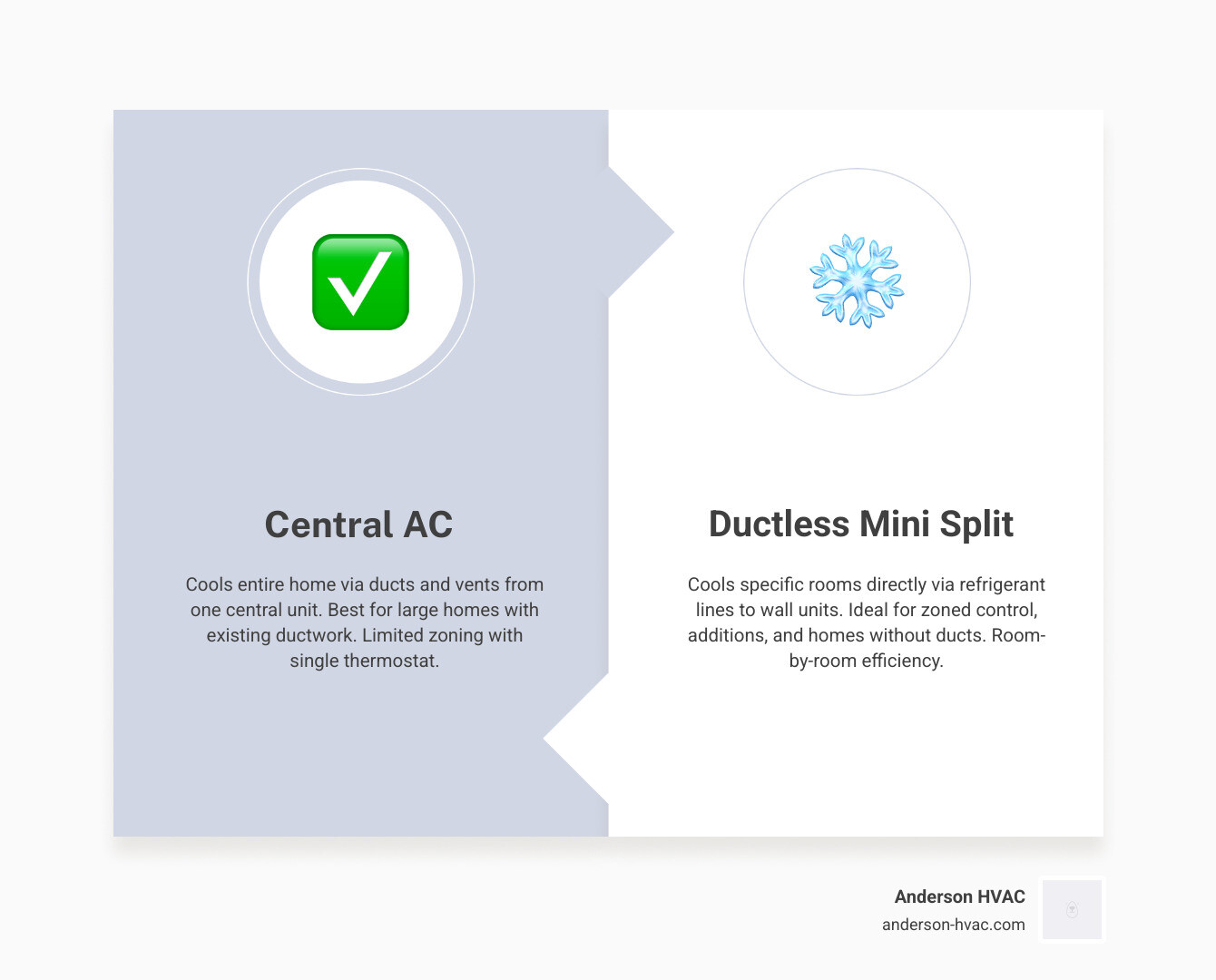
The biggest difference is simple: central AC cools the whole house through ducts, while a ductless mini split cools specific rooms or zones directly.
With central AC, one indoor system and one outdoor unit work together to push conditioned air through supply vents and pull it back through return ducts. With a mini split, the outdoor unit connects to one or more indoor heads using small refrigerant lines. No duct maze hiding in the attic. No vent guessing game.
That means this is really a comparison between whole-home distribution and room-by-room control.
How central AC cools a home from one system
Central air is designed around a single, coordinated system. A thermostat calls for cooling, the indoor coil removes heat from the air, and the blower sends that cooled air through the duct network to supply vents around the home.
For many homes in North Ogden, Pleasant View, Layton, Syracuse, and other nearby communities, this setup works beautifully when the ductwork is already in place and in good condition. It offers:
- Even cooling across many rooms
- A clean look with mostly hidden equipment
- One main thermostat for simple operation
- Strong whole-home airflow
Central AC often makes the most sense in larger homes with existing ducts and a layout built around a ducted system. If you’re exploring a new installation, our guide on central air conditioning installation in North Ogden is a good next step.
How a ductless system delivers targeted comfort
A ductless mini split takes a different approach. Instead of cooling the whole house the same way, it sends comfort right where you need it through individual indoor units, often called heads.
Each indoor head serves its own zone. That makes mini splits especially useful for:
- Older homes without ductwork
- Room additions
- Finished basements
- Garages and workshops
- Sunrooms
- Upstairs bedrooms that never seem to cooperate
Many mini splits use inverter technology, which allows the system to ramp up or down instead of blasting on and off like it’s late for a meeting. That usually means steadier temperatures, less wasted energy, and quieter operation.
If your ductless system is already installed and acting up, our local resource on ductless mini split repair services in Morgan can help you understand what to watch for.
Central AC vs ductless mini split comparison for whole-home use
Can both systems handle a whole house? Yes, but not always in the same way.
Central AC is naturally set up for whole-home cooling. That’s its job description.
A mini split can also cool or heat an entire home if it is designed as a multi-zone system with enough indoor units and the right capacity. But as homes get larger, more chopped up, or multi-story, that design becomes more complex. More rooms often means more heads, more controls, and more planning.
In real homes, we often see these patterns:
- Central AC works best for broad, even comfort across many rooms
- Mini splits work best when certain rooms are used more than others
- Hybrid systems work best when the main house is fine but a few rooms are not
That last point matters. A finished basement, bonus room, or hot upstairs bedroom may not need a whole new ducted redesign. Sometimes the smartest move is to keep central AC for the main home and add ductless for the problem areas.
Energy Efficiency, Operating Costs, and Heating Performance
Efficiency is where mini splits often get a lot of attention, and for good reason. But efficiency on paper and efficiency in your actual house are not always the same thing.
| Feature | Central AC | Ductless Mini Split |
|---|---|---|
| Typical advantage | Whole-home coverage | Higher zoned efficiency |
| Duct losses | Possible | None |
| Part-load performance | Good with proper design | Excellent with inverter operation |
| Best energy strategy | Cool the whole house evenly | Condition only occupied rooms |
| Heating option | AC only unless paired with heating equipment or heat pump | Many models provide heating and cooling |
Why mini splits often use less energy in the right home
Mini splits are generally more efficient because they avoid duct losses and can cool only the rooms you actually use. Research commonly points to duct losses exceeding 30% in some homes, especially when ducts run through hot attics or leaky crawlspaces.
That means a high-rated central system can still underperform if the ductwork is poor. Put differently: a strong AC connected to weak ducts is like putting fancy tires on a shopping cart.
Mini splits also excel at part-load operation. Instead of turning on full blast and then shutting off repeatedly, inverter-driven systems can run longer and lower, which helps with:
- Better energy use
- More stable temperatures
- Quieter operation
- Often better humidity control during milder weather
They are especially efficient for homes with unused rooms, empty nesters who only cool part of the house, or additions that do not need to piggyback on the whole system.
When central AC can still be efficient and practical
Central AC should not be dismissed just because mini splits often post higher efficiency ratings. In the right house, central air is still practical and efficient.
If a home already has:
- Properly sized equipment
- Sealed and insulated ducts
- Good return airflow
- A layout that benefits from whole-home circulation
then central AC can perform very well.
This is especially true in larger homes where most rooms are occupied regularly and homeowners want one simple, unified system instead of multiple indoor heads. If you’re cooling the entire house most of the time anyway, central AC can be a very reasonable choice.
Central AC vs ductless mini split comparison for heating and shoulder seasons
This is where the conversation gets more interesting in 2026. Many ductless mini splits are heat pumps, which means they can cool in summer and heat in cooler months too. That makes them useful during Northern Utah shoulder seasons, when mornings are chilly and afternoons are not.
For some homes, a mini split heat pump can provide excellent year-round comfort in specific zones. For others, it works best as a supplement to the main heating system.
Central AC by itself does not provide heat. Heating performance depends on what it is paired with, such as a furnace or heat pump system.
If you want to explore ductless options for year-round comfort, visit our ductless HVAC services page. If your bigger question is total home heating performance, our heating services page is the better place to start.
Installation Reality: Best Fit by Home Type, Layout, and Lifestyle
A system can look perfect in a brochure and still be wrong for your house. The real decision usually comes down to what your home can support without turning the project into a major remodel.
Best choice for homes without existing ductwork
If your home does not have ducts, a mini split is usually the easiest and most practical fit.
That includes many:
- Older homes
- Historic homes
- Finished basements
- Converted garages
- Additions and bonus rooms
- Detached spaces
Why? Because adding ducts to a finished home can be invasive. Walls, ceilings, closets, attic pathways, and framing all start getting involved. Mini splits avoid most of that disruption because they need only a small wall penetration for the line set.
They are often a natural fit for older Northern Utah homes where preserving finished spaces matters. For more on local ductless concerns, see West Point’s guide to reliable ductless AC repair.
When central AC makes more sense than mini splits
Central AC often wins when the house already has a good duct system and the goal is to cool the whole home evenly with a cleaner visual look.
Homeowners often prefer central AC when they want:
- Hidden delivery through vents instead of visible wall units
- One system serving many rooms
- A familiar setup for a larger family home
- Consistent temperatures throughout the house
In newer builds or houses designed around ducted airflow, central AC is often the simpler long-term answer. If that sounds like your situation, learn more about AC installation.
When a hybrid system is the smartest answer
Sometimes the best answer is “both.”
A hybrid setup combines central AC for the main living areas with one or more mini splits for rooms the ducted system struggles to handle. This is often ideal for:
- Hot upstairs bedrooms
- Over-garage bonus rooms
- Sunrooms
- Garage workshops
- Home offices
- Finished attic spaces
This approach avoids replacing a working central system just because one or two rooms are uncomfortable. It also avoids overcomplicating the entire house with a full multi-zone ductless design if the main areas already perform well.
If you have a problem room that never feels right, our article on ductless AC repair in Kaysville may help you spot whether ductless is the right fix.
Pros and Cons That Matter After Installation
This is the part homeowners live with every day: noise, appearance, maintenance, comfort control, and how annoying the system becomes when it needs attention.
Ductless mini split pros and cons
Pros of ductless mini splits:
- Excellent zoning and room-by-room control
- No duct losses
- Great fit for additions, garages, and older homes
- Often very quiet indoors
- Flexible expansion in certain layouts
- Many systems offer both heating and cooling
Cons of ductless mini splits:
- Indoor units are visible on walls, ceilings, or near the floor
- Whole-home designs can become more complex in large houses
- Each indoor unit needs regular filter cleaning
- Blower wheels and condensate components need maintenance
- A poorly placed head can reduce comfort or create uneven sensing
Mini splits are often quieter than central systems at the room level because there is no duct rush and no big vent blast overhead. But they are not invisible. Some homeowners barely notice the wall units after a week. Others notice them every single day forever. Aesthetics matter, and it is okay to admit that.
If you already have a ductless unit and want help understanding service issues, see this guide for Clinton homeowners.
Central AC pros and cons
Pros of central AC:
- Clean, mostly hidden appearance
- Strong whole-home airflow
- Good match for larger homes with existing ducts
- Simple control from a main thermostat
- Easier to pair with whole-home filtration and ventilation upgrades
Cons of central AC:
- Efficiency depends heavily on duct condition
- Duct leaks can waste significant energy
- Limited zoning without extra system design
- Adding ducts to a finished home can be disruptive
- Ductwork itself needs maintenance and inspection
Central AC is often the better-looking solution because only the vents show. It also handles large-scale airflow very well. But when ducts leak, are undersized, or snake through harsh attic conditions, comfort and efficiency can drop fast.
If your system is struggling, our AC repair page covers common signs that it may be time for service.
Indoor air quality and filtration differences
This category is not just about cooling. It is about what your system can do for the air your family breathes.
Central AC usually has the advantage for whole-home indoor air quality because it can be paired more easily with add-ons such as:
- Media filters
- Advanced filtration systems
- Whole-home ventilation
- Humidity accessories
- Duct cleaning strategies
A ductless mini split has filters too, but they are typically smaller, unit-specific, and more focused on protecting the equipment and catching everyday particles near that zone. They can help, but they are not usually the same as a robust whole-home IAQ setup.
If indoor air quality is a top priority, explore our pages on indoor air quality, duct cleaning, filtration, and ventilation.
How to Choose the Right System in 2026
The best way to make this decision is to look at your actual house, not just equipment brochures. In our experience, these are the factors that matter most:
- Do you already have ductwork, and is it in good condition?
- Are you cooling the whole house or only certain rooms?
- Is your home older, recently added onto, or hard to retrofit?
- Do family members want different temperatures in different rooms?
- Are there hot or cold problem zones?
- Is appearance a major concern?
- Do you want heating and cooling from the same system?
- Are indoor air quality upgrades important to you?
- Are you hoping to qualify for available heat pump incentives or tax credits in 2026?
Central AC vs ductless mini split comparison by homeowner scenario
Here is the short version.
An older house with no ducts:
- Usually better for ductless mini splits
A large family home with solid existing ductwork:
- Usually better for central AC
Empty nesters using only a few rooms daily:
- Often better for ductless zoning
A house with one stubborn upstairs bedroom or bonus room:
- Often better for a hybrid setup
A new addition that is not connected to the duct system:
- Usually better for a mini split
A multi-story home needing even airflow across many rooms:
- Usually better for central AC, provided ducts are well designed
Are there rebates or incentives available in 2026?
Potentially, yes. In 2026, homeowners may find incentives tied to high-efficiency equipment, especially heat pump and qualifying ductless systems. Availability can depend on:
- Federal tax credit rules
- Utility rebate programs
- Product efficiency ratings
- Installation documentation
- Program timing and local eligibility
These programs change, and the details matter. We always recommend checking current requirements before making a decision based on incentives alone. Rebates are helpful, but the wrong system with a nice rebate is still the wrong system.
Which system is better for additions, garages, and older homes?
In most cases, mini splits win here.
They are ideal for spaces that are hard to connect to the main duct system, including:
- Garage conversions
- Bonus rooms
- Detached offices
- Sunrooms
- Older homes without ducts
- Workshops
They offer direct heating and cooling exactly where needed, without forcing a major ductwork project. If your home has one of these spaces, our Harrisville ductless air conditioning repair roadmap offers more local context.
Frequently Asked Questions About Central AC vs Ductless Mini Split Comparison
Can a mini split cool or heat an entire home?
Yes, a mini split can handle a whole home if it is designed correctly as a multi-zone system with enough indoor units and the right total capacity. That said, whole-house mini split design becomes more complicated as room count and square footage increase. For many larger homes, central AC remains the simpler whole-home approach.
Are mini splits quieter and more attractive than central AC?
Mini splits are often quieter inside the room because the equipment modulates gently and avoids duct noise. But whether they are more attractive is a matter of taste. Some homeowners like the sleek indoor units. Others prefer the hidden look of central air vents. If appearance is a big factor, central AC usually has the edge.
Which lasts longer and needs less maintenance?
Both systems can last a long time with professional maintenance. Central AC and mini splits both benefit from annual service, coil cleaning, drain checks, and performance testing. Mini splits also need regular cleaning of each indoor unit’s filter and attention to blower wheel cleanliness. Central systems may require duct inspection and filter replacement but have fewer visible indoor units to maintain room by room.
Conclusion
The truth about central air and ductless cooling is that neither one is universally better. The better system is the one that fits your home, your comfort goals, and how you actually live.
If you have strong existing ducts and want clean-looking whole-home comfort, central AC often makes the most sense. If you need zoned control, have no ductwork, or want to fix a hard-to-condition room, a mini split may be the better answer. And if your house has a little bit of both going on, a hybrid system can be the sweet spot.
At Anderson HVAC, we help homeowners across North Ogden and surrounding Northern Utah communities make these decisions with real-world guidance, not one-size-fits-all advice. As a family-owned company with more than 40 years of experience, we focus on practical comfort solutions that fit the home in front of us.
If you’re ready to compare your options for your own house, learn more about our residential HVAC services.

